Shubham Anand (@shubham___anand) 's Twitter Profile
Shubham Anand

@shubham___anand

Senior full-stack dev @BNYMellon | chess enthusiast | Previously sde @CreditSuisse | sde intern @Amazon | Codeforces Expert | 22' grad

ID: 1358927897348640769

calendar_today08-02-2021 23:57:24

741 Tweet

394 Followers

1,1K Following

Rohit (@rohit4verse) 's Twitter Profile Photo

LangChain's co-founder: "memory can be a real moat." the architecture that builds this? four markdown files and a cron job. someone open sourced the full stack. memory layers, self-rewriting skills, a dream cycle that runs at 3am. yes, you should read every word of this.

Uncle Daddy Wee-Yum (@mrgee54) 's Twitter Profile Photo

I know we all grown. We talk about grown people stuff. Bills, kids, jobs, etc. What do you do for fun? What brings you joy? What do you when seek out a good time or wanna have fun?

Aryan Srivastava (@yetanothercode) 's Twitter Profile Photo

Just a personal suggestion here, this paper is very deep into distributed systems like vector clocks, gossip protocol, raft etc... So if you don't know these concepts this can be pretty overwhelming, just like it was for me. But this was a personal take, feel free to explore it

Harrison Chase (@hwchase17) 's Twitter Profile Photo

>LangChain gives you testing tools. It never tells you what to test, in what order, or when you're done. This is changing soon Launching May 13th at Interrupt: interrupt.langchain.com

Brad Menezes (@bradmenezes) 's Twitter Profile Photo

If you feel like Anthropic is going after every enterprise software market and that the big SaaS enterprise platforms like Salesforce, ServiceNow and Workday are toast, you are wrong. This simplistic thinking fundamentally misunderstands the difference between an AI Agent and

Marc Brooker (@marcjbrooker) 's Twitter Profile Photo

Some thoughts on the RLS discourse. If I'm building a multi-tenant online service backed by a database, I can choose from four basic architectural patterns: control-plane seperation, table-per-customer, explicit user info in schema, or fine-grained DB security features.

Arnav Gupta (@championswimmer) 's Twitter Profile Photo

I’ve gone through the whole arc of 1. Omg AI can write code 2. Meh it makes mistakes 3. Omg Opus is AGI 4. No it still makes slop 5. Yes but everyone is still gonna use it like crazy And my view is these things need finer context. If Codex was told this is high

Ashutosh Maheshwari (@asmah2107) 's Twitter Profile Photo

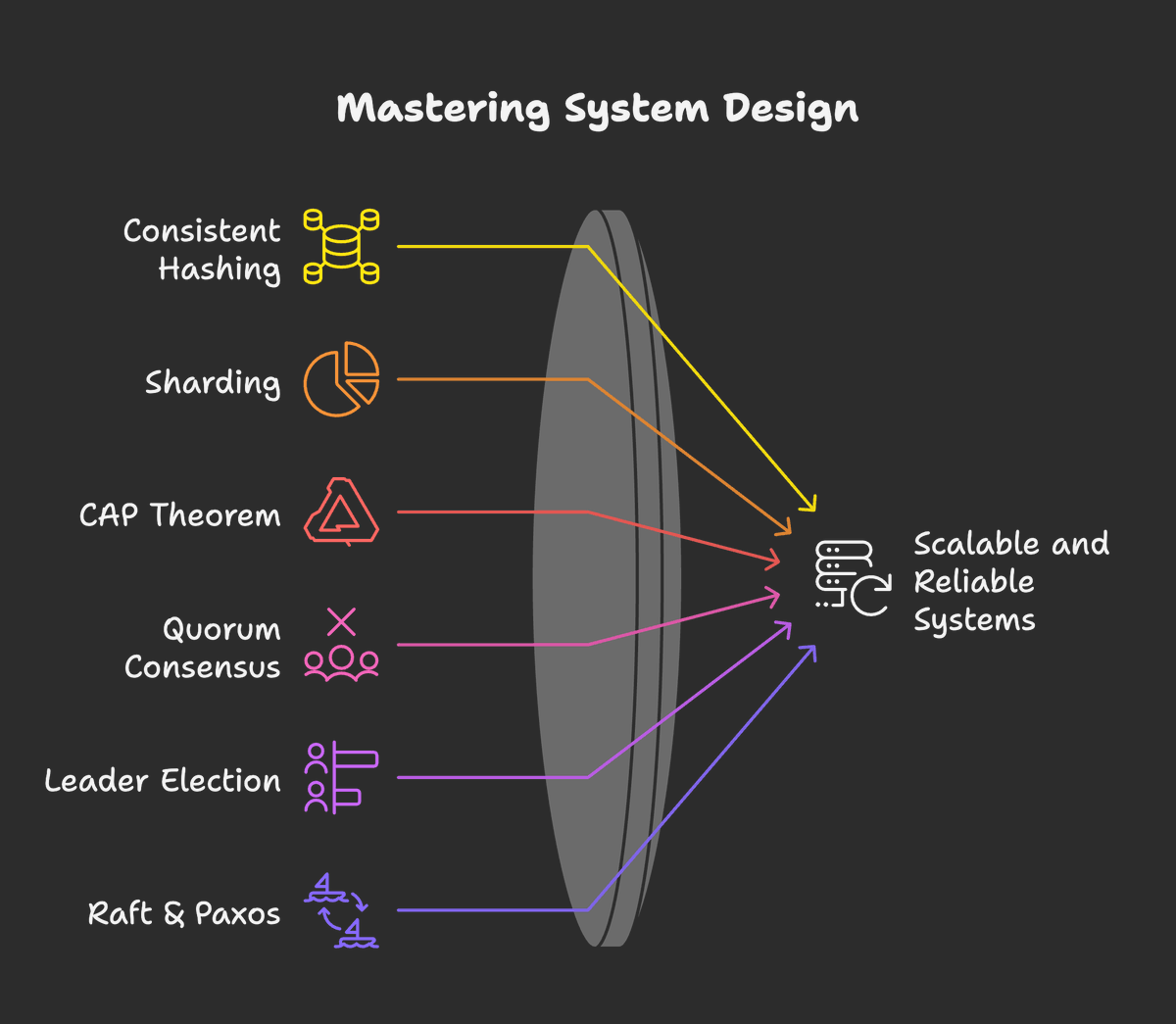
System design concepts I’d master if I wanted to crush it. Bookmark this. 1.Consistent Hashing 2.Sharding 3.CAP Theorem 4.Quorum Consensus 5.Leader Election 6.Raft & Paxos 7.Gossip Protocol 8.Vector Clocks 9.Load Shedding 10.Circuit Breakers 11.Backpressure 12.Tail Latency

System design concepts I’d master if I wanted to crush it.

Bookmark this.

1.Consistent Hashing
2.Sharding
3.CAP Theorem
4.Quorum Consensus
5.Leader Election
6.Raft & Paxos
7.Gossip Protocol
8.Vector Clocks
9.Load Shedding
10.Circuit Breakers
11.Backpressure
12.Tail Latency
Ben Dicken (@benjdicken) 's Twitter Profile Photo

Going from chatting all day with database orchestration engineers -> react devs is such a trip. Most of these people don't even know what a WAL is.

Jeremy Morgan (@jeremycmorgan) 's Twitter Profile Photo

Red Hat's "harness engineering" paper argues the environment an AI works in matters as much as the weights: integrating telemetry, repos, and testing constraints into a single deterministic orchestrator measurably moves code generation reliability by 5%+. You cannot

Vic 🌮 (@vicvijayakumar) 's Twitter Profile Photo

I'm now able to tell my agent “we are going to work on JIRA-1234” and it goes and pulls down the task, makes me a plan, I say yeah okay that looks good, and it generates the commit. I run an AI review from a different session, it finds 4 issues of varying priorities, I paste it