One of the many John Hardy’s (@theagrarian) 's Twitter Profile
One of the many John Hardy’s

@theagrarian

Recovering sarcastic border farmer (MT/ND), retired Monsanto Ag and IT&O sales guy. Yes, that is my mother in the front passenger seat.

ID: 110503490

calendar_today01-02-2010 19:46:52

433 Tweet

220 Followers

647 Following

One of the many John Hardy’s (@theagrarian) 's Twitter Profile Photo

This pretty much sums up the money flow. The Scandal of American Welfare Goes Beyond Fraud by Allysia Finley wsj.com/opinion/the-sc…

The Risk-Monger (@zaruk) 's Twitter Profile Photo

A decade ago, we were told we were killing the bees. And if the bees go extinct, we all go extinct. How did that Armageddon fear campaign work out? It turned out it was a couple cold winters that weakened the colonies. But NGOs were able to ban an important class of insecticides.

Simon Maechling (@simonmaechling) 's Twitter Profile Photo

Glyphosate isn’t controversial because it’s understudied. It’s controversial because the evidence is ignored. Fact 1. This chemical is exhaustively studied: •40+ years of data. •Thousands of studies. •Reviewed repeatedly across continents. Fact 2. Global regulators agree:

Simon Maechling (@simonmaechling) 's Twitter Profile Photo

2026 may determine the future of glyphosate - but not because of new science. The real question is legal: If the U.S. Environmental Protection Agency approves a pesticide label based on decades of evidence, can state juries still impose liability for not adding a cancer warning?

Simon Maechling (@simonmaechling) 's Twitter Profile Photo

2026 will decide the legal future of the herbicide glyphosate - and could alter the shape of global agriculture. geneticliteracyproject.org/2026/01/20/202…

Simon Maechling (@simonmaechling) 's Twitter Profile Photo

One thing I keep noticing in public debates about vaccines and glyphosate is how familiar the arguments feel. Not because the technologies are similar - they aren’t. But because the reasoning patterns are. Again and again, the same steps appear. First, correlation is treated

One thing I keep noticing in public debates about vaccines and glyphosate is how familiar the arguments feel.

Not because the technologies are similar - they aren’t.

But because the reasoning patterns are.
Again and again, the same steps appear.

First, correlation is treated
Simon Maechling (@simonmaechling) 's Twitter Profile Photo

You’re going to be seeing scary posts about pesticides detected at XX ppb in food. Let’s slow this down. Detection is not danger. ppb tells you what can be measured, not what can harm you. ppb = parts per billion. That’s like: • 1 second in 32 years • 1 drop of water in an

One of the many John Hardy’s (@theagrarian) 's Twitter Profile Photo

2026 will decide the legal future of the herbicide glyphosate—and could alter the shape of global agriculture geneticliteracyproject.org/2026/01/20/202… via Genetic Literacy Project

One of the many John Hardy’s (@theagrarian) 's Twitter Profile Photo

Here is a quick read that brings up a few points to ponder. J Regenerative agriculture gets a star turn with “health guru” RFK, Jr. and the Trump Administration. What could go wrong? (Plenty) geneticliteracyproject.org/2026/02/03/reg… via Genetic Literacy Project

One of the many John Hardy’s (@theagrarian) 's Twitter Profile Photo

Viewpoint—It’s time to challenge the European Union’s data-less restrictions on genetically modified (GMO) crops geneticliteracyproject.org/2026/02/02/its… via Genetic Literacy Project

Simon Maechling (@simonmaechling) 's Twitter Profile Photo

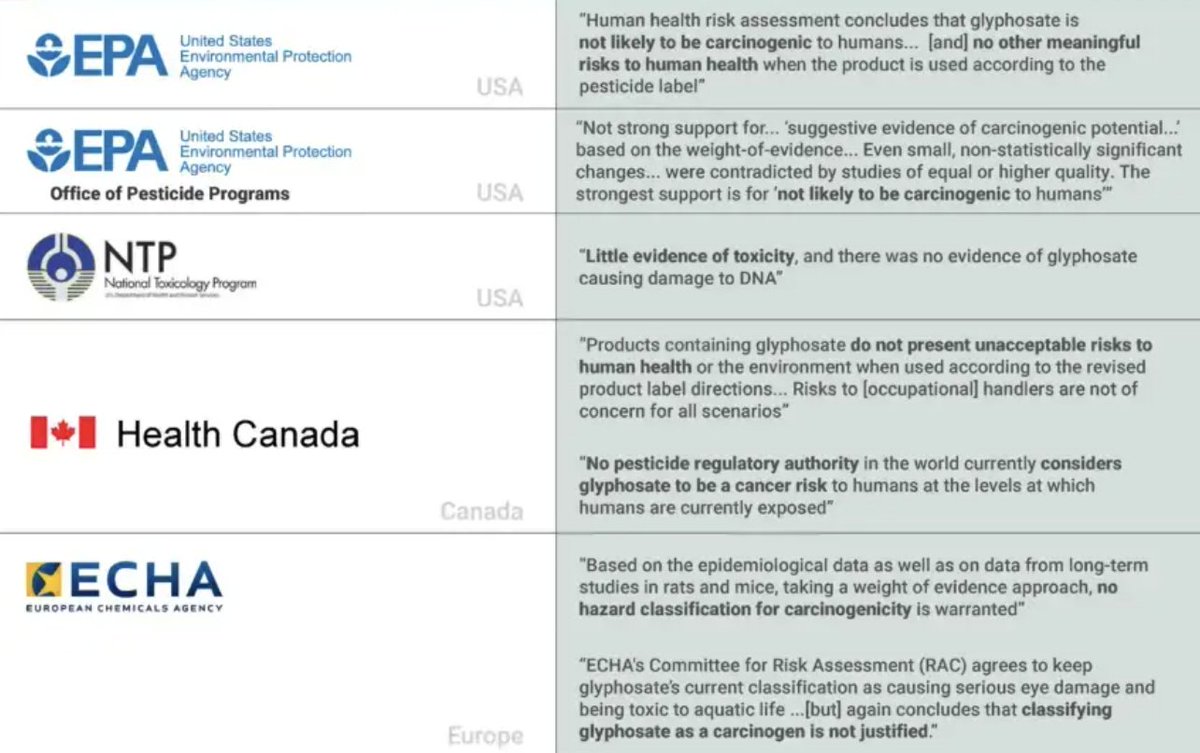
The claim that glyphosate is “poison” is one of the most successful disinformation campaigns of our time. Decades of data. Hundreds of regulatory reviews. No credible cancer signal at real-world exposure. One of the most studied chemicals in human history.

Genetic Literacy Project (@geneticliteracy) 's Twitter Profile Photo

8/9: Since #glyphosate is the tort lawyer-environmental activist coalition’s most lucrative whipping boy, it’s no surprise that it’s front and center among MAHA acolytes, despite over 15 regulatory bodies deeming it safe at trace dietary levels.

8/9: Since #glyphosate is the tort lawyer-environmental activist coalition’s most lucrative whipping boy, it’s no surprise that it’s front and center among MAHA acolytes, despite over 15 regulatory bodies deeming it safe at trace dietary levels.
Liza Dunn (@drlizamd) 's Twitter Profile Photo

Sama Hoole While I agree with many of your posts on livestock, you’re repeating wildly misleading claims about glyphosate. Let’s start with the boring stuff - keep reading for the more interesting facts👇🏽 1) Glyphosate was not patented as a descaling agent. If you have a look at the

Simon Maechling (@simonmaechling) 's Twitter Profile Photo

Dr. Alexandra Muñoz At least 15 regulatory agencies have conducted assessments to determine whether glyphosate increases the risk of certain cancers. They are unanimous in one finding: There is no evidence that glyphosate poses any harm to consumers worried about residues in their food.
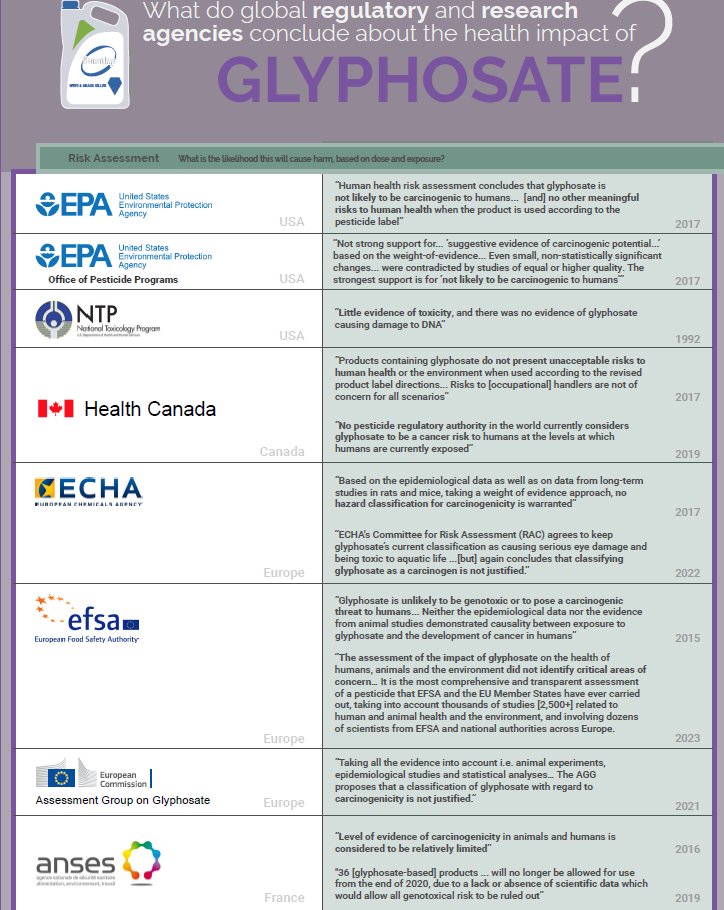
<a href="/amtoxicology/">Dr. Alexandra Muñoz</a> At least 15 regulatory agencies have conducted assessments to determine whether glyphosate increases the risk of certain cancers. 

They are unanimous in one finding: There is no evidence that glyphosate poses any harm to consumers worried about residues in their food.
Simon Maechling (@simonmaechling) 's Twitter Profile Photo

Every regulatory agency that has evaluated glyphosate has concluded that it is safe if used according to label specifications and does not increase cancer risk.

One of the many John Hardy’s (@theagrarian) 's Twitter Profile Photo

Is glyphosate weedkiller a danger to humans, bees and the environment? Addressing 10 controversial claims geneticliteracyproject.org/2024/09/03/is-… via Genetic Literacy Project

Simon Maechling (@simonmaechling) 's Twitter Profile Photo

Cancer should not be used as a political weapon. Over the past decade, glyphosate has been turned into a symbol — of industrial agriculture, of multinational corporations, of environmental anxiety. But somewhere along the way, nuance disappeared. Here’s what gets lost in the