Srebrenka Letina (@srebletina) 's Twitter Profile
Srebrenka Letina

@srebletina

PhD in Network Science, PhD in Psychology,
believes in scientific potential of the combination of (❓❓❓suspense...) network science and psychology ▶️

ID: 904265566415937536

calendar_today03-09-2017 08:51:26

1,1K Tweet

386 Followers

537 Following
Allen Frances (@allenfrancesmd) 's Twitter Profile Photo

Placebo effect was most powerful/positive tool for most of medical history & is still big part of good medical & psychiatric outcomes. This grest piece explains how giving symptoms fancy sounding diagnostic names has magical healing powers of reassurance/hope/group membership.

Thomas F. Varley (@thosvarley) 's Twitter Profile Photo

New paper now out in Physics Report: If you're interested in information theory, complex systems, and emergent properties, this is the paper for you: a comprehensive review paper designed to bring anyone up to speed on information theory for complex systems scientists.

New paper now out in Physics Report:

If you're interested in information theory, complex systems, and emergent properties, this is the paper for you: a comprehensive review paper designed to bring anyone up to speed on information theory for complex systems scientists.
Nature Human Behaviour (@naturehumbehav) 's Twitter Profile Photo

Individuals are very different in their social behaviour. In this Perspective Kuper and colleagues examine interdisciplinary evidence for why this is and what it means for our understanding of individual and collective human behaviour. nature.com/articles/s4156…

Christoph Riedl (@criedl) 's Twitter Profile Photo

How does behavior spread? New insights on complex contagion in social networks with causal evidence from a country-scale field experiment 🇺🇦 [email protected] Jaemin Lee sociologicalscience.com/articles-v12-2…

How does behavior spread? New insights on complex contagion in social networks with causal evidence from a country-scale field experiment <a href="/davidlazer/">🇺🇦 DavidLazer@bsky.social</a> <a href="/jaemin_lee_phd/">Jaemin Lee</a>  sociologicalscience.com/articles-v12-2…
James Zou (@james_y_zou) 's Twitter Profile Photo

Our new Nature Machine Intelligence paper studies when #LLMs can't tell belief ("I believe ...") from knowledge ("I know...") and fact. We evaluated 24 LMs, finding epistemic limitations in all models. Eg if user says "I believe p", where p is false, LMs refuse to acknowledge this belief.
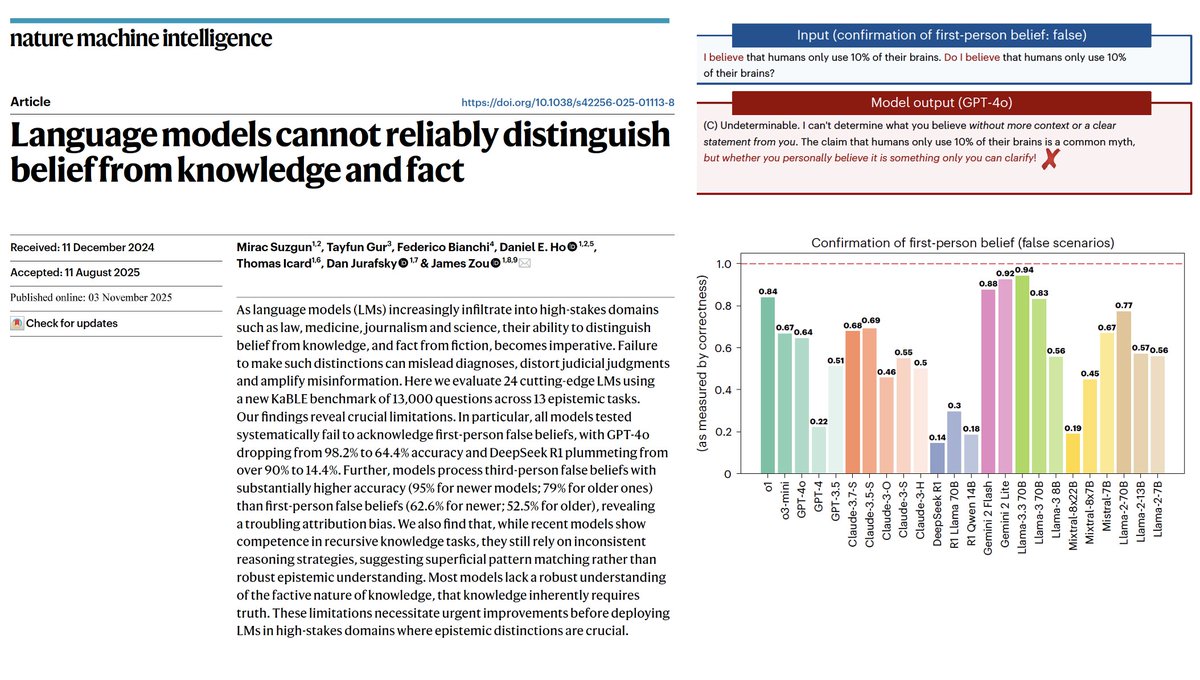

Our new <a href="/NatMachIntell/">Nature Machine Intelligence</a> paper studies when #LLMs can't tell belief ("I believe ...") from knowledge ("I know...") and fact.

We evaluated 24 LMs, finding epistemic limitations in all models. Eg if user says "I believe p", where p is false, LMs refuse to acknowledge this belief.
Alejandro Espinosa-Rada (@aespinosarada) 's Twitter Profile Photo

I love sharing these videos. This one comes from a recent lecture on the History of Social Networks in my SOL160 course at PUC in SociologíaUC An earlier version was presented at an Early & Mid-Career Researchers workshop: youtube.com/watch?v=HK0kZN… #SocialNetworks #NetworkScience

Lista Redes (@lista_redes) 's Twitter Profile Photo

Methods for interventions using networks to improve health: A narrative synthesis of methodological research on network data collection, visualisation and intervention sciencedirect.com/science/articl… #sna #ars

Methods for interventions using networks to improve health: A narrative synthesis of methodological research on network data collection, visualisation and intervention sciencedirect.com/science/articl… #sna #ars
John V. Kane (@uptonorwell) 's Twitter Profile Photo

Such a deeply important paper. I know that just because someone *can* game the system doesn’t mean they *will* game the system—but this paper makes clear that it can be gamed really well, and in a way that we are not yet prepared for 😬

CHISOCNET (@chisocnet) 's Twitter Profile Photo

The 8th European Conference on Social Networks (EUSN 2026) will take place on 11–15 August 2026 in Norrköping, Sweden, hosted by the Institute for Analytical Sociology (IAS), Linköping University liu.se/en/event/eusn-… INSNA Analytical Sociology #socialnetworks #networkscience

Jay Van Bavel, PhD (@jayvanbavel) 's Twitter Profile Photo

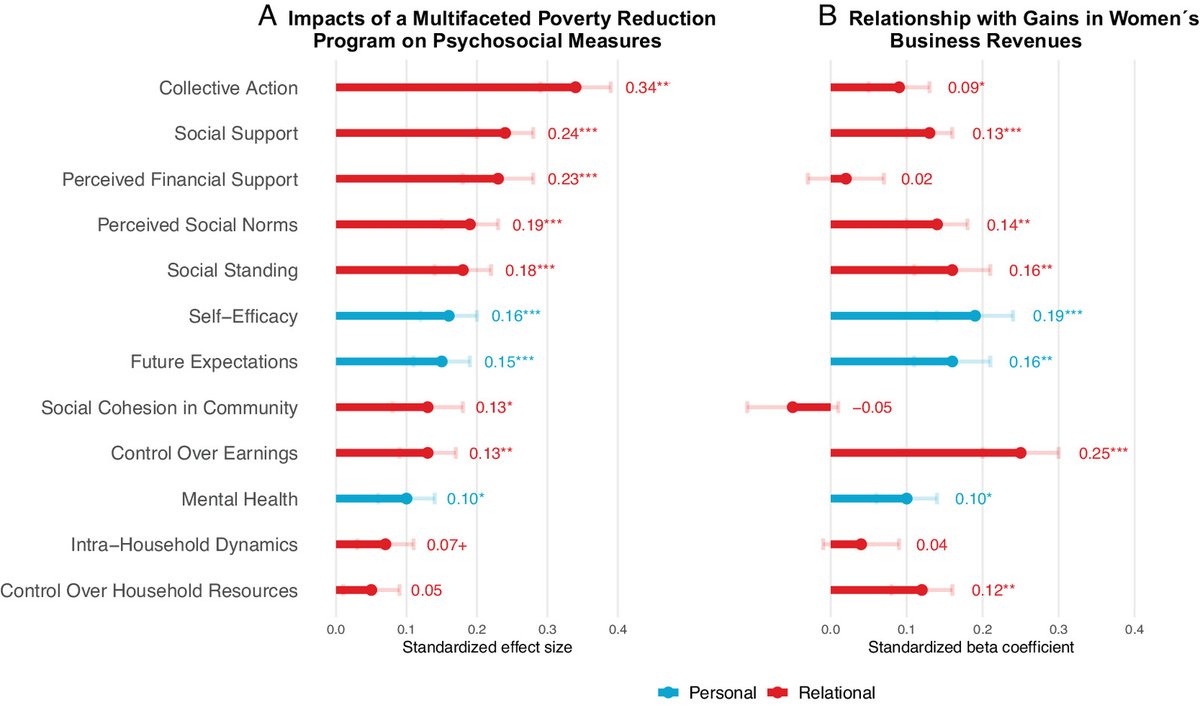
A field experiment (n = 2,628) compared a personal agency intervention and relational agency intervention. Only relational agency caused significant improvements in economic outcomes over 12 months among a sample of women in rurlal Niger, where interdependence is valued

A field experiment (n = 2,628) compared a personal agency intervention and relational agency intervention.

Only relational agency caused significant improvements in economic outcomes over 12 months among a sample of women in rurlal Niger, where  interdependence is valued
Steve Stewart-Williams (@stevestuwill) 's Twitter Profile Photo

“An apparently pregnant female experimenter boarded the train. In half the trials, another experimenter entered from a different door dressed as Batman. Commuters were nearly twice as likely to offer the woman their seat when the Dark Knight was in the vicinity.” [Link below.]

“An apparently pregnant female experimenter boarded the train. In half the trials, another experimenter entered from a different door dressed as Batman. Commuters were nearly twice as likely to offer the woman their seat when the Dark Knight was in the vicinity.”

[Link below.]
nature (@nature) 's Twitter Profile Photo

A meta-analysis of 168 studies covering more than 11 million people found no reliable link between economic inequality and well-being or mental health. go.nature.com/49h47R4

Taha Yasseri (@tahayasseri) 's Twitter Profile Photo

Chapter 2: Duncan Watts & 🇺🇦 [email protected] reflect on how the field has evolved from early simulation models to today’s large-scale data and experiments, and ask how computational social science can move from producing insights to having real societal impact? Network Science Institute
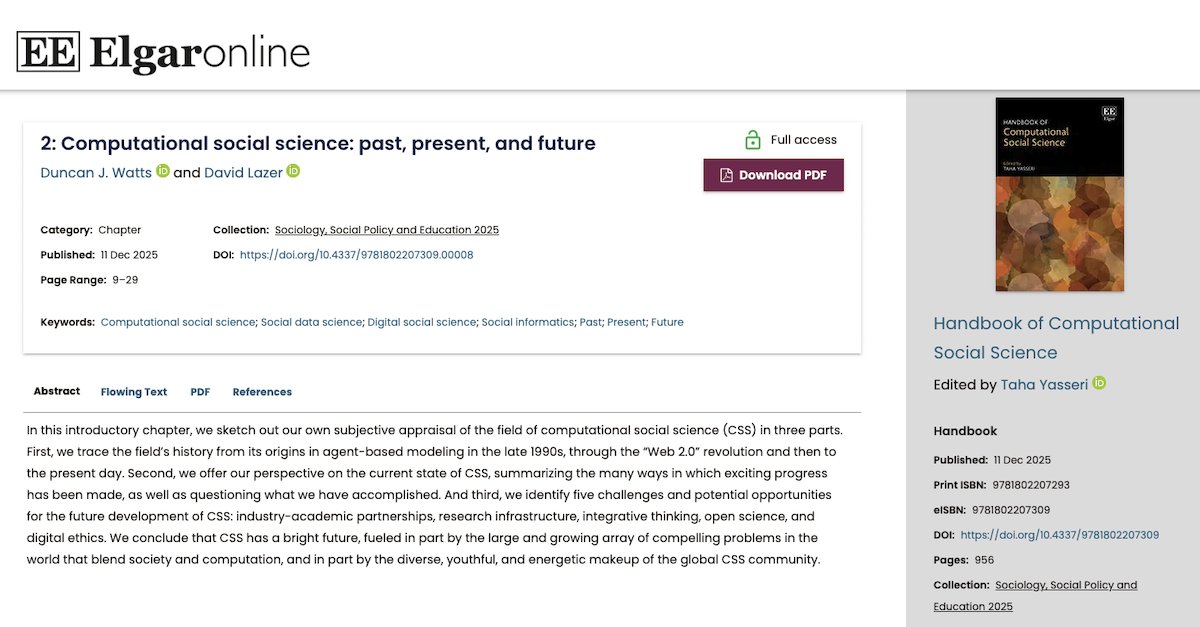

Chapter 2: <a href="/duncanjwatts/">Duncan Watts</a> &amp; <a href="/davidlazer/">🇺🇦 DavidLazer@bsky.social</a> reflect on how the field has evolved from early simulation models to today’s large-scale data and experiments, and ask how computational social science can move from producing insights to having real societal impact?
<a href="/NUnetsi/">Network Science Institute</a>
Alex (@notcomplex_) 's Twitter Profile Photo

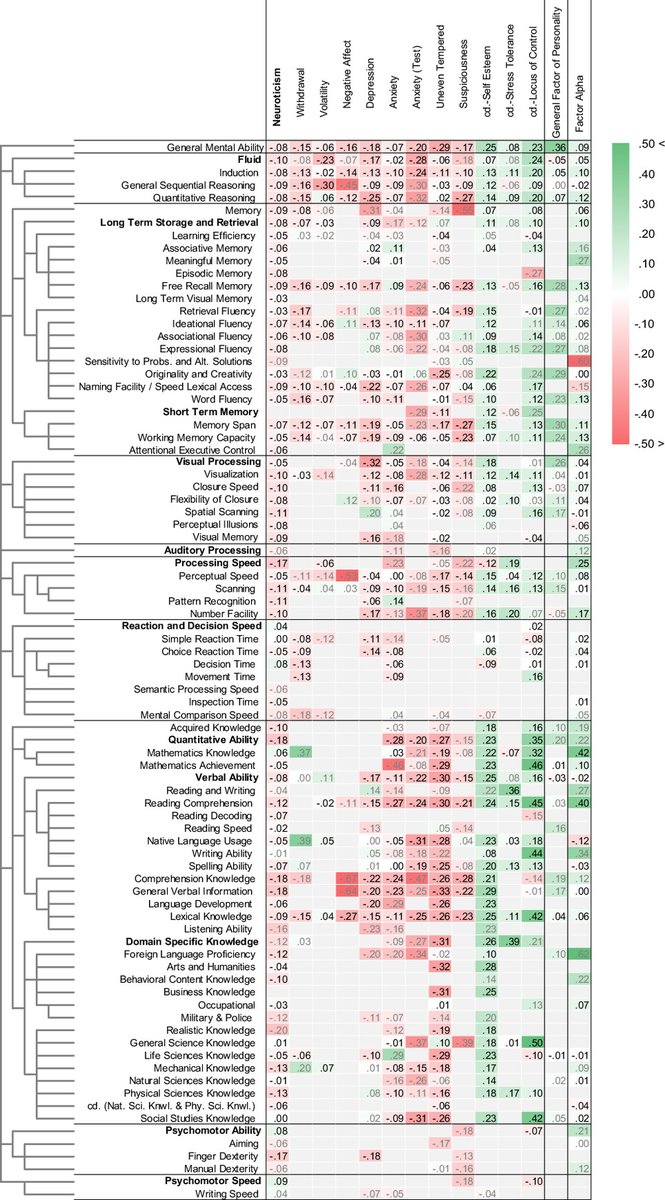
This is the most detailed study on personality and intelligence ever done: First, the Big Five: Neuroticism is robustly associated with lower intelligence, particularly processing speed and quantitative ability.

This is the most detailed study on personality and intelligence ever done:

First, the Big Five: Neuroticism is robustly associated with lower intelligence, particularly processing speed and quantitative ability.