
Nick Gornick DPT | RebuiltPT (@rebuiltpt) 's Twitter Profile
Nick Gornick DPT | RebuiltPT

@rebuiltpt

Simple tips for runners | Physical Therapist | Certified Running Coach | šŸš— Mobile PT and coaching in the Chicago Suburbs šŸƒšŸ“ˆ Book your first visit today šŸ‘‡

ID: 1667178507451990024

linkhttps://linktr.ee/rebuiltpt calendar_today09-06-2023 14:35:15

1,1K Tweet

760 Followers

153 Following
Nick Gornick DPT | RebuiltPT (@rebuiltpt) 's Twitter Profile Photo

When things really start to go well late in a training block, it’s easy to think ā€œmaybe I actually could be doing more, going faster, setting higher goals etcā€ But this is often a trap! When things are going well, don’t mess it up by overextening and trying to jump to the next

Nick Gornick DPT | RebuiltPT (@rebuiltpt) 's Twitter Profile Photo

Most online marathon plans are too short, and progress too quickly. If your marathon training block is truly only 16 weeks, I think you should be entering that plan with a solid base already. This generally means: - Being able to run ~4 days/week - Already have your long run

Nick Gornick DPT | RebuiltPT (@rebuiltpt) 's Twitter Profile Photo

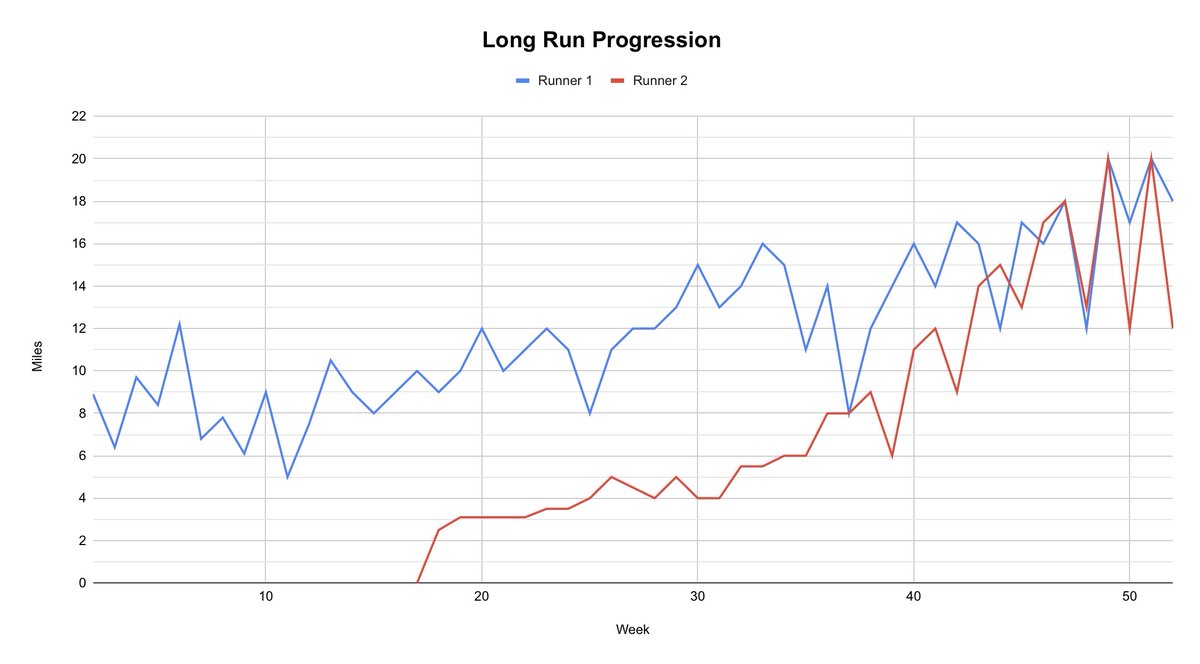
I like using a conservative progression for long runs during marathon training. Here’s a year-long progression of a runner who ran very well in year 2 as a marathoner (Runner 1). We include periods of building, sustaining, back off, then building again. This allows for

I like using a conservative progression for long runs during marathon training. 

Here’s a year-long progression of a runner who ran very well in year 2 as a marathoner (Runner 1). 

We include periods of building, sustaining, back off, then building again. 

This allows for
Nick Gornick DPT | RebuiltPT (@rebuiltpt) 's Twitter Profile Photo

When tapering for a race, it’s important to take into account accumulated fatigue. Don’t just do a 3 week taper because it’s ā€œstandardā€. The purpose of a taper is to reduce accumulated fatigue from a tough training block. A high volume runner who trains 7 days/week will need

Nick Gornick DPT | RebuiltPT (@rebuiltpt) 's Twitter Profile Photo

Not following a training plan can create a situation where a runner progresses too aggressively and lead to injury. But so can strictly following a training plan. It’s common for runners to follow a plan, start to feel aches/pains, but ignore them because they NEED to follow

Nick Gornick DPT | RebuiltPT (@rebuiltpt) 's Twitter Profile Photo

Boston marathoners, congrats on making it to your taper! Now is the time to keep dropping volume, but maintain intensity on your interval reps, and start preparing for any type of weather. It could be anywhere between 30 and 80°F with wind/rain/sleet, so you really should be

Nick Gornick DPT | RebuiltPT (@rebuiltpt) 's Twitter Profile Photo

Some runners can handle a big run/workout every 3-4 days, while others need 5-7 days to recover between big effoets. We can’t just assume everyone can do a workout on Wednesday/Saturday each week. IMO this is part of the reason injury rates are so high in running.

Nick Gornick DPT | RebuiltPT (@rebuiltpt) 's Twitter Profile Photo

9 days left for you Boston marathoners! You don’t gain any aerobic fitness in the last 9 days, but you can’t just take the remaining time off either. Reducing volume, while maintaining pace on your runs will help the legs feel fresh on race day. I find that a mini-workout

Nick Gornick DPT | RebuiltPT (@rebuiltpt) 's Twitter Profile Photo

When rehabbing a running injury, don’t just track pain as a yes/no result to measure progress. We need to track things like: - Pre-run pain - How long could you run before pain? - Pain intensity during the run - Pain duration after the run - Pain the next day Pain doesn’t

Nick Gornick DPT | RebuiltPT (@rebuiltpt) 's Twitter Profile Photo

We’re at the point in the year where a lot of runners are approaching a big race. A few weeks out I think it’s good to have a general race plan, with the expectation that things may change depending on conditions. Things that won’t change are the course elevation profile and

Nick Gornick DPT | RebuiltPT (@rebuiltpt) 's Twitter Profile Photo

"Why continue running while rehabbing an injury, won't that make it worse?" Usually no. It only makes things worse if you keep training as if nothing happened. With most running injuries, we're looking at a period of 6-12 weeks of rehab. Maintaining *some* running, usually

Nick Gornick DPT | RebuiltPT (@rebuiltpt) 's Twitter Profile Photo

Here’s your reminder that you can’t bank time in a marathon. Pushing early to gain time almost always ends up poorly the last 10k.

Nick Gornick DPT | RebuiltPT (@rebuiltpt) 's Twitter Profile Photo

ā€œHow much pain is too much pain to keep running?ā€ If you’re asking this question, a short break of a few days might be needed. But here are the criteria I use. If these signs are present I recommend a break and starting rehabbing it immediately: - Sharp pain on every stride

Nick Gornick DPT | RebuiltPT (@rebuiltpt) 's Twitter Profile Photo

I saw a video yesterday explaining that Boston Marathon Monday is the day where everyone who’s ever ran Boston will come out to remind you that THEY ran Boston too. He was so right.

Nick Gornick DPT | RebuiltPT (@rebuiltpt) 's Twitter Profile Photo

When race planning, I can’t think of a reason why I’d recommend attempting positive splits instead of even or negative splits outside of a few scenarios: 1. Course profile is downhill in first half, uphill in 2nd half. 2. Heavy tailwind early, heavy headwind late 3. The race

Nick Gornick DPT | RebuiltPT (@rebuiltpt) 's Twitter Profile Photo

Most injured runners I meet do a pretty good job at the initial phase of calming down their tendon injury. They do things like relative rest, avoiding irritating activities and letting the tendon settle down. What they usually mess up is loading the tendon to build it back

Nick Gornick DPT | RebuiltPT (@rebuiltpt) 's Twitter Profile Photo

Sprints can be very beneficial for distance runners. But you still need to ease into this type of training. Muscle and tendon forces are REALLY high during sprinting. If you haven’t attempted it in years, you run the risk of pushing into injury. Don’t just try to replicate