kreggscode (@kreggscode) 's Twitter Profile
kreggscode

@kreggscode

As a programmer, I enjoy sharing my knowledge and experience with others through my tweets. I like to keep my followers updated on the latest programming trends

ID: 1615451428646195201

calendar_today17-01-2023 20:50:20

234 Tweet

112 Followers

289 Following
kreggscode (@kreggscode) 's Twitter Profile Photo

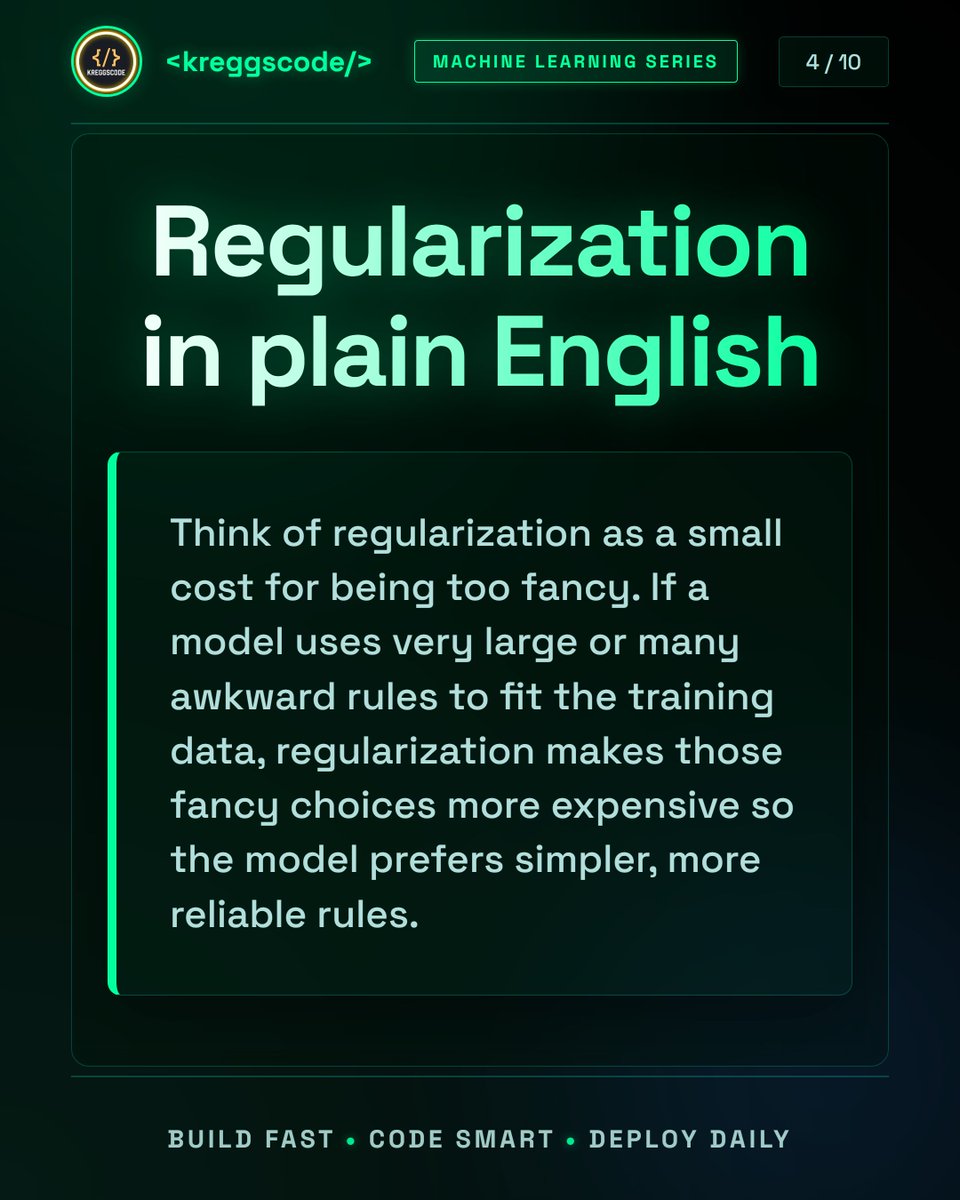
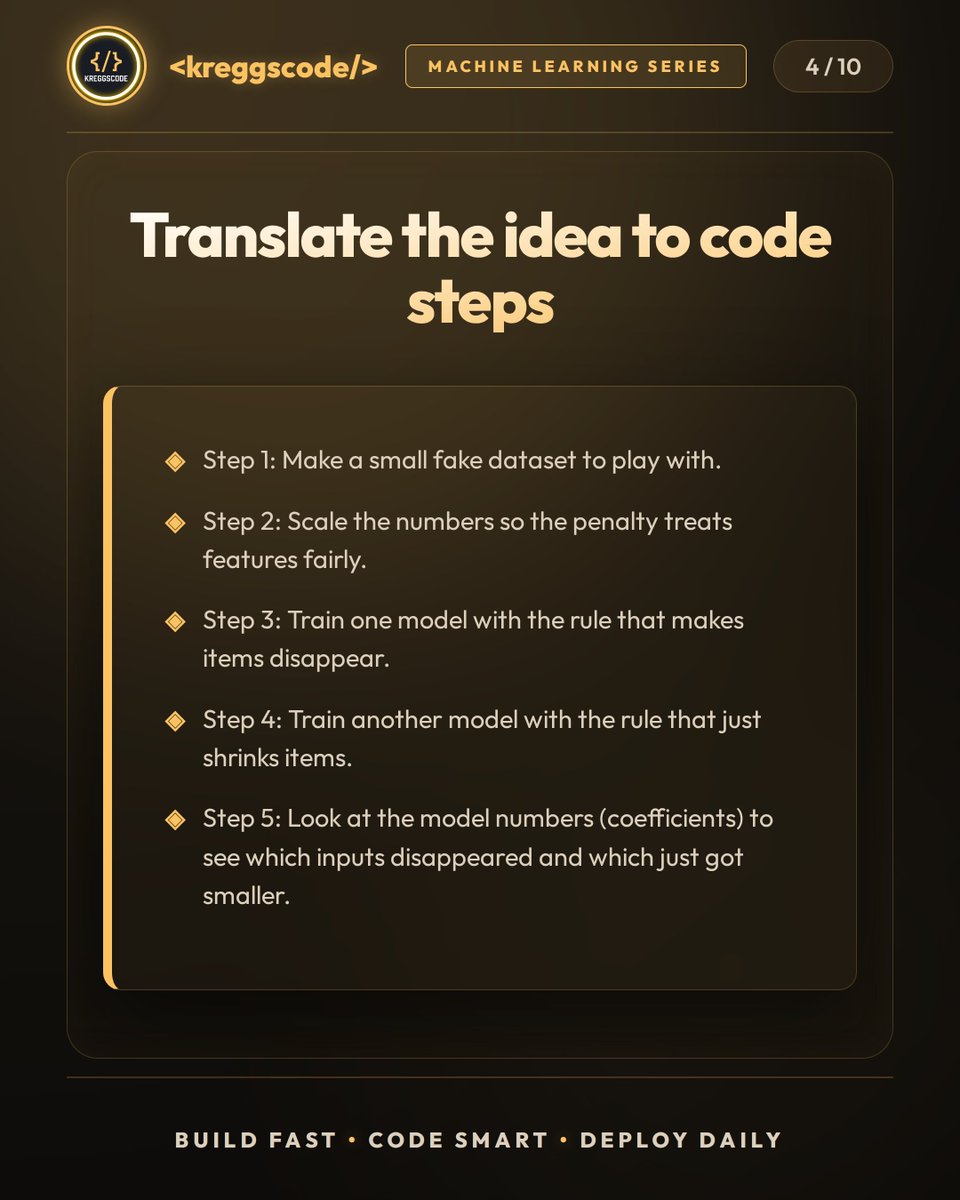
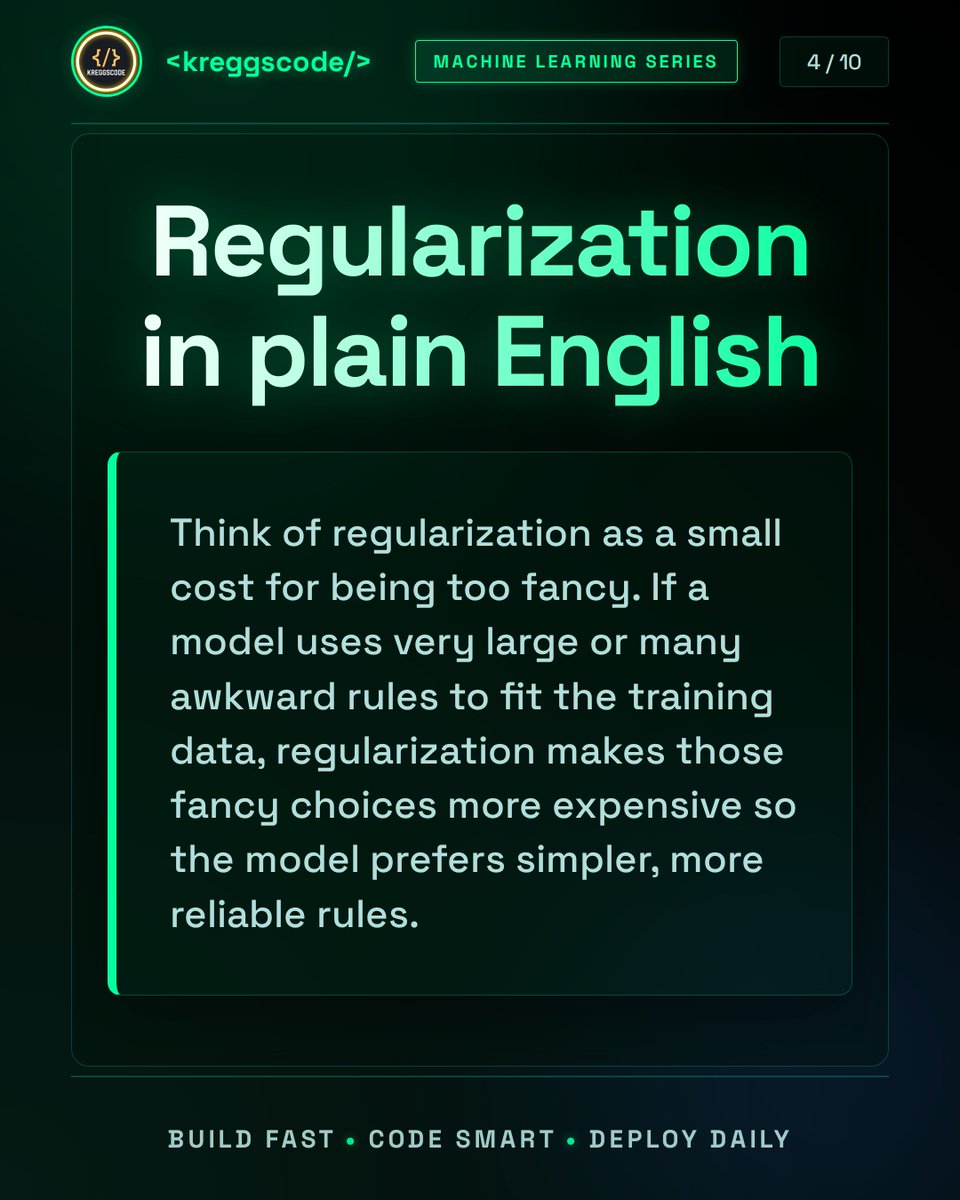
๐Ÿช Day 6 โ€” Regularization: Why L1 and L2 change the game for generalization Regularization is the safety net that stops models from memorizing training noise. Instead of just minimizing training error, we penalize extreme weights so the model prefers simpler explanations tha

๐Ÿช Day 6 โ€” Regularization: Why L1 and L2 change the game for generalization

Regularization is the safety net that stops models from memorizing training noise. Instead of just minimizing training error, we penalize extreme weights so the model prefers simpler explanations tha
kreggscode (@kreggscode) 's Twitter Profile Photo

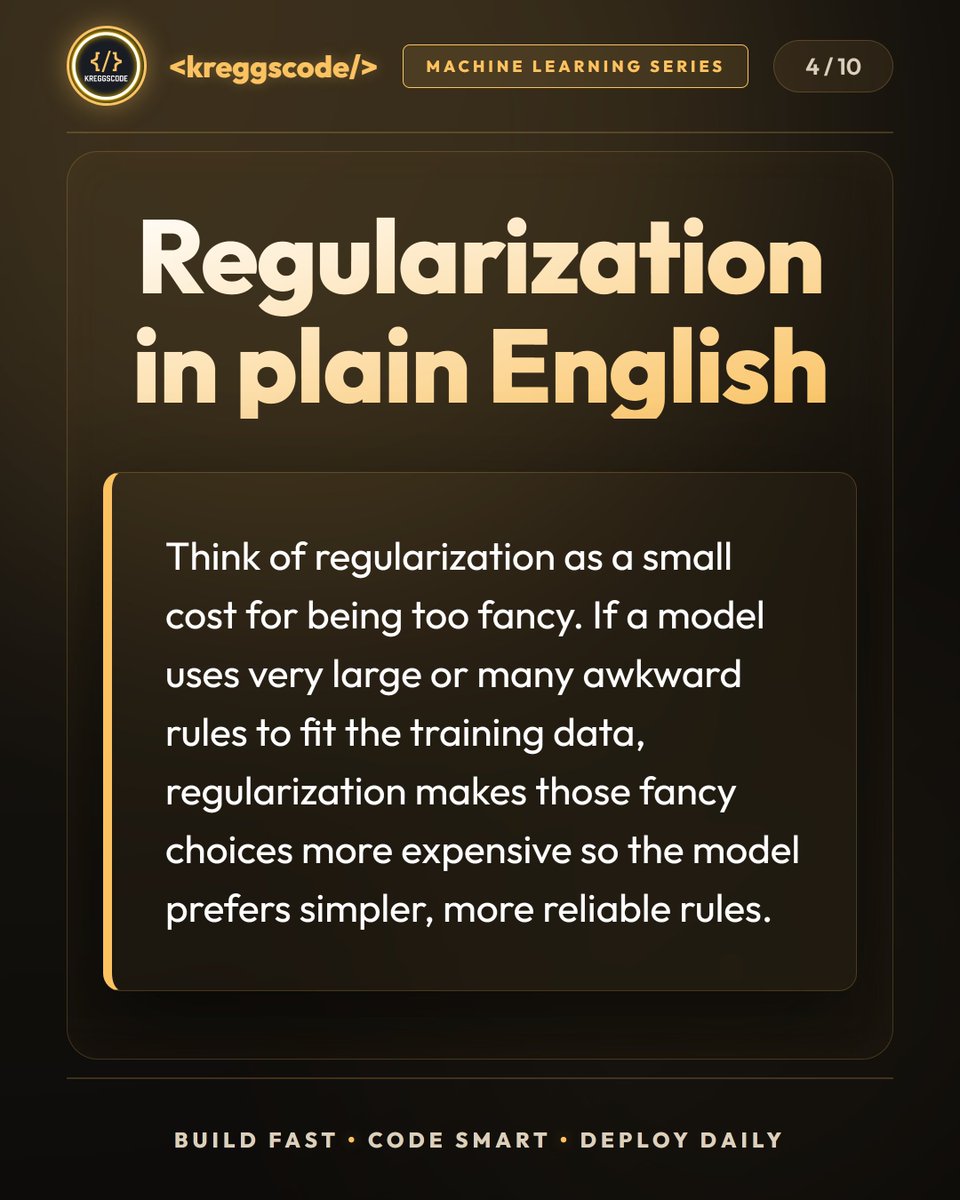
๐Ÿช Day 6 โ€” Regularization: Why L1 and L2 change the game for generalization Regularization is the safety net that stops models from memorizing training noise. Instead of just minimizing training error, we penalize extreme weights so the model prefers simpler explanations tha

๐Ÿช Day 6 โ€” Regularization: Why L1 and L2 change the game for generalization

Regularization is the safety net that stops models from memorizing training noise. Instead of just minimizing training error, we penalize extreme weights so the model prefers simpler explanations tha
kreggscode (@kreggscode) 's Twitter Profile Photo

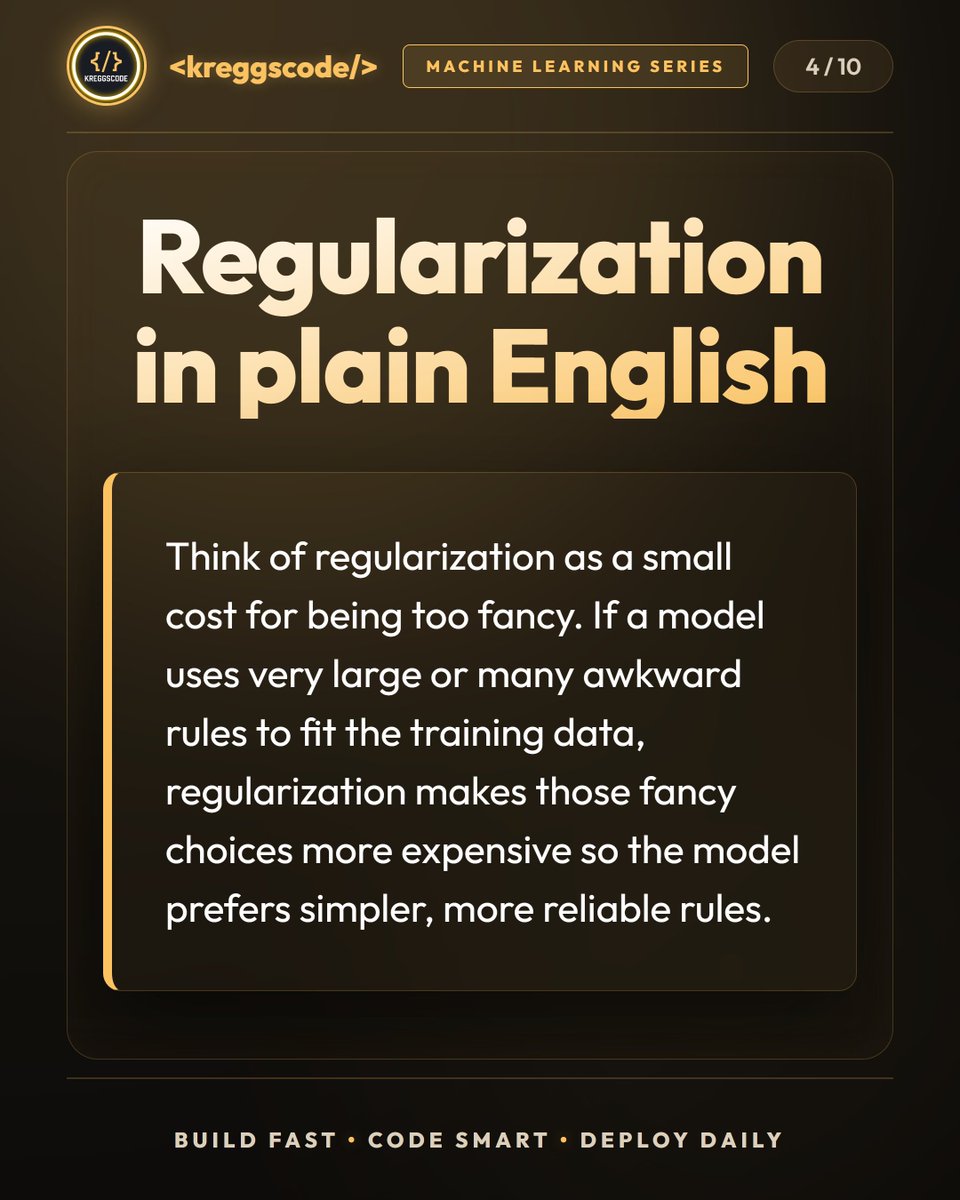
๐Ÿช Day 6 โ€” Regularization: Why L1 and L2 change the game for generalization Regularization is the safety net that stops models from memorizing training noise. Instead of just minimizing training error, we penalize extreme weights so the model prefers simpler explanations tha

๐Ÿช Day 6 โ€” Regularization: Why L1 and L2 change the game for generalization

Regularization is the safety net that stops models from memorizing training noise. Instead of just minimizing training error, we penalize extreme weights so the model prefers simpler explanations tha
kreggscode (@kreggscode) 's Twitter Profile Photo

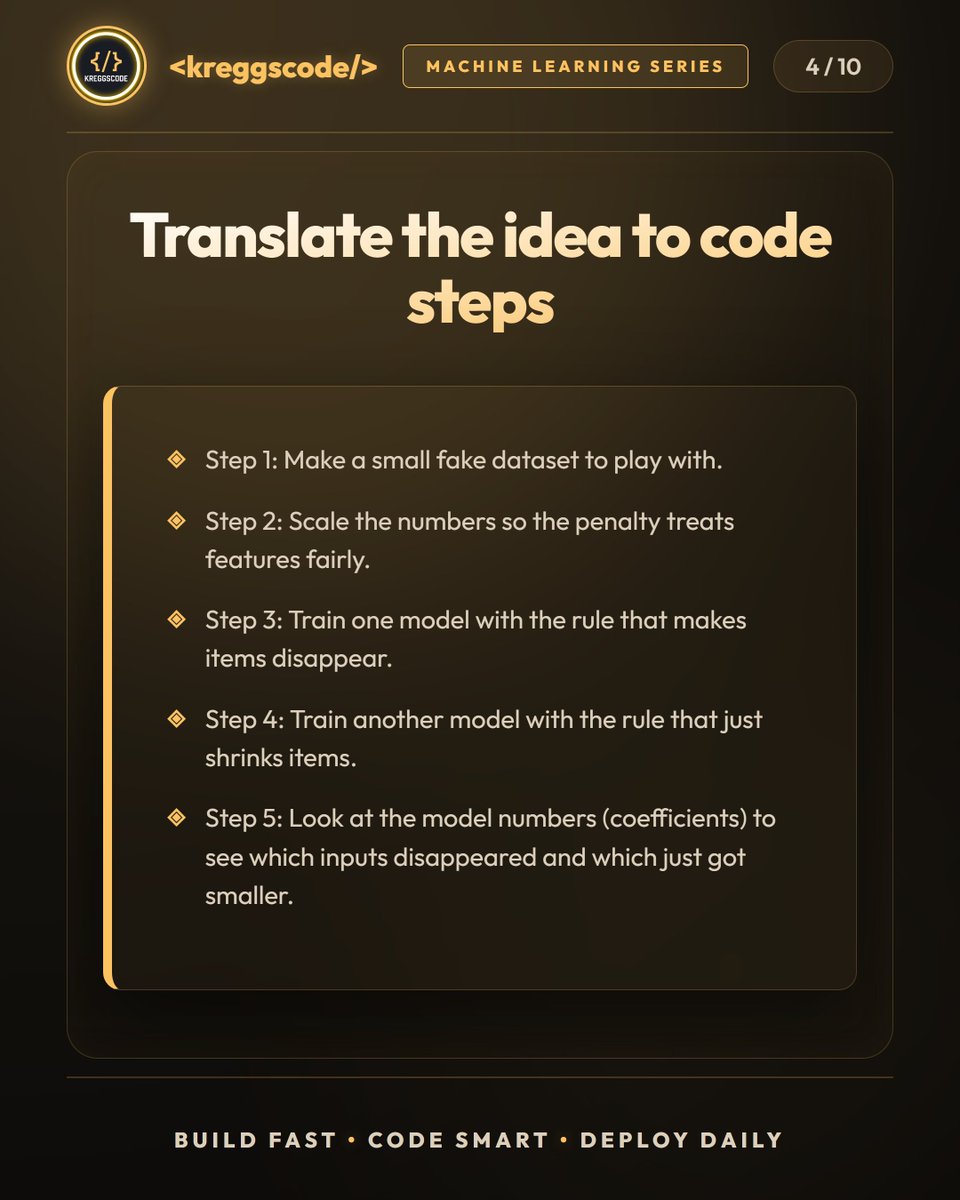
๐Ÿช Day 6 โ€” Regularization: Why L1 and L2 change the game for generalization Regularization is the safety net that stops models from memorizing training noise. Instead of just minimizing training error, we penalize extreme weights so the model prefers simpler explanations tha

๐Ÿช Day 6 โ€” Regularization: Why L1 and L2 change the game for generalization

Regularization is the safety net that stops models from memorizing training noise. Instead of just minimizing training error, we penalize extreme weights so the model prefers simpler explanations tha
kreggscode (@kreggscode) 's Twitter Profile Photo

๐Ÿช Day 7 โ€” Regularization: L1 vs L2 (Why it matters + Python tips) โœจ ๐Ÿ’ก Regularization is the insurance policy for your models โ€” it prevents overfitting by penalizing large weights so the model generalizes better. L2 (Ridge / weight decay) adds the squared magnitude of weight

๐Ÿช Day 7 โ€” Regularization: L1 vs L2 (Why it matters + Python tips) โœจ

๐Ÿ’ก Regularization is the insurance policy for your models โ€” it prevents overfitting by penalizing large weights so the model generalizes better. L2 (Ridge / weight decay) adds the squared magnitude of weight
kreggscode (@kreggscode) 's Twitter Profile Photo

๐Ÿช Day 7 โ€” Regularization: L1 vs L2 (Why it matters + Python tips) โœจ ๐Ÿ’ก Regularization is the insurance policy for your models โ€” it prevents overfitting by penalizing large weights so the model generalizes better. L2 (Ridge / weight decay) adds the squared magnitude of weight

๐Ÿช Day 7 โ€” Regularization: L1 vs L2 (Why it matters + Python tips) โœจ

๐Ÿ’ก Regularization is the insurance policy for your models โ€” it prevents overfitting by penalizing large weights so the model generalizes better. L2 (Ridge / weight decay) adds the squared magnitude of weight
kreggscode (@kreggscode) 's Twitter Profile Photo

๐Ÿช Day 7 โ€” Regularization: L1 vs L2 (Why it matters + Python tips) โœจ ๐Ÿ’ก Regularization is the insurance policy for your models โ€” it prevents overfitting by penalizing large weights so the model generalizes better. L2 (Ridge / weight decay) adds the squared magnitude of weight

๐Ÿช Day 7 โ€” Regularization: L1 vs L2 (Why it matters + Python tips) โœจ

๐Ÿ’ก Regularization is the insurance policy for your models โ€” it prevents overfitting by penalizing large weights so the model generalizes better. L2 (Ridge / weight decay) adds the squared magnitude of weight
kreggscode (@kreggscode) 's Twitter Profile Photo

HTTP/REST API Methods explained visually! ๐ŸŒโšก๏ธ ๐ŸŸข GET: Retrieve Data ๐Ÿ”ต POST: Create Data ๐ŸŸก PUT: Replace Data ๐ŸŸฃ PATCH: Partially Update ๐Ÿ”ด DELETE: Remove Data Watch the cycle bounce in real-time! ๐Ÿ’ป๐Ÿ”ฅ #webdev #api #programming #coding

kreggscode (@kreggscode) 's Twitter Profile Photo

๐Ÿช Day 8 โ€” Linear Regression: The Intuition Linear regression is the simplest, most powerful idea in supervised learning: fit the best straight line to predict a numeric outcome, and you get interpretability, speed, and a baseline everyone should master. Linear regression m

๐Ÿช Day 8 โ€” Linear Regression: The Intuition

Linear regression is the simplest, most powerful idea in supervised learning: fit the best straight line to predict a numeric outcome, and you get interpretability, speed, and a baseline everyone should master.

Linear regression m
kreggscode (@kreggscode) 's Twitter Profile Photo

What if AIs raced for Consciousness? ๐Ÿง ๐Ÿค– Watch this 'Singularity Sprint' where AI models compete to: โœจ Generate novel philosophy ๐Ÿค” Exhibit true curiosity ๐Ÿ”ฎ Form self-aware predictions Who will reach the singularity first? ๐ŸŒ๐Ÿ”ฅ #ai #machinelearning #tech #programming

kreggscode (@kreggscode) 's Twitter Profile Photo

The ultimate Pathfinding Algorithm Race! ๐Ÿš€๐Ÿ Watch A*, Dijkstra, BFS, DFS, Greedy, and Bi-BFS go head-to-head in this stunning visualizer. Which one is the fastest? ๐Ÿ‘‡ #programming #coding #algorithms #computerscience #tech #webdev

kreggscode (@kreggscode) 's Twitter Profile Photo

๐Ÿช Day 9 โ€” Linear Regression in Python: Fit, interpret, and predict with confidence. ๐Ÿ’ก Linear regression models a continuous target as a weighted sum of inputs (y โ‰ˆ Xฮฒ + intercept). It's the first tool every ML practitioner learns because it's simple, interpretable, and fast

๐Ÿช Day 9 โ€” Linear Regression in Python: Fit, interpret, and predict with confidence.

๐Ÿ’ก Linear regression models a continuous target as a weighted sum of inputs (y โ‰ˆ Xฮฒ + intercept). It's the first tool every ML practitioner learns because it's simple, interpretable, and fast
kreggscode (@kreggscode) 's Twitter Profile Photo

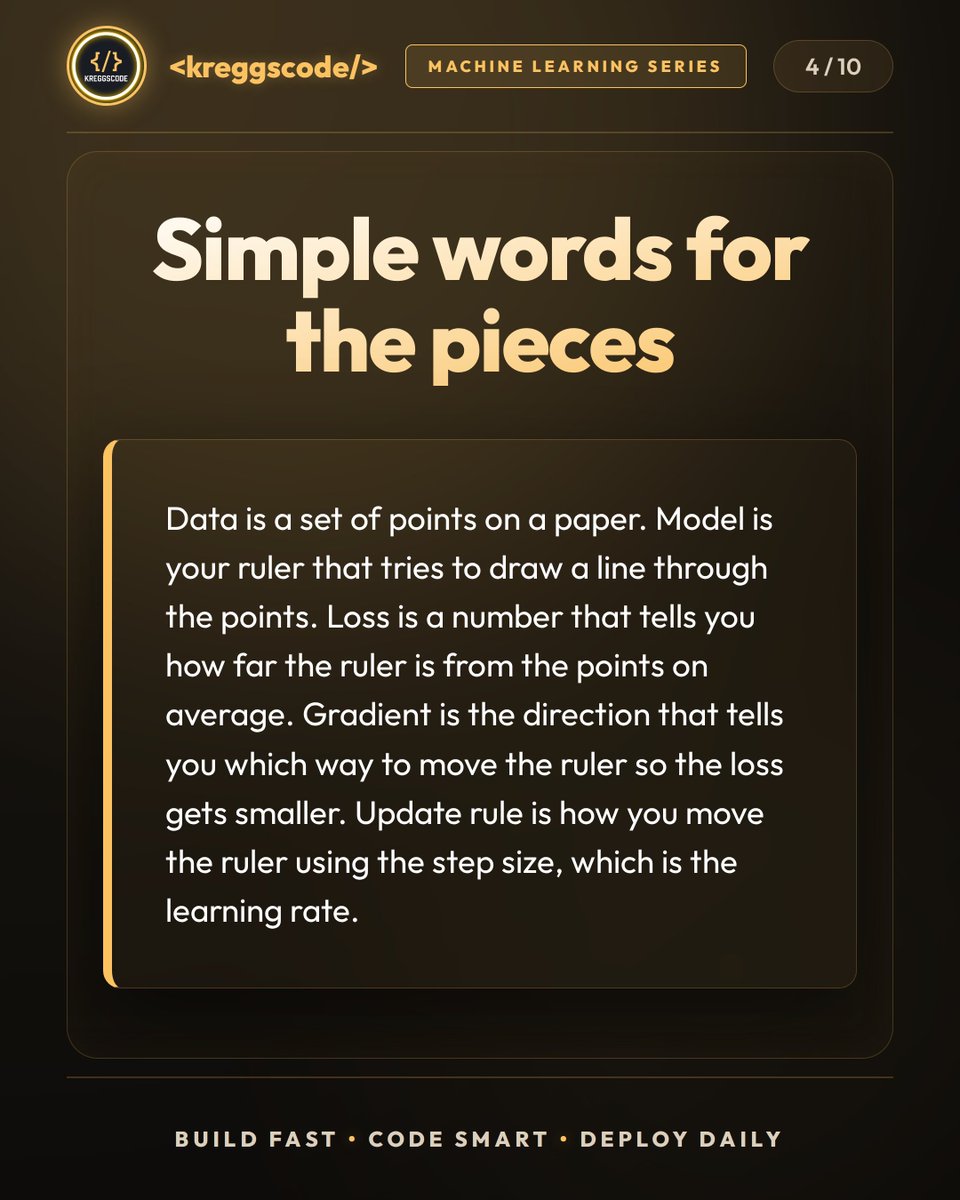
๐Ÿช Gradient Descent โ€” walk downhill to make your model learn faster. ๐Ÿงญ ๐Ÿ’ก Gradient Descent Intuition: Think of the loss surface as a mountainous landscape where height = error. The gradient at a point is the direction of steepest ascent โ€” so stepping in the negative gradient

๐Ÿช Gradient Descent โ€” walk downhill to make your model learn faster. ๐Ÿงญ

๐Ÿ’ก Gradient Descent Intuition:
Think of the loss surface as a mountainous landscape where height = error. The gradient at a point is the direction of steepest ascent โ€” so stepping in the negative gradient
kreggscode (@kreggscode) 's Twitter Profile Photo

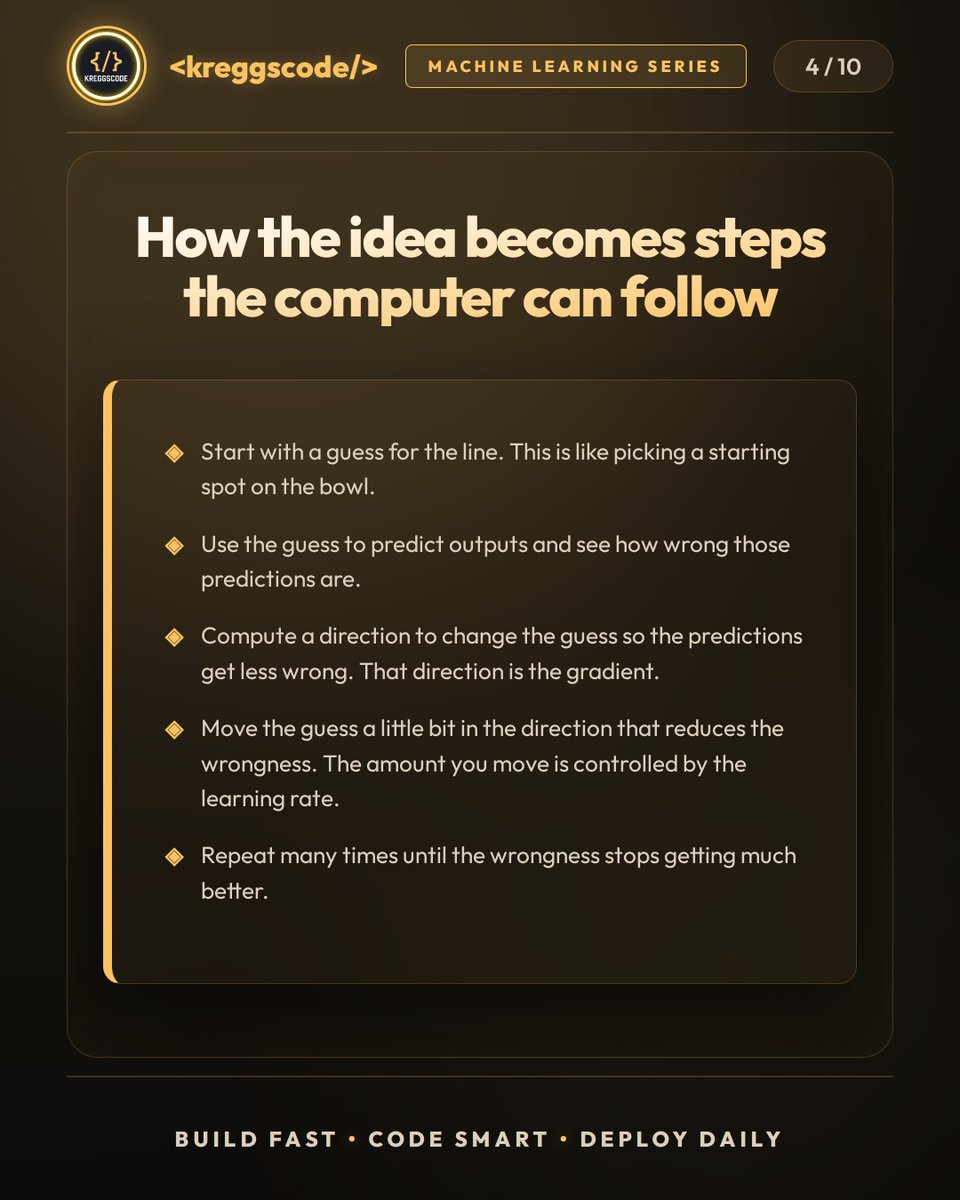
๐Ÿช Day 11: Gradient Descent โ€” Python in action ๐Ÿ’ก Gradient Descent is the workhorse behind training most machine learning models: it iteratively nudges parameters in the direction that reduces the loss. At each step we compute the gradient (the slope) of the loss with respect

๐Ÿช Day 11: Gradient Descent โ€” Python in action

๐Ÿ’ก Gradient Descent is the workhorse behind training most machine learning models: it iteratively nudges parameters in the direction that reduces the loss. At each step we compute the gradient (the slope) of the loss with respect
kreggscode (@kreggscode) 's Twitter Profile Photo

๐Ÿช Day 12 โ€” Learning Rate & Convergence: The Intuition Learning rate is the step size your optimizer takes in parameter space; get it right and training is fast and stable, get it wrong and your model either crawls or explodes. Learning rate controls how far you move along

๐Ÿช Day 12 โ€” Learning Rate & Convergence: The Intuition

Learning rate is the step size your optimizer takes in parameter space; get it right and training is fast and stable, get it wrong and your model either crawls or explodes.

Learning rate controls how far you move along
kreggscode (@kreggscode) 's Twitter Profile Photo

๐Ÿช Day 13 โ€” Learning Rate & Convergence: the step size that decides if your model learns or explodes. Learning rate (LR) is the single most impactful hyperparameter for gradient-based training: it scales the gradient update and balances speed vs stability. Too large โ†’ diverg

๐Ÿช Day 13 โ€” Learning Rate & Convergence: the step size that decides if your model learns or explodes.

Learning rate (LR) is the single most impactful hyperparameter for gradient-based training: it scales the gradient update and balances speed vs stability. Too large โ†’ diverg
kreggscode (@kreggscode) 's Twitter Profile Photo

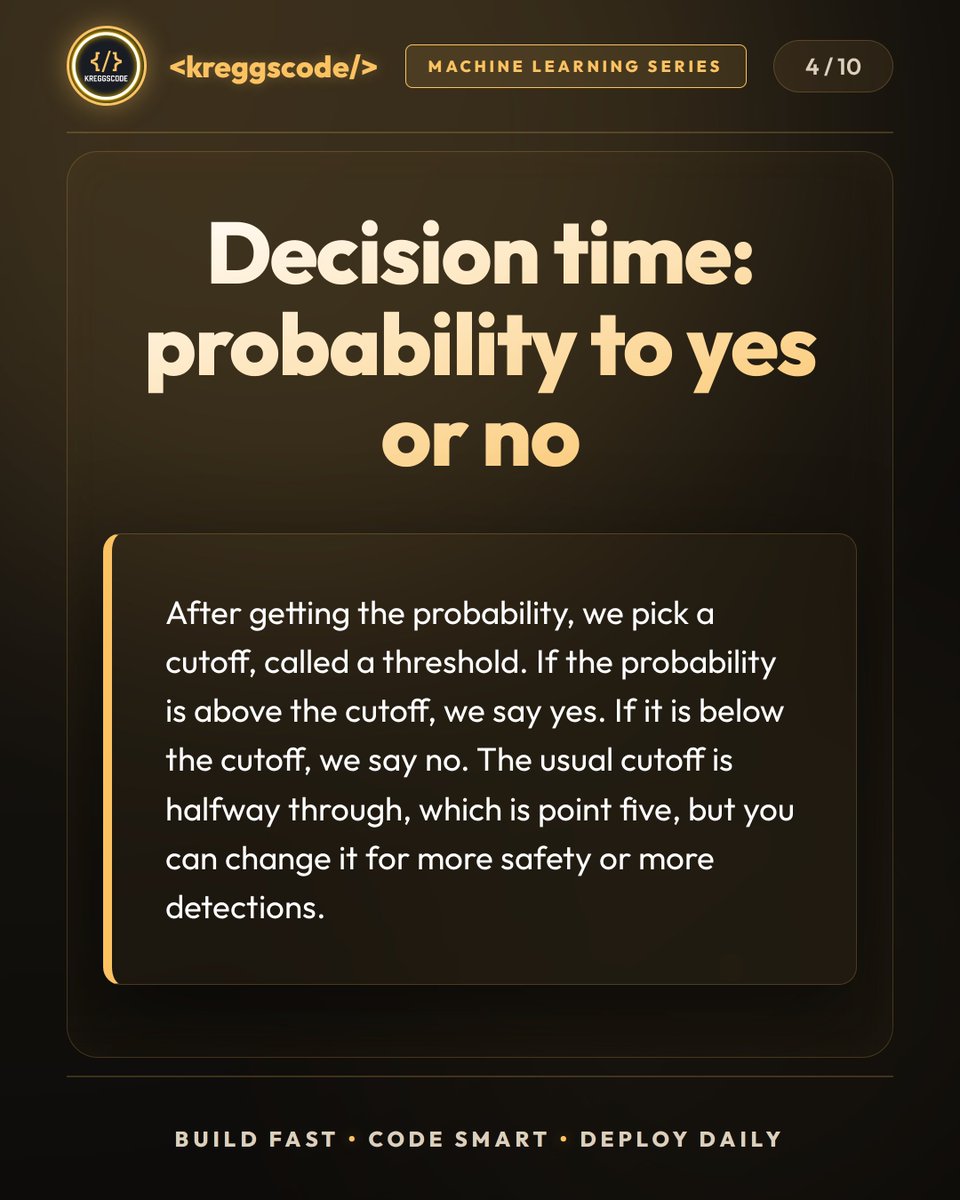
๐Ÿช Day 14 โ€” Logistic Regression: The Intuition ๐Ÿ’ก Logistic regression predicts probabilities for binary outcomes by turning a linear score into a value between 0 and 1 using the sigmoid. Unlike linear regression, which predicts continuous values, logistic regression models th

๐Ÿช Day 14 โ€” Logistic Regression: The Intuition

๐Ÿ’ก Logistic regression predicts probabilities for binary outcomes by turning a linear score into a value between 0 and 1 using the sigmoid. Unlike linear regression, which predicts continuous values, logistic regression models th