Daniel Feygin (@innov8r) 's Twitter Profile
Daniel Feygin

@innov8r

Reimagining the future of software delivery with AI platform engineering.

ID: 7104842

calendar_today27-06-2007 08:29:34

620 Tweet

232 Followers

2,2K Following

Yufan Zhuang (@yufan_zhuang) 's Twitter Profile Photo

Can LLMs reason beyond context limits? 🤔 Introducing Knowledge Flow, a training-free method that helped gpt-oss-120b & Qwen3-235B achieve 100% on the AIME-25, no tools. How? like human deliberation, for LLMs. 📝 Blog: yufanzhuang.notion.site/knowledge-flow 💻 Code: github.com/EvanZhuang/kno…


Can LLMs reason beyond context limits? 🤔 

Introducing Knowledge Flow, a training-free method that helped gpt-oss-120b & Qwen3-235B achieve 100% on the AIME-25, no tools.

How? like human deliberation, for LLMs.

📝 Blog: yufanzhuang.notion.site/knowledge-flow
💻 Code: github.com/EvanZhuang/kno…
Chris Dixon (@cdixon) 's Twitter Profile Photo

We’re excited to share our 2025 State of Crypto report. This year’s story: the maturation of the crypto industry — with growing institutional adoption, the rise of stablecoins, better infrastructure, new consumer experiences, and long-awaited regulatory clarity. Read the full

We’re excited to share our 2025 State of Crypto report.

This year’s story: the maturation of the crypto industry — with growing institutional adoption, the rise of stablecoins, better infrastructure, new consumer experiences, and long-awaited regulatory clarity.

Read the full
Andrew White 🐦‍⬛ (@andrewwhite01) 's Twitter Profile Photo

After two years of work, we’ve made an AI Scientist that runs for days and makes genuine discoveries. Working with external collaborators, we report seven externally validated discoveries across multiple fields. It is available right now for anyone to use. 1/5

After two years of work, we’ve made an AI Scientist that runs for days and makes genuine discoveries. Working with external collaborators, we report seven externally validated discoveries across multiple fields. It is available right now for anyone to use. 1/5
chastronomic (@chastronomic) 's Twitter Profile Photo

If you’re an "ML Engineer" and you think “Transformer” just means stacking encoder–decoder blocks and calling it a day, you’re missing the actual mechanism that makes modern AI work. Concept 16: The Transformer Is a Math Engine, Not a “Model Architecture "Most people can

Simon Willison (@simonw) 's Twitter Profile Photo

OpenAI aren't talking about it yet, but it turns out they've adopted Anthropic's brilliant "skills" mechanism in a big way Skills are now live in both ChatGPT and their Codex CLI tool, I wrote up some detailed notes on how they work so far here: simonwillison.net/2025/Dec/12/op…

Andrej Karpathy (@karpathy) 's Twitter Profile Photo

I love the expression “food for thought” as a concrete, mysterious cognitive capability humans experience but LLMs have no equivalent for. Definition: “something worth thinking about or considering, like a mental meal that nourishes your mind with ideas, insights, or issues that

Boris Cherny (@bcherny) 's Twitter Profile Photo

Andrej Karpathy I feel this way most weeks tbh. Sometimes I start approaching a problem manually, and have to remind myself “claude can probably do this”. Recently we were debugging a memory leak in Claude Code, and I started approaching it the old fashioned way: connecting a profiler, using the


Engineering (@xeng) 's Twitter Profile Photo

We have open-sourced our new 𝕏 algorithm, powered by the same transformer architecture as xAI's Grok model. Check it out here:  github.com/xai-org/x-algo…

Mikel Jollett (@mikel_jollett) 's Twitter Profile Photo

As someone who has studied cults (wrote a bestseller about it), let me tell you something: The lies Trump, Vance and Miller say are not meant to be believed by their followers. They are meant to be REPEATED. The repetition of the lie is the test of loyalty to the cult.

Google Research (@googleresearch) 's Twitter Profile Photo

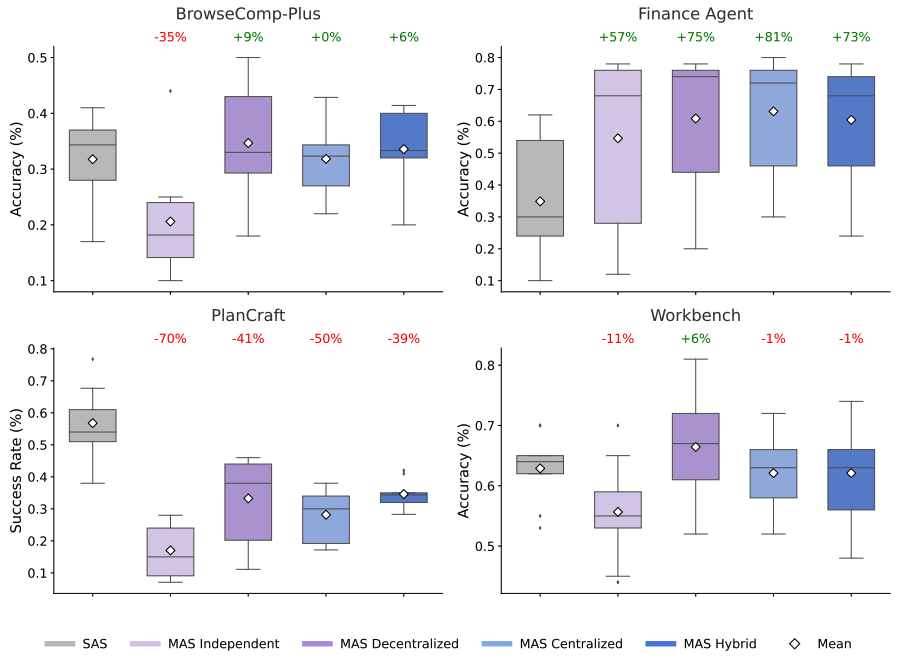
A common heuristic in LLM agent design—"more agents is better"—might be wrong. Across 180 configurations, we find multi-agent coordination is task-contingent: +81% on parallelizable tasks (finance), but -70% on sequential ones (planning). Architecture-task alignment matters more

A common heuristic in LLM agent design—"more agents is better"—might be wrong.

Across 180 configurations, we find multi-agent coordination is task-contingent: +81% on parallelizable tasks (finance), but -70% on sequential ones (planning). Architecture-task alignment matters more
Alex Zhang (@a1zhang) 's Twitter Profile Photo

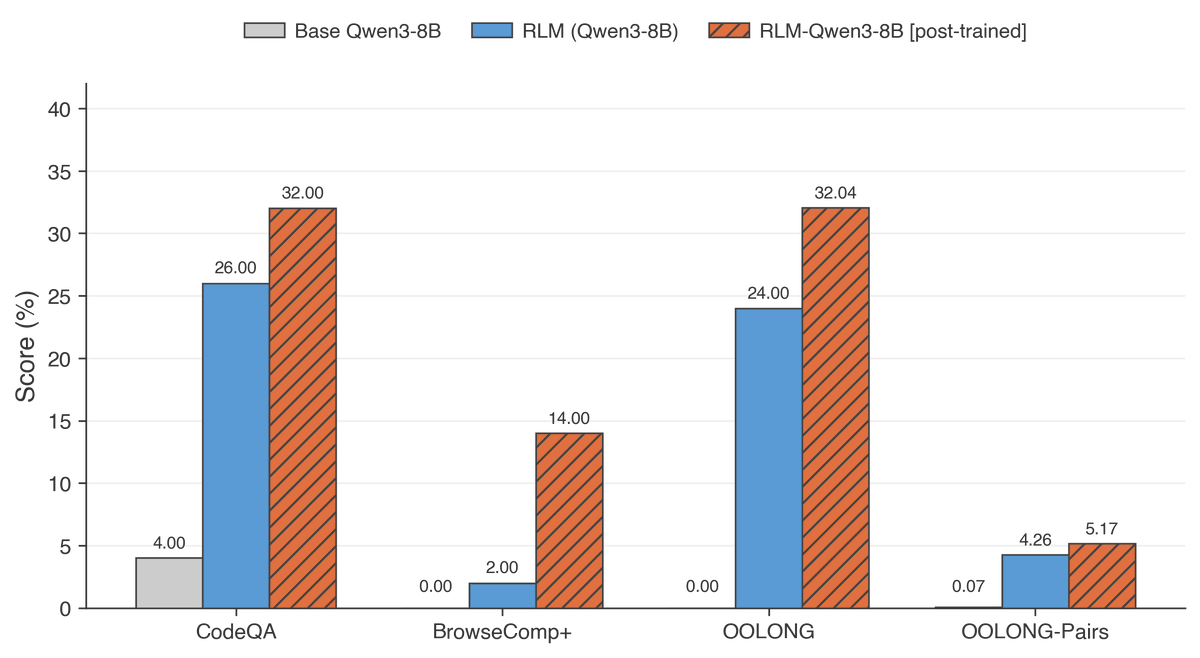
We just updated the RLM paper with some new stuff. First, we just released RLM-Qwen3-8B, the first natively recursive language model (at tiny scale!). We post-trained Qwen3-8B using only ~1000 RLM trajectories from unrelated domains to our evaluation benchmarks. RLM-Qwen3-8B

We just updated the RLM paper with some new stuff.

First, we just released RLM-Qwen3-8B, the first natively recursive language model (at tiny scale!).

We post-trained Qwen3-8B using only ~1000 RLM trajectories from unrelated domains to our evaluation benchmarks.

RLM-Qwen3-8B
Leonie (@helloiamleonie) 's Twitter Profile Photo

i'm clearly biased but this is the most interesting take on agent memory i've seen so far. (yes, forget the "filesystem vs database" discussion) a few weeks back i had a nice chat with vintro from Plastic Labs and their approach is: memory is not a retrieval problem.

i'm clearly biased but this is the most interesting take on agent memory i've seen so far.  
(yes, forget the "filesystem vs database" discussion)

a few weeks back i had a nice chat with <a href="/vintrotweets/">vintro</a> from <a href="/plasticlabs/">Plastic Labs</a> and their approach is:

memory is not a retrieval problem.
Robert Youssef (@rryssf_) 's Twitter Profile Photo

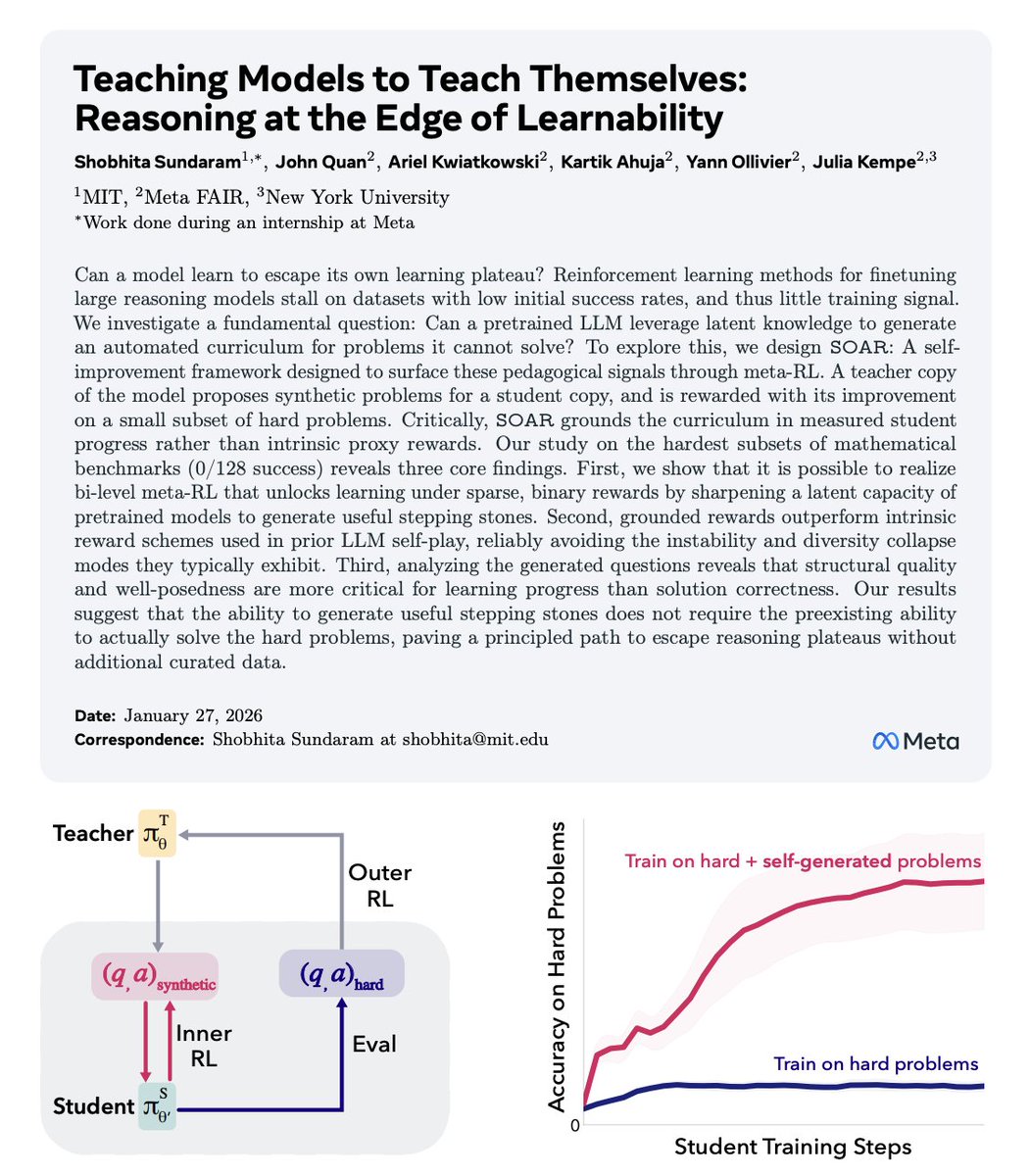
Holy shit… this paper from MIT quietly explains how models can teach themselves to reason when they’re completely stuck 🤯 The core idea is deceptively simple: Reasoning fails because learning has nothing to latch onto. When a model’s success rate drops to near zero,

Holy shit… this paper from MIT quietly explains how models can teach themselves to reason when they’re completely stuck 🤯

The core idea is deceptively simple:

Reasoning fails because learning has nothing to latch onto.

When a model’s success rate drops to near zero,
Arvind Narayanan (@random_walker) 's Twitter Profile Photo

Why do coding agents work so well and what would it take to replicate their success in other domains? One important and under-appreciated reason is that agentic coding is a type of neurosymbolic AI. The main weakness of LLMs is that they are statistical machines and struggle at

Greg Brockman (@gdb) 's Twitter Profile Photo

Software development is undergoing a renaissance in front of our eyes. If you haven't used the tools recently, you likely are underestimating what you're missing. Since December, there's been a step function improvement in what tools like Codex can do. Some great engineers at

Omar Khattab (@lateinteraction) 's Twitter Profile Photo

Nope. My lab is making 3 algorithmic bets. One of them is on recursion, RLMs being step 1. Another one is on the power of late interaction retrieval. Conventional single-vector retrieval was always a bottleneck, even back in 2019 when starting ColBERT. So if you're wondering if

Physics In History (@physinhistory) 's Twitter Profile Photo

In 2015, physicists at the University of Rochester discovered the classic 17th-century Wallis formula for π hidden within quantum mechanical calculations of the hydrogen atom's energy levels. It was a purely mathematical relationship found to be baked into the fabric of physical

In 2015, physicists at the University of Rochester discovered the classic 17th-century Wallis formula for π hidden within quantum mechanical calculations of the hydrogen atom's energy levels. It was a purely mathematical relationship found to be baked into the fabric of physical