Claudio (@cfofiu) 's Twitter Profile
Claudio

@cfofiu

Director of Engineering & Co-founder @madebymonogram — agentic AI systems, composable apps & elegant engineering.

ID: 307337146

linkhttp://monogram.io calendar_today29-05-2011 13:13:02

567 Tweet

174 Followers

536 Following

Google for Developers (@googledevs) 's Twitter Profile Photo

🤩 Interested to learn more about leveraging Gemini's advanced image recognition and expansive context window? See how Google for Developers partners #BuildWithGemini 🛠️ Deep dive into Gemini 1.5 Pro explorations with Monogram ↓ goo.gle/3TGe8zh

Codie Sanchez (@codie_sanchez) 's Twitter Profile Photo

My richest mentor told me... "I win more for one reason. I move fast. By the time most people are done analyzing, I've already made three mistakes and found a better way."

Andrew Gazdecki (@agazdecki) 's Twitter Profile Photo

Friendly reminder that startups with a better product lose often to startups with better distribution, brand, marketing, storytelling, and sales.

Monogram (@madebymonogram) 's Twitter Profile Photo

Just wrapped up an amazing offsite in Mexico City 🇲🇽 🌮 — thriving at the intersection of Design + Engineering + Service depends on a team sharing strong friendships, laughter, good food, and a sense of wonder. ¡Hasta luego, #CDMX!

Just wrapped up an amazing offsite in Mexico City 🇲🇽 🌮 — thriving at the intersection of Design + Engineering + Service depends on a team sharing strong friendships, laughter, good food, and a sense of wonder.

¡Hasta luego, #CDMX!
Alex Albert (@alexalbert__) 's Twitter Profile Photo

2025 will be the year of agentic systems The pieces are falling into place: computer use, MCP, improved tool use. It's time to start thinking about building these systems. At Anthropic, we're seeing a few best practices emerge - we wrote a blog post with our findings:

2025 will be the year of agentic systems

The pieces are falling into place: computer use, MCP, improved tool use. It's time to start thinking about building these systems.

At Anthropic, we're seeing a few best practices emerge - we wrote a blog post with our findings:
Claudio (@cfofiu) 's Twitter Profile Photo

Legends, old friends, and new faces—Interrupt 2025 delivered. A full day of honest conversations on building AI agents, what’s working, what’s not, and how to get to prod. Shoutout to the crew for a great event.

Legends, old friends, and new faces—Interrupt 2025 delivered. A full day of honest conversations on building AI agents, what’s working, what’s not, and how to get to prod. Shoutout to the <a href="/langchain/"></a>  crew for a great event.
Claudio (@cfofiu) 's Twitter Profile Photo

Gemini Flash for IVR is wild. 🤯 ~75% faster on big prompts, latency barely changes as context grows. For real-time, natural conversation, nothing else comes close. #gemini #ai #googleio

Vercel (@vercel) 's Twitter Profile Photo

We now support Bun on Vercel. Bun is an open runtime pushing the frontier on DX and performance. Start building and see our latest benchmarks. vercel.fyi/buntime

Nav Singh (@heynavsingh) 's Twitter Profile Photo

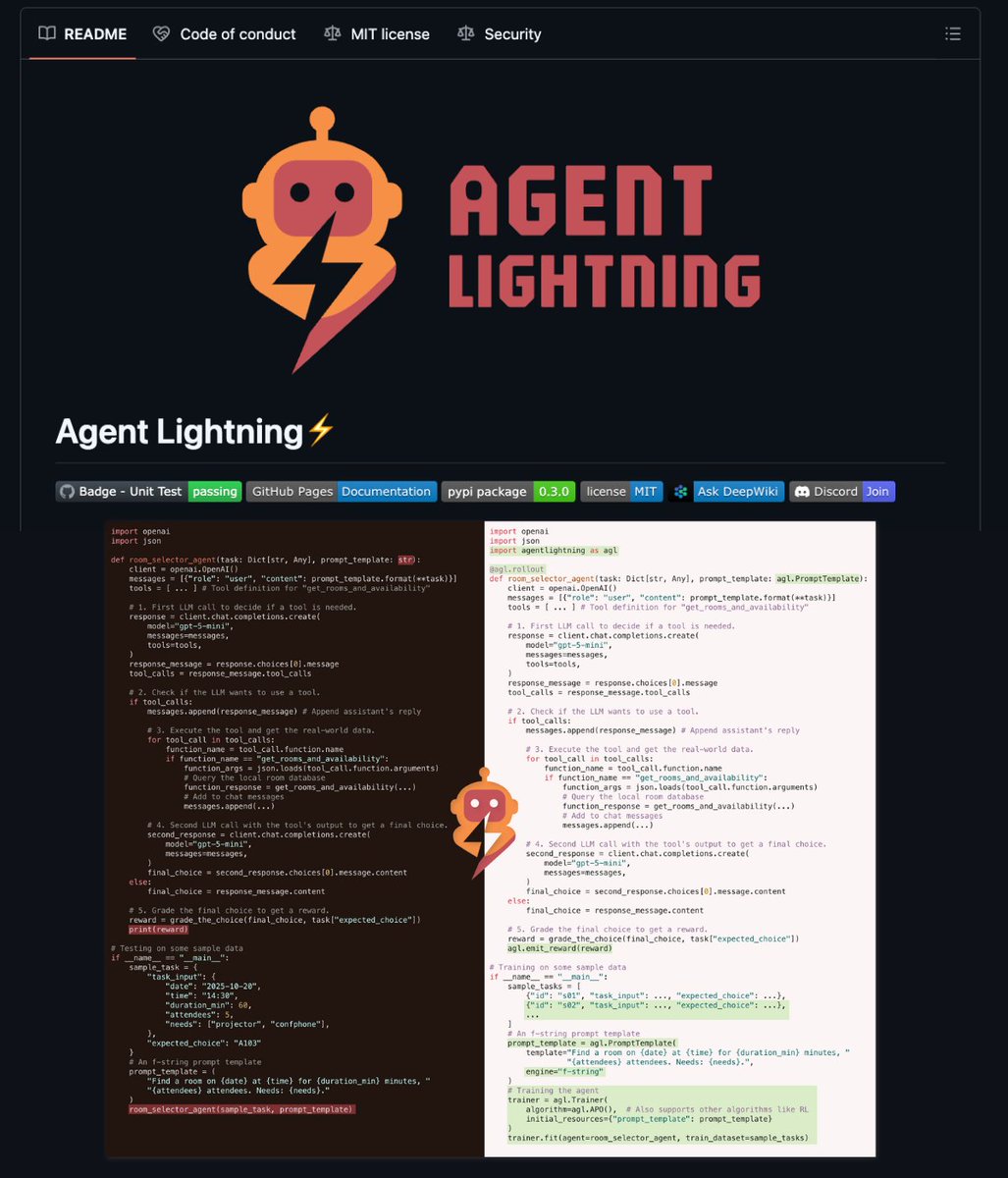
🚨BREAKING: Microsoft just solved the "Agent Loop" problem. Agent Lightning is an open-source framework that lets agents learn from their own mistakes using Reinforcement Learning. Your agent fails a task → Agent Lightning analyzes why → Updates the prompt automatically →

🚨BREAKING: Microsoft just solved the "Agent Loop" problem.

Agent Lightning is an open-source framework that lets agents learn from their own mistakes using Reinforcement Learning.

Your agent fails a task → Agent Lightning analyzes why → Updates the prompt automatically →
Claudio (@cfofiu) 's Twitter Profile Photo

The hardest part of building AI agents isn't the AI. It's making them predictable. Users expect: - consistent answers - reliable actions - no weird edge cases Getting there means: - strict tool schemas - defensive prompts - evals for edge cases and regressions - retries and

Claudio (@cfofiu) 's Twitter Profile Photo

Quick gut check I've been using while building AI systems: - Are we storing everything or only what matters? - Can the system update what it "knows" about a user over time? - Can that knowledge be inspected and corrected? - Do our evals catch edge cases and regressions? The hard