

Adam P. Goucher (@apgox) 's Twitter Profile
Adam P. Goucher

@apgox

Algorithmist

ID: 2804577409

linkhttps://cp4space.hatsya.com calendar_today11-09-2014 23:42:40

3,3K Tweet

1,1K Followers

1,1K Following
Jade-Amanda Laporte (@ladyjadeamanda) 's Twitter Profile Photo

Haven’t been on here for over a year but a special exception has to be made to send a huge thanks & to express my sheer admiration of Tessa Barton for creating this work of art & gift wrapping with such TLC (and a chip bow!) (and ofc Adam P. Goucher for such a unique surprise) #gpu #bag
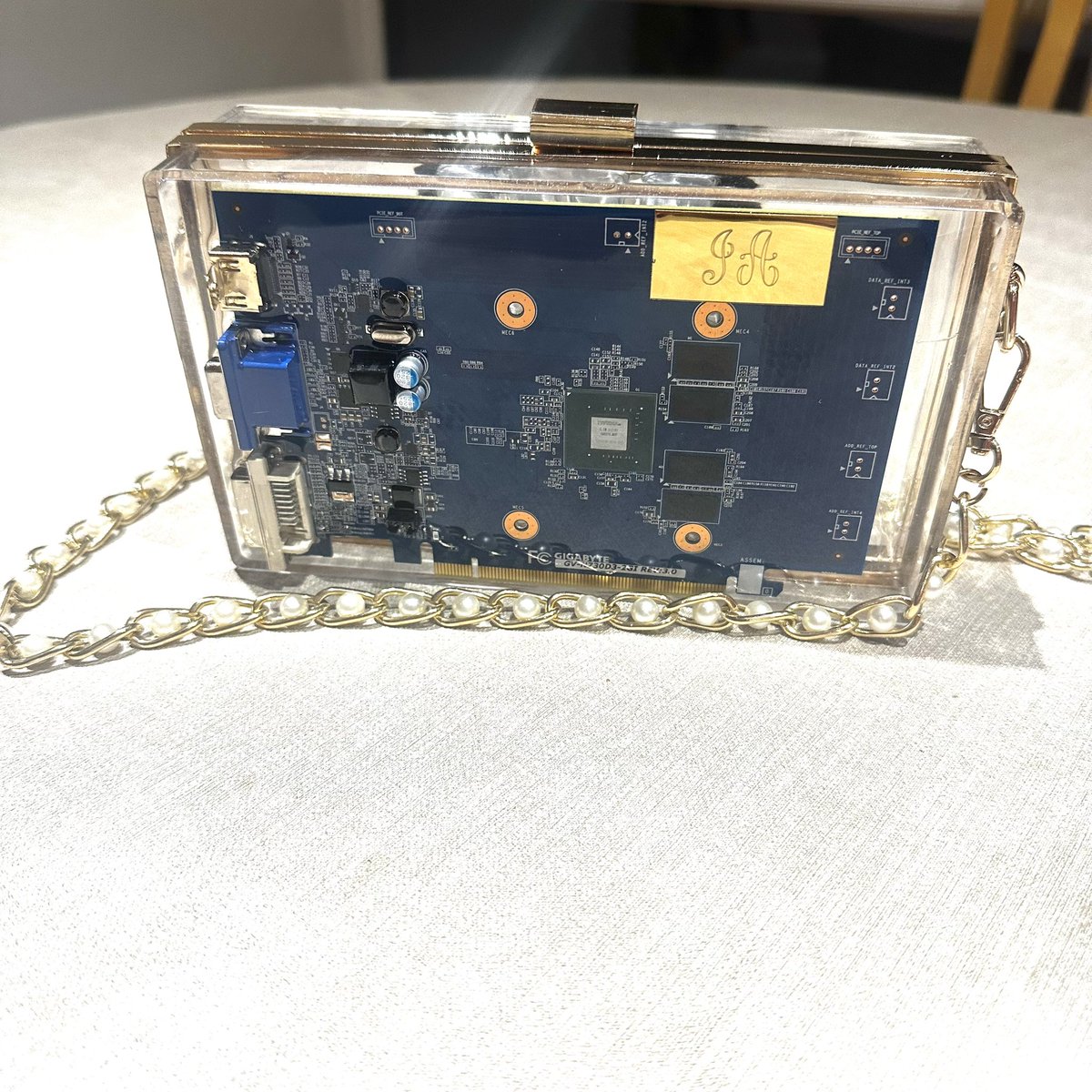

Haven’t been on here for over a year but a special exception has to be made to send a huge thanks &amp; to express my sheer admiration of <a href="/tessybarton/">Tessa Barton</a> for creating this work of art &amp; gift wrapping with such TLC (and a chip bow!) (and ofc <a href="/apgox/">Adam P. Goucher</a> for such a unique surprise) #gpu #bag
Sam Altman (@sama) 's Twitter Profile Photo

it is hard to overstate how much alec radford has contributed to the field, and how much of everyone's current progress traces back to his work. i believe he is a genius at the level of einstein, and also he is one of my favorite people ever--hard to imagine a nicer, warmer, or

Adam P. Goucher (@apgox) 's Twitter Profile Photo

Not at all! You can generate and store hashes of all strings within a Levenshtein distance of r of the password and see whether there are collisions between those two radius-r balls, determining whether they’re within a distance of 2r. (r=1 is very practical.)

Adam P. Goucher (@apgox) 's Twitter Profile Photo

I've written up what I know about a heavily customised PDP-3 computer built in 1960 by Charles Corderman and collaborators (originally for military applications, and later used for recreational mathematics): cp4space.hatsya.com/2025/03/18/cha…

Adam P. Goucher (@apgox) 's Twitter Profile Photo

This was the culmination of a long story! The origins of these ideas came from writing AVX assembly back in 2019 for transposing bitmatrices, and now finally have come to fruition as a general framework for choosing register layouts on SIMD architectures:

Adam P. Goucher (@apgox) 's Twitter Profile Photo

Potentially worth stockpiling 4090s: the new Blackwell GPUs don’t natively support single-bit matrix multiply accumulate.

Adam P. Goucher (@apgox) 's Twitter Profile Photo

Léo @AltmejdAdam Clive Chan Scott wrote his own SASS assembler so that he could get his matmul kernel to 98% of theoretical throughput (ptxas could only get 70%). github.com/nervanasystems… I learned so much of what I know about writing efficient CUDA from reading Scott’s sgemm walkthrough!


Stanislav Fort (@stanislavfort) 's Twitter Profile Photo

I worked with Sam extensively at DeepMind (for example on arxiv . org / abs / 2105.13343 = multiple augmentations of the same data point in the batch => better & faster training) and this seems like an amazing opportunity to join a great team & mentor at the same time!

ncklr (@n1ckler) 's Twitter Profile Photo

We just published "Hash-based signatures for Bitcoin," a new analysis of post-quantum schemes by Mikhail Kudinov and myself at Blockstream Research. This paper serves as a gentle intro to hash-based schemes and explores how to optimize them specifically for application in Bitcoin. 🧵

We just published "Hash-based signatures for Bitcoin," a new analysis of post-quantum schemes by <a href="/kudinov_mikhail/">Mikhail Kudinov</a> and myself at <a href="/blksresearch/">Blockstream Research</a>.

This paper serves as a gentle intro to hash-based schemes and explores how to optimize them specifically for application in Bitcoin. 🧵