Honggui Wu (@wu_honggui) 's Twitter Profile
Honggui Wu

@wu_honggui

Postdoc in Feng Zhang lab @BroadInstitute.
Graduated from Sunney Xie Lab at Peking University.

ID: 909636494800805889

linkhttps://scholar.google.com/citations?user=EZTuUqEAAAAJ&hl=en calendar_today18-09-2017 04:33:35

488 Tweet

770 Takipçi

1,1K Takip Edilen
Will Hua (@williamcqhua) 's Twitter Profile Photo

A foundation model for enzyme retrieval and function prediction is released. EnzymeCAGE is trained on ~1M enzyme-reaction pairs via CLIP, and can be used to annotate unseen enzymes or orphan reactions. We open-source it before releasing the manuscript: github.com/GENTEL-lab/Enz…

Dr Naomi Moris (@nmoris) 's Twitter Profile Photo

Have you ever wondered how your back formed? The human embryo makes a neural tube (future spinal cord) and somites (trunk muscle/bone) from ~d20. They’re formed at the same time and place, so we used human Trunk-like Structures (hTLS) to investigate their ‘co-development’… (1/7)

Have you ever wondered how your back formed? The human embryo makes a neural tube (future spinal cord) and somites (trunk muscle/bone) from ~d20. They’re formed at the same time and place, so we used human Trunk-like Structures (hTLS) to investigate their ‘co-development’… (1/7)
Zane Koch (@zanehkoch) 's Twitter Profile Photo

WHY DOES THE EPIGENETIC CLOCK TICK? While money has been poured into developing therapies to reverse the epigenetic clock (Altos Labs 🤑), why the epigenome changes with age at all is unclear. In Nature Aging today, we suggest a potential driver: somatic mutations.


WHY DOES THE EPIGENETIC CLOCK TICK?

While money has been poured into developing therapies to reverse the epigenetic clock (<a href="/altos_labs/">Altos Labs</a> 🤑), why the epigenome changes with age at all is unclear.

In <a href="/NatureAging/">Nature Aging</a> today, we suggest a potential driver: somatic mutations.
Nature Methods (@naturemethods) 's Twitter Profile Photo

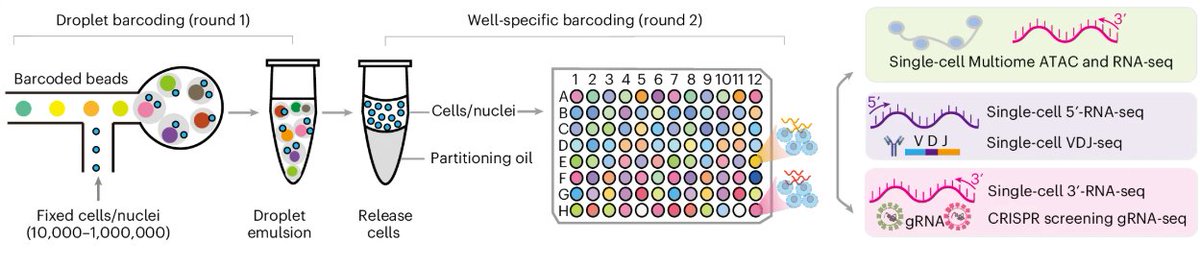
.Lan Jiang and colleagues developed droplet-based UDA-seq by incorporating a post-indexing step into two-round combinatorial indexing, enhancing throughput for large-scale single-cell analysis. nature.com/articles/s4159…

.<a href="/LanJiangBoston/">Lan Jiang</a> and colleagues developed droplet-based UDA-seq by incorporating a post-indexing step into two-round combinatorial indexing, enhancing throughput for large-scale single-cell analysis.

nature.com/articles/s4159…
Gerlich Lab (@gerlich_lab) 's Twitter Profile Photo

New #preprint from our lab at IMBA imbavienna.bsky.social ! How do DNA breaks locate homology sites in the vast space of the human genome? We show how #cohesin guides homology search for faithful repair! Read more 👉 tinyurl.com/DSBcohesin Follow along for key insights! 🧵1/12

Claudio Ballabio (@claballabio) 's Twitter Profile Photo

Did you know cancer cells can be electrically active, just like neurons? This electrical activity plays a key role in tumor progression. Excited to share my first postdoc paper at The Crick (and first paper from Leanne Li Lab), published in nature! nature.com/articles/s4158…

bioRxiv Genomics (@biorxiv_genomic) 's Twitter Profile Photo

Sequencing by Expansion (SBX) -- a novel, high-throughput single-molecule sequencing technology biorxiv.org/content/10.110… #biorxiv_genomic

Feng Zhang (@zhangf) 's Twitter Profile Photo

We are excited to report the discovery of TIGRs, a widely-occurring RNA-guided system found in bacteria and their viruses. TIGRs consist of a peculiar repeat region which is transcribed into RNA and processed into multiple guide RNAs to direct TIGR-associated proteins to their

Siyuan (Steven) Wang (@sstevenwang) 's Twitter Profile Photo

Introducing RAEFISH, our lab's new flagship image-based spatial transcriptomics technology that simultaneously enables single-molecule spatial resolution and whole-genome level coverage of long and short, endogenous and engineered RNA species in cell cultures and intact tissues.

Introducing RAEFISH, our lab's new flagship image-based spatial transcriptomics technology that simultaneously enables single-molecule spatial resolution and whole-genome level coverage of long and short, endogenous and engineered RNA species in cell cultures and intact tissues.
Björn Schumacher (@schumacherbj) 's Twitter Profile Photo

🔥🔥🔥OUR NEW PREPRINT: Slowing and reversing aging? Nature does it, here we show how! Age deceleration and reversal gene patterns in dauer diapause. Huge congrats to Kristy Totska, João Barata, Walter Sandt and David Meyer biorxiv.org/content/10.110…

Ben Kleinstiver (@bkleinstiver) 's Twitter Profile Photo

In @nature we describe the use of scalable #proteinengineering & #machinelearning to predict millions of bespoke CRISPR-Cas9 enzymes, offering safer & more genome editing tools. 🧬🖥️ Rachel Silverstein CGM at MGH @MGH_RI MassGeneral News Harvard Medical School nature.com/articles/s4158…
Honggui Wu (@wu_honggui) 's Twitter Profile Photo

Our scMicro-C paper is out in Nature Genetics! Huge thanks to the reviewers for their valuable insights, to SunneyXie for unwavering support, and to fantastic collaborators Jiankun Zhang & Longzhi Tan. Thrilled to share this work!
bioRxiv Genomics (@biorxiv_genomic) 's Twitter Profile Photo

Whole-genome single-cell multimodal history tracing to reveal cell identity transition biorxiv.org/content/10.110… #biorxiv_genomic

Leo Zang (@leotz03) 's Twitter Profile Photo

🤔 “Here we present evidence that eukaryotic circular RNAs (circRNAs) can serve as templates for 3' to 5' backward translation (BT), yielding polypeptides with distinct sequence and structural features not found in canonical proteomes.” biorxiv.org/content/10.648…