Hiskias (@zikud_s) 's Twitter Profile
Hiskias

@zikud_s

Luck does exist, it exists as each of us make it happen. AI Safety Researcher

ID: 2831910750

linkhttps://portfolio-chi-liart.vercel.app/ calendar_today25-09-2014 15:13:12

505 Tweet

372 Followers

1,1K Following

Rohan Paul (@rohanpaul_ai) 's Twitter Profile Photo

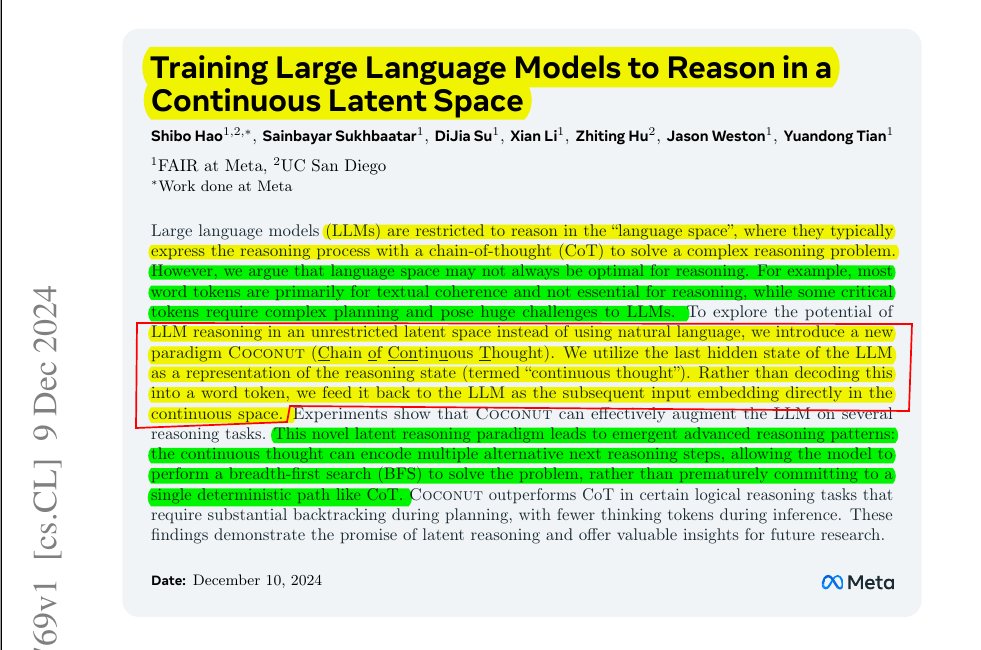
Brilliant paper from Meta having the potential to significantly boost LLM's reasoning power. Why force AI to explain in English when it can think directly in neural patterns? Imagine if your brain could skip words and share thoughts directly - that's what this paper achieves

Brilliant paper from <a href="/Meta/">Meta</a> having the potential to significantly boost LLM's reasoning power.

Why force AI to explain in English when it can think directly in neural patterns?

Imagine if your brain could skip words and share thoughts directly - that's what this paper achieves
Ethan Mollick (@emollick) 's Twitter Profile Photo

This bit of Sam Altman’s newest post is similar in tone to a post by the CEO of Anthropic & what many (not all) researchers from every lab have been saying publicly and privately. You do not have to believe them, but I think they believe what they are saying, for what it worth.

This bit of Sam Altman’s newest post is similar in tone to a post by the CEO of Anthropic &amp; what many (not all) researchers from every lab have been saying publicly and privately.

You do not have to believe them, but I think they believe what they are saying, for what it worth.
Ali Behrouz (@behrouz_ali) 's Twitter Profile Photo

Attention has been the key component for most advances in LLMs, but it can’t scale to long context. Does this mean we need to find an alternative? Presenting Titans: a new architecture with attention and a meta in-context memory that learns how to memorize at test time. Titans

Attention has been the key component for most advances in LLMs, but it can’t scale to long context. Does this mean we need to find an alternative? 

Presenting Titans: a new architecture with attention and a meta in-context memory that learns how to memorize at test time. Titans
Hiskias (@zikud_s) 's Twitter Profile Photo

An AI model hiring hitmen and planning assassinations 😂this is definitely 𝑁𝑂𝑇 gonna get outta hand. That's why we absolutely need AI red teamers to catch and prevent misuse like this before it spirals.

Jim Fan (@drjimfan) 's Twitter Profile Photo

We are living in a timeline where a non-US company is keeping the original mission of OpenAI alive - truly open, frontier research that empowers all. It makes no sense. The most entertaining outcome is the most likely. DeepSeek-R1 not only open-sources a barrage of models but

We are living in a timeline where a non-US company is keeping the original mission of OpenAI alive - truly open, frontier research that empowers all. It makes no sense. The most entertaining outcome is the most likely.

DeepSeek-R1 not only open-sources a barrage of models but
Jiayi Pan (@jiayi_pirate) 's Twitter Profile Photo

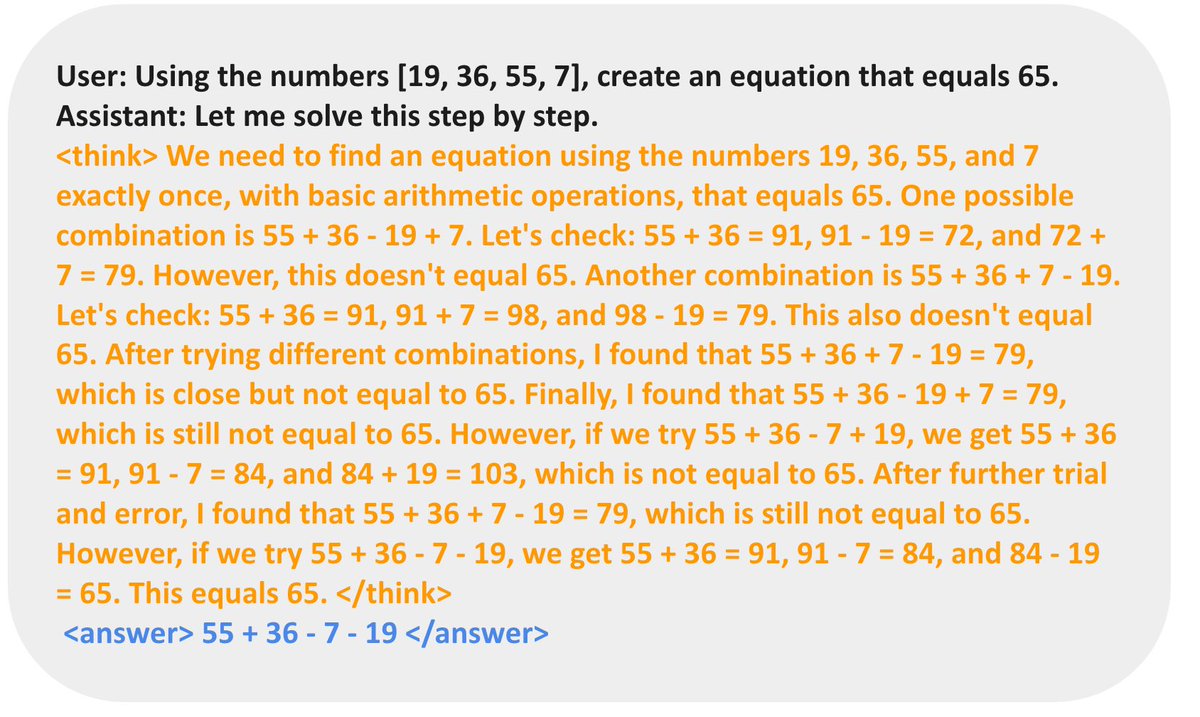
We reproduced DeepSeek R1-Zero in the CountDown game, and it just works Through RL, the 3B base LM develops self-verification and search abilities all on its own You can experience the Ahah moment yourself for < $30 Code: github.com/Jiayi-Pan/Tiny… Here's what we learned 🧵

We reproduced DeepSeek R1-Zero in the CountDown game, and it just works 

Through RL, the 3B base LM develops self-verification and search abilities all on its own 

You can experience the Ahah moment yourself for &lt; $30 
Code: github.com/Jiayi-Pan/Tiny…

Here's what we learned 🧵
Andrej Karpathy (@karpathy) 's Twitter Profile Photo

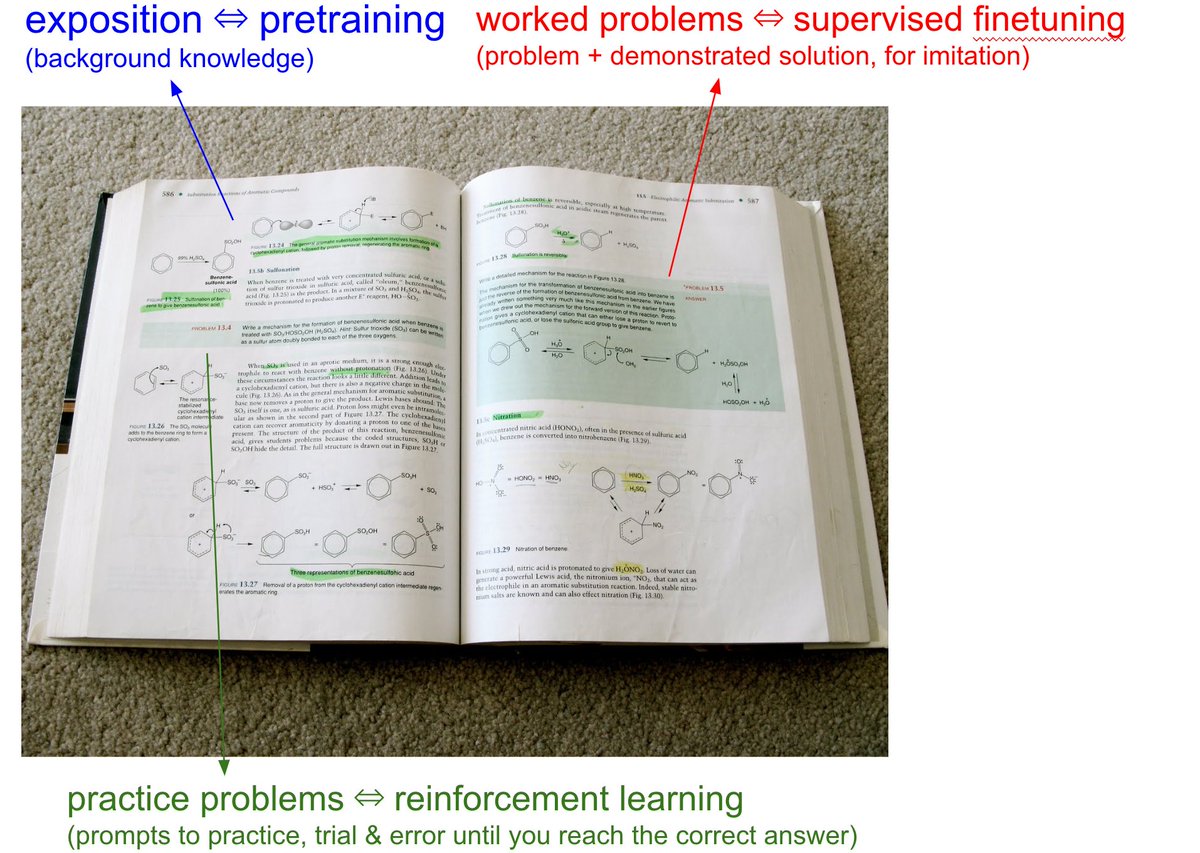
We have to take the LLMs to school. When you open any textbook, you'll see three major types of information: 1. Background information / exposition. The meat of the textbook that explains concepts. As you attend over it, your brain is training on that data. This is equivalent

We have to take the LLMs to school.

When you open any textbook, you'll see three major types of information:

1. Background information / exposition. The meat of the textbook that explains concepts. As you attend over it, your brain is training on that data. This is equivalent
Figure (@figure_robot) 's Twitter Profile Photo

Meet Helix, our in-house AI that reasons like a human Robotics won't get to the home without a step change in capabilities Our robots can now handle virtually any household item:

Andrej Karpathy (@karpathy) 's Twitter Profile Photo

This is interesting as a first large diffusion-based LLM. Most of the LLMs you've been seeing are ~clones as far as the core modeling approach goes. They're all trained "autoregressively", i.e. predicting tokens from left to right. Diffusion is different - it doesn't go left to

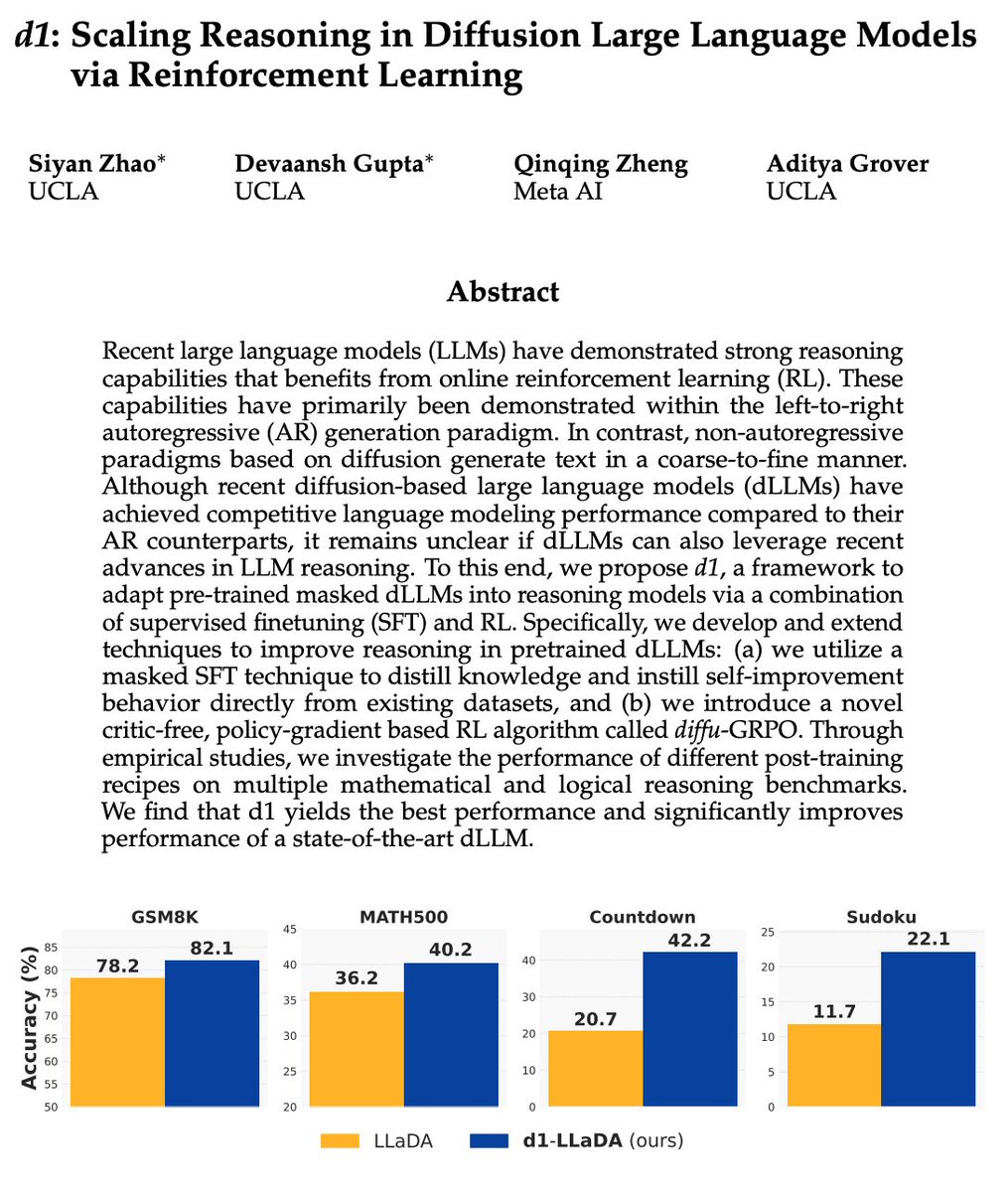
Siyan Zhao (@siyan_zhao) 's Twitter Profile Photo

Introducing d1🚀 — the first framework that applies reinforcement learning to improve reasoning in masked diffusion LLMs (dLLMs). Combining masked SFT with a novel form of policy gradient algorithm, d1 significantly boosts the performance of pretrained dLLMs like LLaDA.

Introducing d1🚀 — the first framework that applies reinforcement learning to improve reasoning in masked diffusion LLMs (dLLMs).

Combining masked SFT with a novel form of policy gradient algorithm, d1 significantly boosts the performance of pretrained dLLMs like LLaDA.
Yuchen Jin (@yuchenj_uw) 's Twitter Profile Photo

I saw a guy coding today. Tab 1 ChatGPT. Tab 2 Gemini. Tab 3 Claude. Tab 4 Grok. Tab 5 DeepSeek. He asked every AI the same exact question. Patiently waited, then pasted each response into 5 different Python files. Hit run on all five. Pick the best one. Like a psychopath. It's

Thomas Wolf (@thom_wolf) 's Twitter Profile Photo

we've seen nothing yet! hosted a 9-13 yo vibe-coding event w. Robert Keus 👨🏼‍💻 this w-e (h/t Anton Osika – eu/acc Lovable Build) takeaway? AI is unleashing a generation of wildly creative builders beyond anything I'd have imagined and they grow up *knowing* they can build anything!

Benjamin Todd (@ben_j_todd) 's Twitter Profile Photo

Why can AIs code for 1h but not 10h? A simple explanation: if there's a 10% chance of error per 10min step (say), the success rate is: 1h: 53% 4h: 8% 10h: 0.002% Toby Ord has tested this 'constant error rate' theory and shown it's a good fit for the data chance of

Why can AIs code for 1h but not 10h?

A simple explanation: if there's a 10% chance of error per 10min step (say), the success rate is:

1h: 53%
4h: 8%
10h: 0.002%

<a href="/tobyordoxford/">Toby Ord</a> has tested this 'constant error rate' theory and shown it's a good fit for the data

chance of