yishu (@yishusee) 's Twitter Profile
yishu

@yishusee

what the fuck is this place and why am I back

ID: 27190305

linkhttps://yishus.dev calendar_today28-03-2009 06:15:21

3,3K Tweet

334 Followers

434 Following

staysaasy (@staysaasy) 's Twitter Profile Photo

As a general rule, you should be simplifying things for people in the org chart above you and elaborating/elucidating things for people in the org chart below you. Your manager needs you to be super concise, and your reports need details and explanations. Tragically, this is

yishu (@yishusee) 's Twitter Profile Photo

Junior engineer interviewer: “Binary tree right side view” Staff engineer interviewer: “Given list of key value pairs, find the value of ‘mary’”

yishu (@yishusee) 's Twitter Profile Photo

Maybe skill issue but with agent aided coding, I’m spending more time refactoring. The model is very conservative in not generalising that I need to point out the abstractions every time

yishu (@yishusee) 's Twitter Profile Photo

Every time I see a bus I calculate how I can make reach a number that is divisible by 10 using the digits of the bus number

Josh Wardle (@powerlanguish) 's Twitter Profile Photo

I've released a new word game called Parseword, that tries to make cryptic crosswords more accessible. You can play it here: parseword.com

Cheng Lou (@_chenglou) 's Twitter Profile Photo

I’m very happy to present my toy research project: Sotaku! It's a neural net that automatically discovered the rules of sudoku and learned to solve them, achieving a new state-of-the-art score of 98.9% on one of the hardest sudoku datasets, while being agnostic to the game, and

I’m very happy to present my toy research project: Sotaku!

It's a neural net that automatically discovered the rules of sudoku and learned to solve them, achieving a new state-of-the-art score of 98.9% on one of the hardest sudoku datasets, while being agnostic to the game, and
NP (@np_hard) 's Twitter Profile Photo

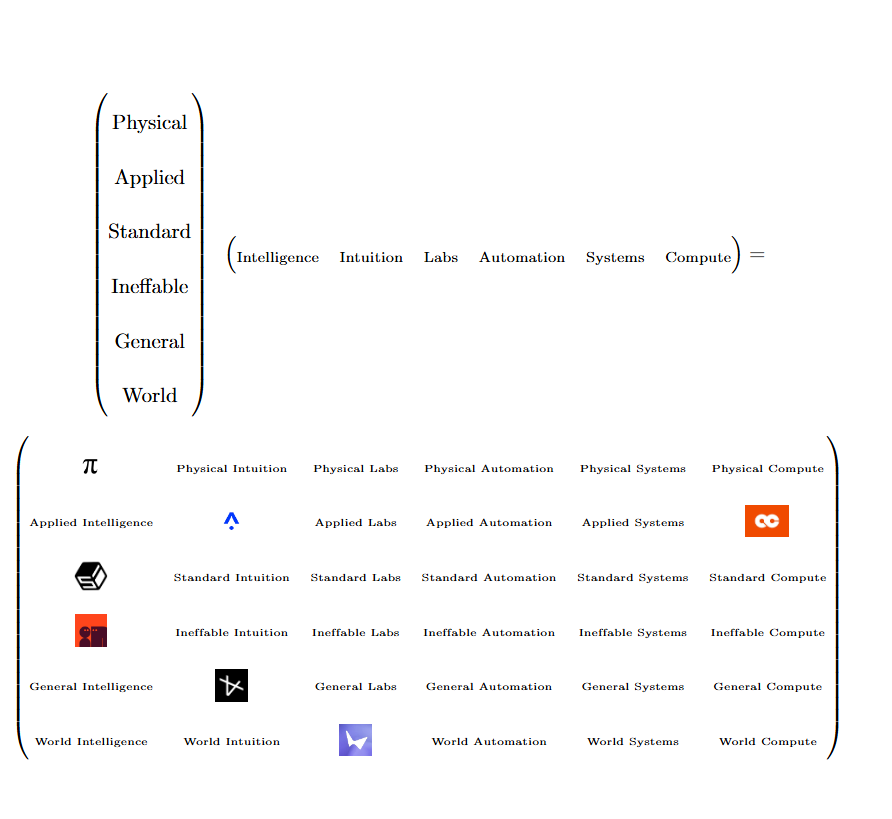
As part of Prime Intellect's RL residency program, I've been exploring how to do multi-agent RL using their current stack (from verifiers + prime-rl to lab experiments with hosted training /evals) and thinking about how it could be extended to support these abstractions natively.
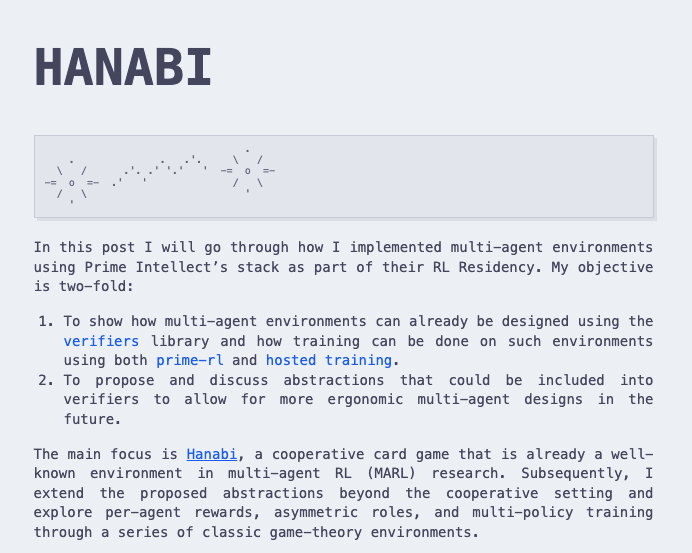

As part of <a href="/PrimeIntellect/">Prime Intellect</a>'s RL residency program, I've been exploring how to do multi-agent RL using their current stack (from verifiers + prime-rl to lab experiments with hosted training /evals) and thinking about how it could be extended to support these abstractions natively.

madoka magicock (@rifflexielian) 's Twitter Profile Photo

If people are fighting for an orb you are reading fantasy. If people are fighting for a cube you are reading sci-fi. If it has more sides than that. I dont know. I dont know man.

Cheng Lou (@_chenglou) 's Twitter Profile Photo

My dear front-end developers (and anyone who’s interested in the future of interfaces): I have crawled through depths of hell to bring you, for the foreseeable years, one of the more important foundational pieces of UI engineering (if not in implementation then certainly at

yishu (@yishusee) 's Twitter Profile Photo

Been recommending Stanford CS336 to friends, it being incredibly beginner friendly and the focus on squeezing out the most from your hardware

Bojie Li (@bojie_li) 's Twitter Profile Photo

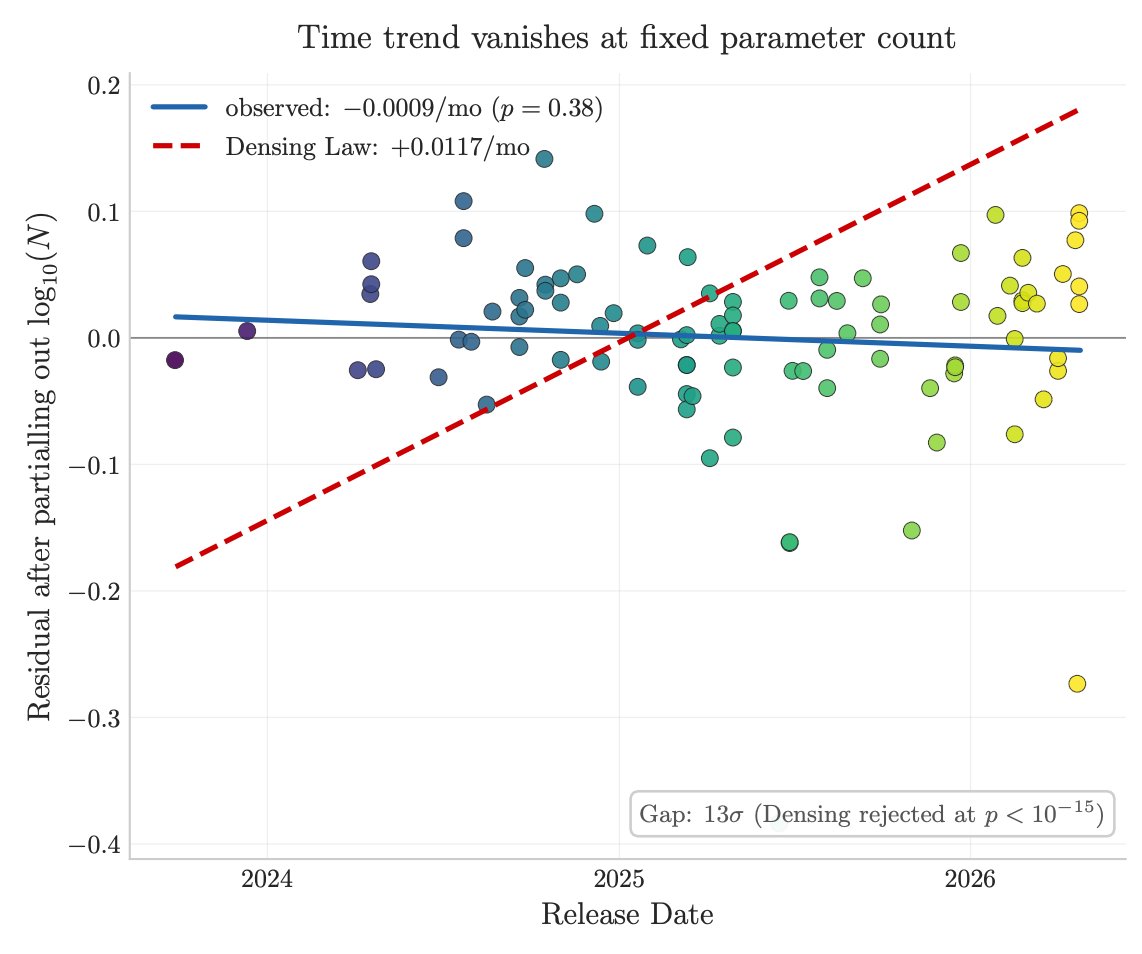
Closed labs hide model sizes. They can't hide what their models know, and what a model knows is an indicator on how big it is. Reasoning compresses. Factual knowledge doesn't. So you can size a frontier model from black-box API calls alone, and across releases you can literally

Closed labs hide model sizes. They can't hide what their models know, and what a model knows is an indicator on how big it is.

Reasoning compresses. Factual knowledge doesn't. So you can size a frontier model from black-box API calls alone, and across releases you can literally