MrTelecoms (@titilopebanjoko) 's Twitter Profile
MrTelecoms

@titilopebanjoko

10+ years experience in telecommunications ☎️ | Software Engineering 👨🏿‍💻 | Business 🧳

ID: 911283762633363456

linkhttp://www.linkedin.com/in/titilopebanjoko calendar_today22-09-2017 17:39:14

1,1K Tweet

75 Takipçi

313 Takip Edilen

MrTelecoms (@titilopebanjoko) 's Twitter Profile Photo

Telecom is not saturated — it is under-skilled. What looks like “too much competition” is actually a shortage of real competence. There are many people with titles, but very few with the depth of understanding required to design, optimize, secure, and scale modern networks. The

MrTelecoms (@titilopebanjoko) 's Twitter Profile Photo

High VSWR (Voltage Standing Wave Ratio) means that a significant portion of the transmitted RF power is not being properly radiated by the antenna but is instead reflected back toward the transmitter. When this happens, three key problems arise: 1.Reflected Power Increases

MrTelecoms (@titilopebanjoko) 's Twitter Profile Photo

A few weeks ago, we officially kicked off our mentorship class on Radio Access Network (RAN) Management — a structured 12-week program carefully designed to equip participants with practical, industry-relevant skills and prepare them for the TCNA certification. Now in week

MrTelecoms (@titilopebanjoko) 's Twitter Profile Photo

Week 1 of our RAN Mentorship (TCNA Track) focused on building a strong foundation for our participants. We began with a comprehensive overview of the telecommunications environment, helping mentees understand how the entire ecosystem functions and how different teams work

MrTelecoms (@titilopebanjoko) 's Twitter Profile Photo

Week 2 of our mentorship program took us deeper into the building blocks of live telecom networks. We went beyond theory to clearly understand critical BTS components such as antennas, jumpers, RRUs, BBUs, CPRI cables, SFP modules, microwave antennas, and waveguides. More

MrTelecoms (@titilopebanjoko) 's Twitter Profile Photo

When I’m not writing code, I intentionally devote my weekends and spare time to delivering structured instruction on the fundamentals of Radio Access Networks (RAN). My sessions go beyond theory, covering practical concepts such as network architecture, RF planning, site design,

When I’m not writing code, I intentionally devote my weekends and spare time to delivering structured instruction on the fundamentals of Radio Access Networks (RAN). My sessions go beyond theory, covering practical concepts such as network architecture, RF planning, site design,
MrTelecoms (@titilopebanjoko) 's Twitter Profile Photo

Telecom is not just about masts, antennas, and fiber cables. It is the invisible infrastructure powering banking, education, healthcare, security, and the digital economy. At Tilicom, we train engineers to understand this bigger picture — not just pass exams.

MrTelecoms (@titilopebanjoko) 's Twitter Profile Photo

Our TCNA-focused mentorship is structured around real industry knowledge: RAN fundamentals, BTS architecture, RF concepts, transmission, KPIs, and troubleshooting. This is practical learning designed for real telecom environments, not classroom theory.

MrTelecoms (@titilopebanjoko) 's Twitter Profile Photo

One of the biggest gaps I see in the industry is this: many engineers can name equipment, but few truly understand how they work together inside a live network. Our training focuses on building that deep understanding.

MrTelecoms (@titilopebanjoko) 's Twitter Profile Photo

There’s nothing more rewarding than seeing my students connect the lessons I teach to the psychology that drives real-world telecommunications decisions. When they start to recognize how human behavior affects network performance, customer experience, operational strategy, and

MrTelecoms (@titilopebanjoko) 's Twitter Profile Photo

Most people don’t fail because they lack talent. They fail because they lack discipline. Showing up daily beats raw intelligence. Small habits compound into massive results. What has mattered more in your journey, talent or discipline?

MrTelecoms (@titilopebanjoko) 's Twitter Profile Photo

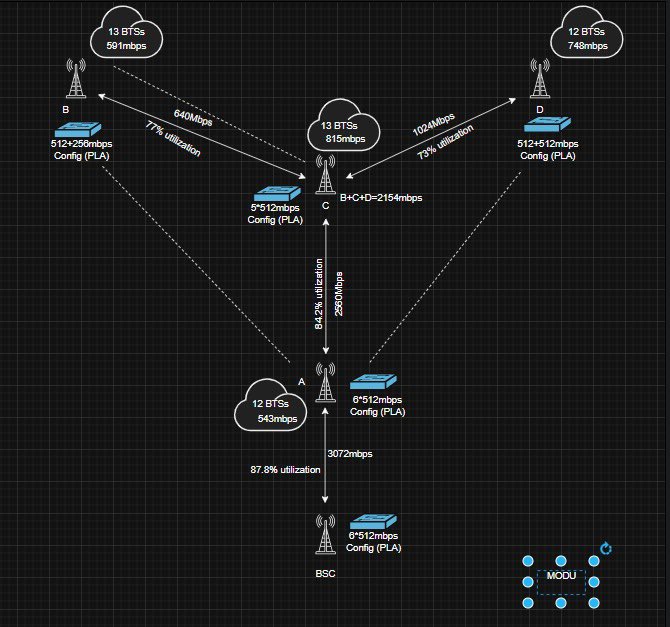
This morning’s mentorship session was truly impactful. We went beyond textbook definitions and explored telecommunications topology the way it exists in the real world — how architecture decisions affect latency, resilience, outages, scalability, and overall network performance.

MrTelecoms (@titilopebanjoko) 's Twitter Profile Photo

Challenge one in our mentorship class. Each student has been assigned a logical cluster of 50 BTS sites already grouped under four aggregation hubs (Hub A, Hub B, Hub C, and Hub D), with Hub A serving as the only hub connected directly to the BSC. For each BTS, the carried

MrTelecoms (@titilopebanjoko) 's Twitter Profile Photo

Designing a clean logical network topology in telecommunications industry is one of the greatest assets I have admired over the years.

MrTelecoms (@titilopebanjoko) 's Twitter Profile Photo

Just wrapped up an advanced mentorship session on telecom topology optimization. We explored how to engineer high-performance networks by balancing congestion management, Line-of-Sight (LOS) constraints, inter-site proximity, traffic distribution, capacity planning, and resilient

Just wrapped up an advanced mentorship session on telecom topology optimization. We explored how to engineer high-performance networks by balancing congestion management, Line-of-Sight (LOS) constraints, inter-site proximity, traffic distribution, capacity planning, and resilient
MrTelecoms (@titilopebanjoko) 's Twitter Profile Photo

Most telecom training teaches commands. We teach architecture. At Tilicom, students solve real transmission planning and network topology challenges — with calculations, redundancy design, and failure scenarios, just like in operator environments. If this excites you, you’re

MrTelecoms (@titilopebanjoko) 's Twitter Profile Photo

Most telecom training stops at how to configure. At Tilicom, we go further — we teach why networks are designed the way they are. Our students work on real transmission planning and topology challenges involving traffic aggregation, capacity dimensioning, redundancy paths, and

MrTelecoms (@titilopebanjoko) 's Twitter Profile Photo

The greatest skill in RAN telecommunications engineering is the ability to design an optimized network and implement it. We are now set to start training our students on how to configure a Huawei IDU. A skill so scare to acquire. This will contribute towards achieving their

The greatest skill in RAN telecommunications engineering is the ability to design an optimized network and implement it. We are now set to start training our students on how to configure a Huawei IDU. A skill so scare to acquire. This will contribute towards achieving their