Pablo Gutiérrez Cubillos (@pgutiecu) 's Twitter Profile
Pablo Gutiérrez Cubillos

@pgutiecu

Assistant professor, DCS, @fenuchile.
Nerding out about taxes, econometrics, economic inequality, and decision theory.
Fist gen grad. @ubcvse alumi.

ID: 1279215553215893504

linkhttp://pgutiecu.github.io calendar_today04-07-2020 00:48:58

381 Tweet

317 Followers

406 Following

Gabriel Zucman (@gabriel_zucman) 's Twitter Profile Photo

The Paris School of Economics Stone center on Global Wealth Dynamics is offering fully-funded PhD fellowships for students working on inequality. Deadline May 4. Details and applications here 👇👇👇 stone-center-pse.eu/grants/phd-fel…

Claudio Ferraz (@claudferraz) 's Twitter Profile Photo

The call for papers for the 2025 LACEA conference is out. The conference will be in Recife, Brazil, Nov 20-22 lacea2025.org. Please submit your paper before May 30th Vox.LACEA UFPE PIMES - Pós Graduação em Economia UFPE

The call for papers for the 2025 LACEA conference is out. The conference will be in Recife, Brazil, Nov 20-22 lacea2025.org. Please submit your paper before May 30th <a href="/voxlacea/">Vox.LACEA</a> <a href="/ufpeoficial/">UFPE</a> <a href="/pimes_em/">PIMES - Pós Graduação em Economia UFPE</a>
Ignacio Flores (@_ignacio_flores) 's Twitter Profile Photo

Check out our new paper. We explore how housing booms and pension withdrawals reshaped wealth inequality from 2007-2021 in Chile. A story of macroeconomic shifts and extreme inequality.

Check out our new paper. We explore how housing booms and pension withdrawals reshaped wealth inequality from 2007-2021 in Chile. A story of macroeconomic shifts and extreme inequality.
Ercio (@ercio) 's Twitter Profile Photo

Happy to share that my paper "Intergenerational Educational Mobility within Chile" has been accepted at Estudios de Economía Revista Estudios de Economia 🤗 Working paper here: dx.doi.org/10.18235/00135…

Bia (@beatrizgietner) 's Twitter Profile Photo

I am working on a guide to all possible scenarios that someone who wants to implement DiD might face, like "what estimator should I use?". Questions to ask include: timing of treatment, nature of a) treatment effect & b) treatment variable, data structure, assumptions/violations

I am working on a guide to all possible scenarios that someone who wants to implement DiD might face, like "what estimator should I use?". Questions to ask include: timing of treatment, nature of a) treatment effect &amp; b) treatment variable, data structure, assumptions/violations
Bård Harstad (@bardharstad) 's Twitter Profile Photo

Last month, I stepped down as an editor after 6.5 years (4 REStud; 2.5 JEEA). I have gathered a few suggestions that can help you avoid unnecessary negative referee reports.

Last month, I stepped down as an editor after 6.5 years (4 REStud; 2.5 JEEA). 
I have gathered a few suggestions that can help you avoid unnecessary negative referee reports.
John B. Holbein (@johnholbein1) 's Twitter Profile Photo

I read *a lot* of scientific abstracts that are missing key elements. Here are the 5 things an abstract needs: 1. Introduce the topic, 2. State the unknown, 3. Outline the method used to answer the question, 4. Preview the findings, and 5. Tell us what your work teaches us.

I read *a lot* of scientific abstracts that are missing key elements.

Here are the 5 things an abstract needs:

1. Introduce the topic, 
2. State the unknown, 
3. Outline the method used to answer the question, 
4. Preview the findings, and 
5. Tell us what your work teaches us.
John B. Holbein (@johnholbein1) 's Twitter Profile Photo

This (recently updated) free textbook on difference-in-differences looks amazing! It comes with practitioner checklists and practice data + code. A teaching/research goldmine! by Clément de Chaisemartin and Xavier D'Haultfoeuille.

This (recently updated) free textbook on difference-in-differences looks amazing!

It comes with practitioner checklists and practice data + code. 

A teaching/research goldmine!

by <a href="/CdeChaisemartin/">Clément de Chaisemartin</a> and Xavier D'Haultfoeuille.
Vinícius Peçanha (@viniciuspecanha) 's Twitter Profile Photo

esse foi o artigo que tinha mencionado há um tempo atrás. Nele avaliamos o piloto do programa "Conjunto de Estratégias de Prevenção", política de prevenção a crimes de rua que implementamos em um hotspot no Méier.

esse foi o artigo que tinha mencionado há um tempo atrás. Nele avaliamos o piloto do programa "Conjunto de Estratégias de Prevenção", política de prevenção a crimes de rua que implementamos em um  hotspot no Méier.
Rohit Lamba (@rohlamba) 's Twitter Profile Photo

1/ Week 28: Theory paper in focus this week is the seminal article by Anthony Atkinson and Joseph E. Stiglitz that is now famously referred to as the "zero commodity/capital taxation" benchmark in public economics. It has led to much technical & policy debates. Let's find out.

1/ Week 28: Theory paper in focus this week is the seminal article by Anthony Atkinson and <a href="/JosephEStiglitz/">Joseph E. Stiglitz</a>  that is now famously referred to as  the "zero commodity/capital taxation" benchmark in public economics. It has led to much technical &amp; policy debates. Let's find out.
AEA Journals (@aeajournals) 's Twitter Profile Photo

Forthcoming in the AER: "Managers and Public Hospital Performance" by Pablo Muñoz and Cristóbal Otero. aeaweb.org/articles?id=10…

Antonio Mele (@antoniomele101) 's Twitter Profile Photo

If you haven't read "AI Agents for Economic Research" by Anton Korinek , you should drop everything and do it right now. Get up to date or get left behind. Link in the next post.


If you haven't read "AI Agents for Economic Research" by <a href="/akorinek/">Anton Korinek</a> , you should drop everything and do it right now. Get up to date or get left behind. Link in the next post.
Philipp Heimberger (@heimbergecon) 's Twitter Profile Photo

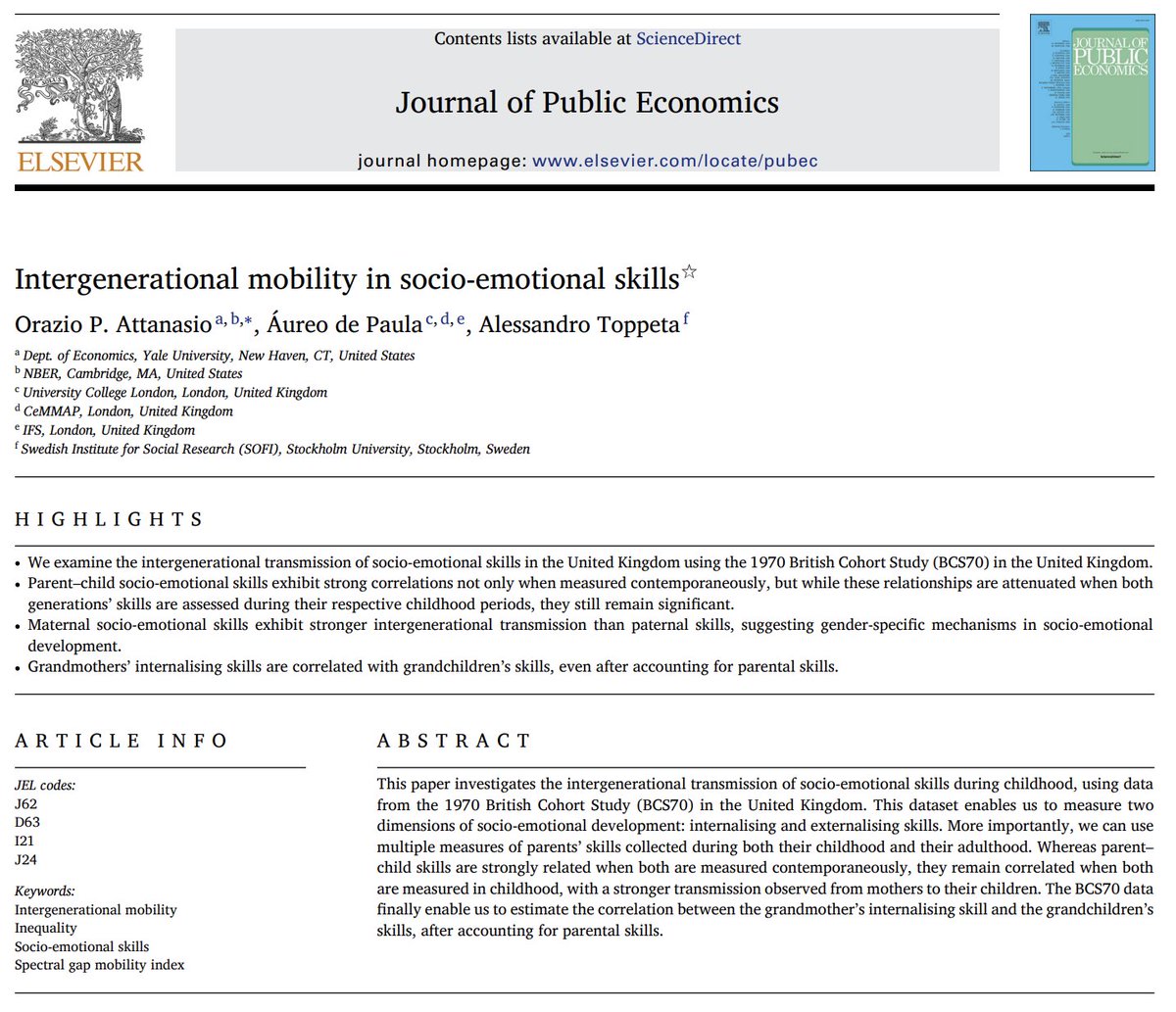
This new study shows: in Germany, it has become much harder for children to earn more than their parents, now about as hard as in the US: "parental income has become much more important for educational outcomes of children"

This new study shows: in Germany, it has become much harder for children to earn more than their parents, now about as hard as in the US: "parental income has become much more important for educational outcomes of children"
NBER (@nberpubs) 's Twitter Profile Photo

Using longitudinal administrative data covering all North Carolina public school students to document five facts about first-generation academic excellence gaps, from Uditi Karna, @econ_4_everyone, Andrew Simon, and Haruka Uchida nber.org/papers/w34228


Using longitudinal administrative data covering all North Carolina public school students to document five facts about first-generation academic excellence gaps, from Uditi Karna, @econ_4_everyone, <a href="/andrewrsimon/">Andrew Simon</a>, and <a href="/haruka__uchida/">Haruka Uchida</a> nber.org/papers/w34228
Damián Vergara (@dvergarad) 's Twitter Profile Photo

Dada la discusión sobre el salario mínimo que se ha dado las últimas semanas, con Pablo Muñoz Henríquez escribimos este ensayo: ciperchile.cl/2025/09/20/que… Resumen: el debate es harto más complejo de lo que se plantea. Reducir la discusión al efecto empleo no permite un análisis riguroso.