Paul Bousquet (@paulbsqt) 's Twitter Profile
Paul Bousquet

@paulbsqt

Econ PhD @UVA | mostly retweeting interesting macro research

ID: 1653059787486113792

linkhttp://pbousquet.com calendar_today01-05-2023 15:32:28

290 Tweet

58 Takipรงi

115 Takip Edilen

Tim Willems (@timwillems85) 's Twitter Profile Photo

New paper with Paul Beaudry (UBC Economics) and Paolo Cavallino (Bank for International Settlements). In it, we argue that monetary policy may be driving secular trends in real interest rates because very persistent rate changes have only weak effects on activity [1/7]

New paper with Paul Beaudry (<a href="/ubcVSE/">UBC Economics</a>) and Paolo Cavallino (<a href="/BIS_org/">Bank for International Settlements</a>). In it, we argue that monetary policy may be driving secular trends in real interest rates because very persistent rate changes have only weak effects on activity [1/7]
Francesco Furlanetto ๐Ÿ‡บ๐Ÿ‡ฆ (@francescofurla8) 's Twitter Profile Photo

๐ŸŽขThe roller coaster paper is conditionally accepted at the American Economic Journal: Macroeconomics. Our point: the inflation surge is mainly demand-driven and check carefully the deterministic component of your SVAR Drago Bergholt Nicolรฒ Maffei-Faccioli Pรฅl Bergset Ulvedal and ๐Ÿ‘‘Fabio Canova๐ŸŽข

Pablo A. Guerron (It's all about uncertainty) (@pablo_guerron) 's Twitter Profile Photo

A non-technical explanation of the difference between Risk and Uncertainty philadelphiafed.org/-/media/frbp/aโ€ฆ And this is a survey (technical) on the impact of uncertainty on the macroeconomy nber.org/papers/w26768 Visit my website for lectures on uncertainty sites.google.com/site/pabloagueโ€ฆ

Felix Geiger (@flx_geiger) 's Twitter Profile Photo

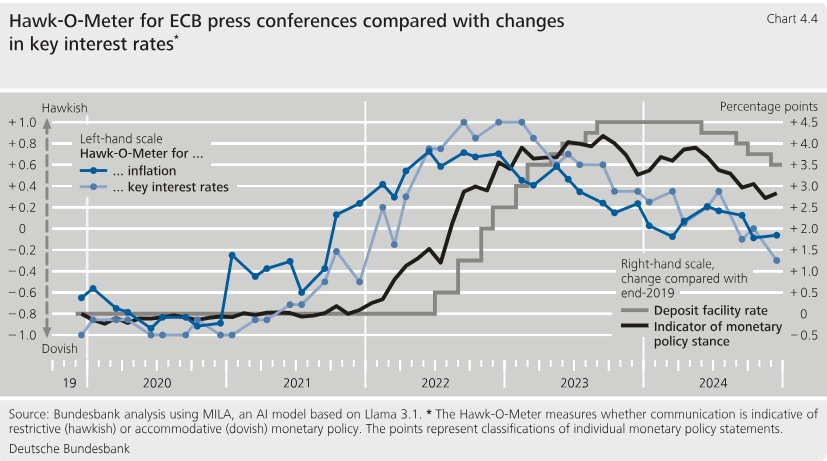
We have developed ๐— ๐—œ๐—Ÿ๐—” (๐— ๐—ผ๐—ป๐—ฒ๐˜๐—ฎ๐—ฟ๐˜†-๐—œ๐—ป๐˜๐—ฒ๐—น๐—น๐—ถ๐—ด๐—ฒ๐—ป๐˜ ๐—Ÿ๐—ฎ๐—ป๐—ด๐˜‚๐—ฎ๐—ด๐—ฒ ๐—”๐—ด๐—ฒ๐—ป๐˜) - an AI tool designed to evaluate ECB communication, assessing individual sentences from monetary policy statements and speeches given both in-document and the macro context. \1

We have developed ๐— ๐—œ๐—Ÿ๐—” (๐— ๐—ผ๐—ป๐—ฒ๐˜๐—ฎ๐—ฟ๐˜†-๐—œ๐—ป๐˜๐—ฒ๐—น๐—น๐—ถ๐—ด๐—ฒ๐—ป๐˜ ๐—Ÿ๐—ฎ๐—ป๐—ด๐˜‚๐—ฎ๐—ด๐—ฒ ๐—”๐—ด๐—ฒ๐—ป๐˜) - an AI tool designed to evaluate ECB communication, assessing individual sentences from monetary policy statements and speeches given both in-document and the macro context. \1
FedResearch (@fedresearch) 's Twitter Profile Photo

Do households actually adjust their consumption in response to interest rate changes? Using 10 macro shocks, this #FEDSPaper finds no evidence that households substitute intertemporally. Instead, income expectations explain almost all consumption responses federalreserve.gov/econres/feds/dโ€ฆ

International and Monetary Economics Network (@int_mon_econ) 's Twitter Profile Photo

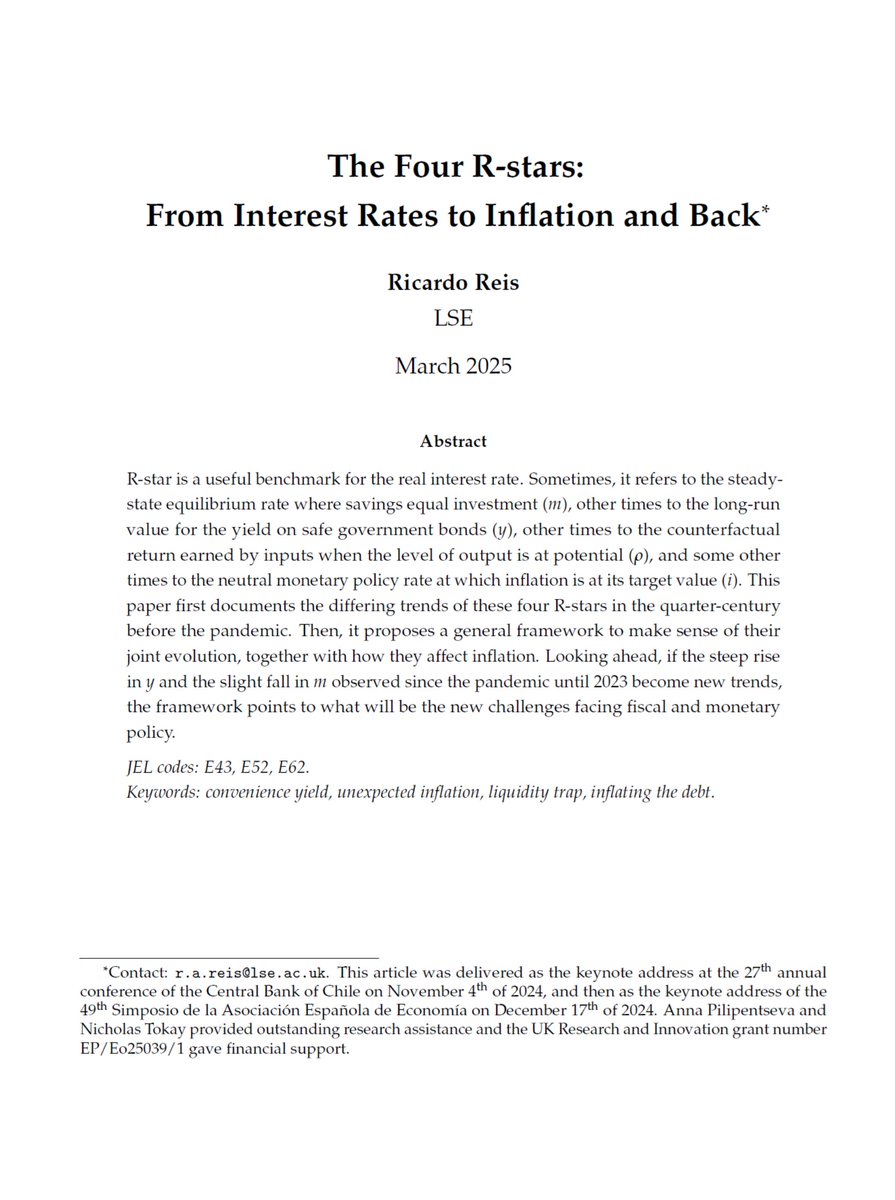
Very insightful! "The Four R-stars: From Interest Rates to Inflation and Back" by Ricardo Reis "R-star is a useful benchmark for the real interest rate. Sometimes, it refers to the steady-state equilibrium rate where savings equal investment (m), other times to the long-run

Very insightful!

"The Four R-stars: From Interest Rates to Inflation and Back" by Ricardo Reis

"R-star is a useful benchmark for the real interest rate. Sometimes, it refers to the steady-state equilibrium rate where savings equal investment (m), other times to the long-run
Niklas Kroner (@kronerniklas) 's Twitter Profile Photo

I am very happy that this project finally came out as a FedResearch working paper. In the following, I provide a summary of the paper which might be of interest to you if you work on anything related to asset pricing and macroeconomics. Paper: federalreserve.gov/econres/feds/hโ€ฆ 1/16

I am very happy that this project finally came out as a <a href="/FedResearch/">FedResearch</a> working paper. In the following, I provide a summary of the paper which might be of interest to you if you work on anything related to asset pricing and macroeconomics.
Paper: federalreserve.gov/econres/feds/hโ€ฆ
1/16
Basil Halperin (@basilhalperin) 's Twitter Profile Photo

Introducing the Stripe Economics of AI Fellowship: The economics of AI remains surprisingly understudied. The fellowship aims to help fill that gap, by supporting grad students and early-career researchers with $, data, a conference, and community โ€“

Introducing the Stripe Economics of AI Fellowship:

The economics of AI remains surprisingly understudied. The fellowship aims to help fill that gap, by supporting grad students and early-career researchers with $, data, a conference, and community โ€“
Jesรบs Fernรกndez-Villaverde (@jesusferna7026) 's Twitter Profile Photo

Deep learning (DL) is proving remarkably effective at solving dynamic models in economics: ๐Ÿ“„ nber.org/papers/w33117 Curiously, DL often yields stable solutions without explicitly imposing boundary conditions (e.g., transversality). Why does this work? A short thread ๐Ÿงต๐Ÿ‘‡ 1/7

Simon Scheidegger (@comp_simon) 's Twitter Profile Photo

๐ŸšจPaper๐Ÿšจ "Scalable Global Solution Techniques for High-Dimensional Models in Dynare" (papers.ssrn.com/sol3/papers.cfโ€ฆ), code: https://nvls. co/Dynare/GlobalMethods/SparseGrids (@HECLausanneEconwith N. Rion DynareTeam Michel Juillard Banque de France Aryan Eftekhari)

๐ŸšจPaper๐Ÿšจ
"Scalable Global Solution Techniques for High-Dimensional Models in Dynare" (papers.ssrn.com/sol3/papers.cfโ€ฆ), code: https://nvls. co/Dynare/GlobalMethods/SparseGrids (@HECLausanneEconwith N. Rion <a href="/DynareTeam/">DynareTeam</a> Michel Juillard <a href="/banquedefrance/">Banque de France</a> <a href="/AryanEftekhari/">Aryan Eftekhari</a>)
Luca Fornaro (@lucafornaro3) 's Twitter Profile Photo

Olivier Blanchard argues that we should understand better the macroeconomics of the medium run, and I could not agree more. Since I have been working on this for a while, let me show you why this is a promising field for young researchers!


<a href="/ojblanchard1/">Olivier Blanchard</a> argues that we should understand better the macroeconomics of the medium run, and I could not agree more. Since I have been working on this for a while, let me show you why this is a promising field for young researchers!
Christian Matthes (@cmatthes_econ) 's Twitter Profile Photo

A great point by Tom. These estimates, by themselves, do not take into account GE effects. Iโ€™d be remiss, however, if I didnโ€™t mention some recent work of mine with Naoya Nagasaka and Felipe Schwartzman that shows how these results can be leveraged
Joseph Wang (@fedguy12) 's Twitter Profile Photo

SOFR actually printed above IOR yesterday and it wasn't a period-end date. Looks like there really was some funding pressure building up. ht Amit Noam Tal

SOFR actually printed above IOR yesterday and it wasn't a period-end date. Looks like there really was some funding pressure building up.

ht <a href="/amital13/">Amit Noam Tal</a>
Niklas Kroner (@kronerniklas) 's Twitter Profile Photo

Iโ€™m thrilled to share that our paper will finally be published in ๐“๐ก๐ž ๐‘๐ž๐ฏ๐ข๐ž๐ฐ ๐จ๐Ÿ ๐„๐œ๐จ๐ง๐จ๐ฆ๐ข๐œ ๐’๐ญ๐ฎ๐๐ข๐ž๐ฌ! Huge thanks to editor Kurt MIT-shock-man and the three anonymous referees for giving us a chance and helping us improve the paper along the way. Thread๐Ÿ‘‡ 1/17

Saki Bigio (@sakibigio) 's Twitter Profile Photo

The increase in uncertainty and asset volatility can propagate to the real economy, amplifying the direct effects of policies on productivity. "Heterogeneous Beliefs, Asset Prices, and Business Cycles" with Dejanir Silva & Eduardo Zilberman, may be useful to understand how. ๐Ÿงต Thread ๐Ÿ‘‡

Paul Bousquet (@paulbsqt) 's Twitter Profile Photo

Great way to frame an important friction to diffusion. At the same time, I'd bet before too long models we currently consider to be quite good will be very cheap, which means you can have a small army of AI agents checking details that'll be on par with a single, careful human

Itamar Caspi (@itamarcaspi) 's Twitter Profile Photo

Joe Weisenthal According to Jarocinski and Karadi, when that hypothetical 50ย bp surprise cut (MP shock) hits the tape, your first question should be: Is the S&P flying or tanking? That tells you how much of the move in the long bond will stick once the dust settles.
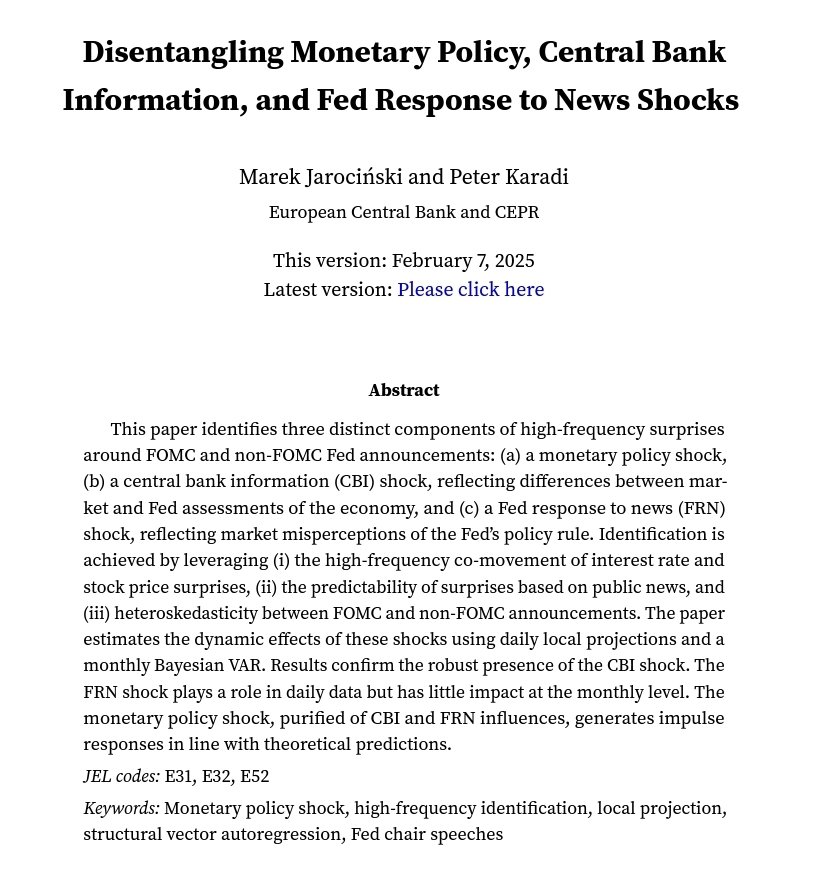
<a href="/TheStalwart/">Joe Weisenthal</a> According to Jarocinski and Karadi, when that hypothetical 50ย bp surprise cut (MP shock) hits the tape, your first question should be: Is the S&amp;P flying or tanking? That tells you how much of the move in the long bond will stick once the dust settles.