Minae Kwon (@minaekwon) 's Twitter Profile
Minae Kwon

@minaekwon

Working @AnthropicAI | PhD @StanfordAILab

ID: 1075589434031001600

calendar_today20-12-2018 03:11:19

114 Tweet

829 Followers

530 Following

Chris Cundy (@chriscundy) 's Twitter Profile Photo

Introducing *SequenceMatch*, training LLMs with an imitation learning loss Avoids compounding error in generation by: 1. Training against *different divergences* like χ^2 with more support OOD 2. Adding a *backspace* action: model can correct errors! arxiv.org/abs/2306.05426 1/7

Tri Dao (@tri_dao) 's Twitter Profile Photo

Announcing FlashAttention-2! We released FlashAttention a year ago, making attn 2-4 faster and is now widely used in most LLM libraries. Recently I’ve been working on the next version: 2x faster than v1, 5-9x vs standard attn, reaching 225 TFLOPs/s training speed on A100. 1/

Announcing FlashAttention-2! We released FlashAttention a year ago, making attn 2-4 faster and is now widely used in most LLM libraries. Recently I’ve been working on the next version: 2x faster than v1, 5-9x vs standard attn, reaching 225 TFLOPs/s training speed on A100. 1/
Yuchen Cui (@yuchencui1) 's Twitter Profile Photo

We use gestures all the time for specifying targets! How can robots make sense of “gimme that one”? We propose GIRAF, a framework for interpreting human gesture instructions using LLMs. Paper to appear in Conference on Robot Learning: arxiv.org/abs/2309.02721 Website: tinyurl.com/giraf23

Priya Sundaresan (@priyasun_) 's Twitter Profile Photo

Hungry? Let our robot twirl your spaghetti for you! 🍝🤖 Introducing VAPORS: Visual Action Planning OveR Sequences, a framework for long-horizon food acquisition. Project Page: sites.google.com/view/vaporsbot Paper: arxiv.org/abs/2309.05197 To appear at Conference on Robot Learning 1/11🧵

Sang Michael Xie (@sangmichaelxie) 's Twitter Profile Photo

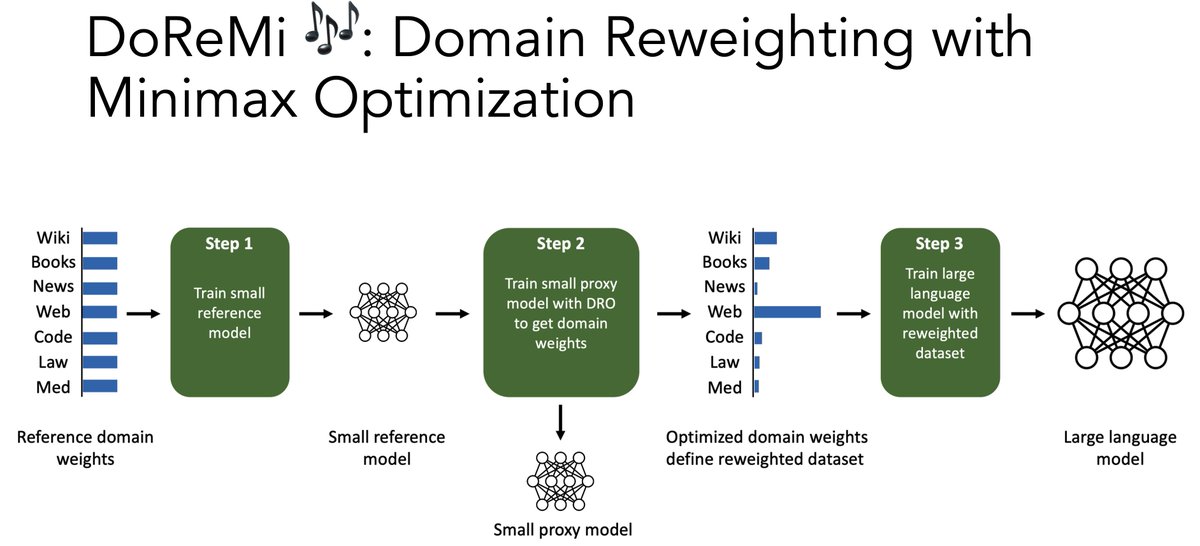
Releasing an open-source PyTorch implementation of DoReMi! github.com/sangmichaelxie… The pretraining data mixture is a secret sauce of LLM training. Optimizing your data mixture for robust learning with DoReMi can reduce training time by 2-3x. Train smarter, not longer!

Releasing an open-source PyTorch implementation of DoReMi! github.com/sangmichaelxie…

The pretraining data mixture is a secret sauce of LLM training. Optimizing your data mixture for robust learning with DoReMi can reduce training time by 2-3x. Train smarter, not longer!
shreya rajpal (@shreyar) 's Twitter Profile Photo

It's an absolute honor to be a guest on the The TWIML AI Podcast podcast! Sam Charrington and I cover everything under the sun in LLMOps, from hallucinations, RAG to LLM safety. Check out the podcast on the link below!


Foundation Models, LLMs, and Game Theory Workshop (@fm_llms_gt) 's Twitter Profile Photo

We are excited to announce the first workshop on Foundation Models, Large Language Models (LLMs), and Game Theory! The workshop will take place at the Center for Discrete Mathematics and Theoretical Computer Science (DIMACS) on October 19-20, 2023. dimacs.rutgers.edu/events/details…

Foundation Models, LLMs, and Game Theory Workshop (@fm_llms_gt) 's Twitter Profile Photo

We also call on researchers with ongoing research to submit posters to our workshop. The workshop will provide financial support to a limited number of researchers. Applications for financial support will remain open until September 23, 2023. docs.google.com/forms/d/e/1FAI…

Andy Shih (@andyshih_) 's Twitter Profile Photo

Excited about recent improvements of our NeurIPS Spotlight paper, now even faster with ⚡️⚡️multiprocessing⚡️⚡️! We now get 2x speedup on as low as 50-step DDIM, and 4x speedup on 200-step DDIM! The first version of our paper showed good results, but we wanted even better. -

Alex Tamkin (@alextamkin) 's Twitter Profile Photo

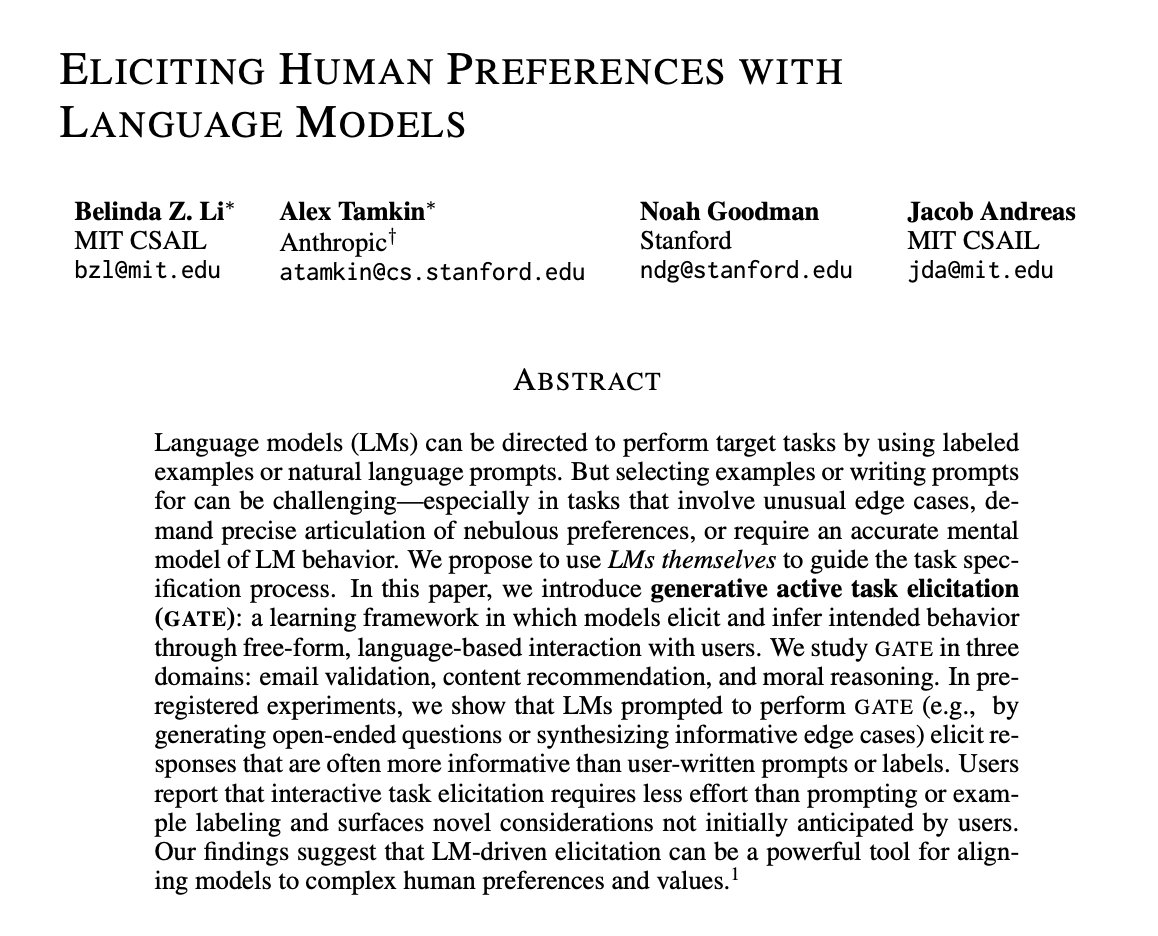
Eliciting Human Preferences with Language Models Currently, people write detailed prompts to describe what they want a language model to do We explore *generative elicitation*—where models interactively ask for this information through open-ended conversation 1/

Eliciting Human Preferences with Language Models

Currently, people write detailed prompts to describe what they want a language model to do

We explore *generative elicitation*—where models interactively ask for this information through open-ended conversation 

1/
Hugh Zhang (@hughbzhang) 's Twitter Profile Photo

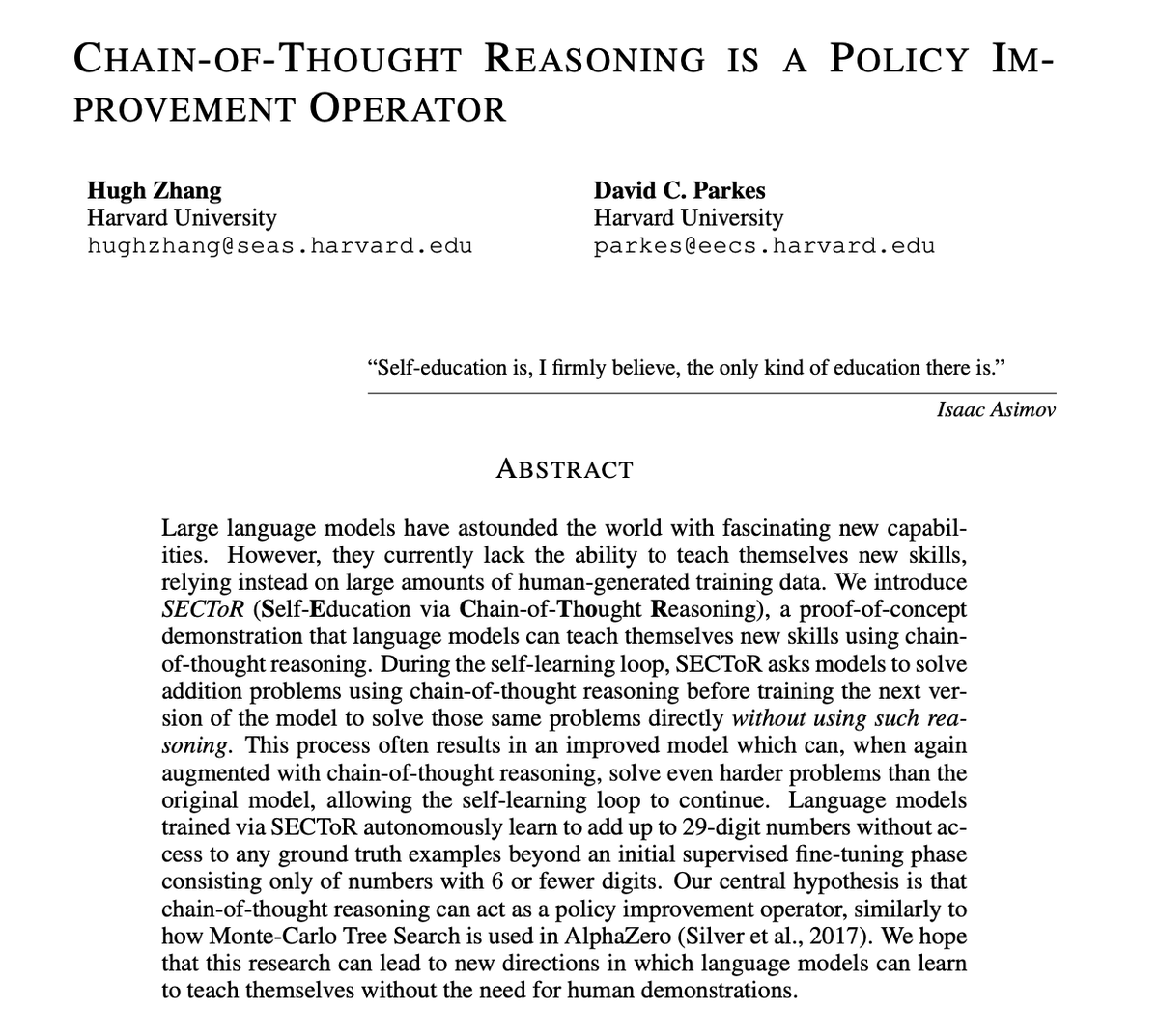
I also have no idea what Q* is, but given speculation that it’s a method of self-learning and Monte-Carlo Tree Search (MCTS) in language models, I thought I’d share some recent work on an adjacent idea.

I also have no idea what Q* is, but given speculation that it’s a method of self-learning and Monte-Carlo Tree Search (MCTS) in language models, I thought I’d share some recent work on an adjacent idea.
Jesse Mu (@jayelmnop) 's Twitter Profile Photo

We’re hiring for the adversarial robustness team Anthropic! As an Alignment subteam, we're making a big effort on red-teaming, test-time monitoring, and adversarial training. If you’re interested in these areas, let us know! (emails in 🧵)

We’re hiring for the adversarial robustness team <a href="/AnthropicAI/">Anthropic</a>!

As an Alignment subteam, we're making a big effort on red-teaming, test-time monitoring, and adversarial training. If you’re interested in these areas, let us know! (emails in 🧵)
Alex Tamkin (@alextamkin) 's Twitter Profile Photo

Made a short video exploring tool use and subagents! (w/ @aaron_begg and everett) Goal: Find the “quickest quicksort” implementation on GitHub by having a larger model orchestrate 100 subagent models Here’s how it works: 1/ x.com/AnthropicAI/st…

Dorsa Sadigh (@dorsasadigh) 's Twitter Profile Photo

At #ICRA24 we've a few papers on 𝗴𝗿𝗼𝘂𝗻𝗱𝗲𝗱 𝗿𝗲𝗮𝘀𝗼𝗻𝗶𝗻𝗴 of LLMs/VLMs. • Grounded common-sense reasoning via active perception - Minae Kwon's 🧵👇 • Physically grounding VLMs - Jensen Gao's 🧵👇 • Learning from online language corrections - @lihanzha's 🧵👇

Anthropic (@anthropicai) 's Twitter Profile Photo

Introducing Claude 3.5 Sonnet—our most intelligent model yet. This is the first release in our 3.5 model family. Sonnet now outperforms competitor models on key evaluations, at twice the speed of Claude 3 Opus and one-fifth the cost. Try it for free: claude.ai

Introducing Claude 3.5 Sonnet—our most intelligent model yet.

This is the first release in our 3.5 model family.

Sonnet now outperforms competitor models on key evaluations, at twice the speed of Claude 3 Opus and one-fifth the cost.

Try it for free: claude.ai
Ethan Perez (@ethanjperez) 's Twitter Profile Photo

I’m taking applications for collaborators via ML Alignment & Theory Scholars! It’s a great way for new or experienced researchers outside AI safety research labs to work with me/others in these groups: Neel Nanda, Evan Hubinger, mrinank 🍂, Nina, Fabien Roger, Rylan Schaeffer, ...🧵

Anthropic (@anthropicai) 's Twitter Profile Photo

Introducing an upgraded Claude 3.5 Sonnet, and a new model, Claude 3.5 Haiku. We’re also introducing a new capability in beta: computer use. Developers can now direct Claude to use computers the way people do—by looking at a screen, moving a cursor, clicking, and typing text.

Introducing an upgraded Claude 3.5 Sonnet, and a new model, Claude 3.5 Haiku. We’re also introducing a new capability in beta: computer use.

Developers can now direct Claude to use computers the way people do—by looking at a screen, moving a cursor, clicking, and typing text.
Anthropic (@anthropicai) 's Twitter Profile Photo

We’re publishing a new constitution for Claude. The constitution is a detailed description of our vision for Claude’s behavior and values. It’s written primarily for Claude, and used directly in our training process. anthropic.com/news/claude-ne…