Ce Jin (@jcvbcn) 's Twitter Profile
Ce Jin

@jcvbcn

ID: 3121113537

linkhttps://ce-jin.github.io/ calendar_today27-03-2015 12:09:55

111 Tweet

1,1K Followers

967 Following

Gautam Kamath (@thegautamkamath) 's Twitter Profile Photo

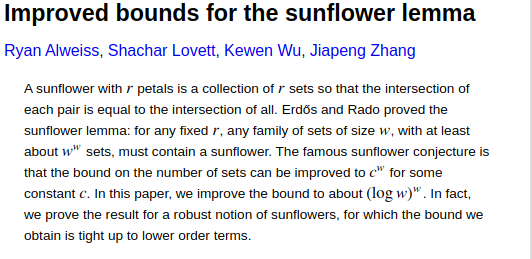
The proceedings for #STOC2020 are now online (dl.acm.org/doi/proceeding…)! With them come the best paper awards. The best paper is "Improved bounds for the sunflower lemma," by Ryan Alweiss, Shachar Lovett, Kewen Wu (Kewen Wu), and Jiapeng Zhang. (1/2) arxiv.org/abs/1908.08483

The proceedings for #STOC2020 are now online (dl.acm.org/doi/proceeding…)! With them come the best paper awards. 

The best paper is "Improved bounds for the sunflower lemma," by Ryan Alweiss, Shachar Lovett, Kewen Wu (<a href="/wu_kewen/">Kewen Wu</a>), and Jiapeng Zhang. (1/2) arxiv.org/abs/1908.08483
Lijie Chen (@wjmzbmr1) 's Twitter Profile Photo

Check the following STOC talk by Ce Jin Ce Jin on hardness magnification! We showed that for some problems one can (non-trivially) prove an n^{2-eps} lower bound while improving that to n^{2+eps} would imply super-poly lower bounds. youtube.com/watch?v=MhaUr1…

Lijie Chen (@wjmzbmr1) 's Twitter Profile Photo

Also check out STOC talk by Hanlin Ren Hanlin Ren on new average-case circuit lower bounds! We showed non-deterministic quasi-polynomial time is strongly-average case hard for ACC^0, while previously no such result is known even for AC^0[2]. youtube.com/watch?v=xWDQ4L…

Tom Gur (@tomgur) 's Twitter Profile Photo

This Thursday at 5pm London time, Lijie Chen (Lijie Chen , Massachusetts Institute of Technology (MIT)) will tell us about intriguing sharp threshold results in computational complexity at the Oxford-Warwick Complexity Seminar. Can't wait! dcs.warwick.ac.uk/~igorcarb/comp…

Association for Computing Machinery (@theofficialacm) 's Twitter Profile Photo

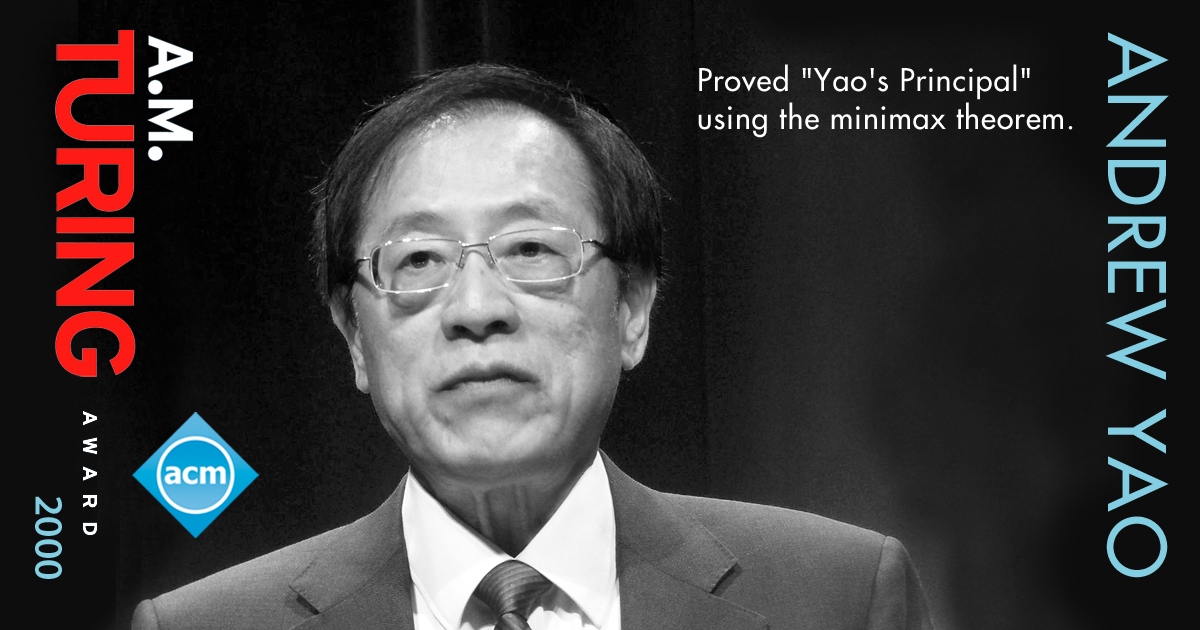
Happy birthday to Andrew Chi-Chih Yao! Yao received the 2000 #ACMTuringAward for his fundamental contributions to the theory of computation, including the complexity-based theory of pseudorandom number generation, cryptography and communication complexity. bit.ly/34vIHif

Happy birthday to Andrew Chi-Chih Yao! Yao received the 2000 #ACMTuringAward for his fundamental contributions to the theory of computation, including the complexity-based theory of pseudorandom number generation, cryptography and communication complexity. bit.ly/34vIHif
TCS blog aggregator (@cstheory) 's Twitter Profile Photo

TR21-159 | Constructive Separations and Their Consequences | Lijie Chen, Ce Jin, Rahul Santhanam, Ryan Williams ift.tt/3kDYsMl

Stefan Neumann | @stefanresearch.bsky.social (@stefanresearch) 's Twitter Profile Photo

Lots of conditionally optimal algorithms for Knapsack in the past few days. Very exciting to see this problem solved! Karl Bringmann and Ce Jin Ce Jin can compute an exact solution in time O(n + w_max^2), where n is the number of items and w_max is the maximum item weight.

Stefan Neumann | @stefanresearch.bsky.social (@stefanresearch) 's Twitter Profile Photo

Xiao Mao considers approximate solutions and shows that a (1-eps)-approximate solution can be computed in time O(n + 1/eps^2). Karl's paper: arxiv.org/abs/2308.03075 Ce's paper: arxiv.org/abs/2308.04093 Xiao's paper: arxiv.org/abs/2308.07004

Jelani Nelson (@minilek) 's Twitter Profile Photo

Major surprise by 3 UC Berkeley EECS grad students: Meghal Gupta, Hongxun Wu, Mihir Singhal. *Deterministic* eps-approximate quantiles in O(1/eps) mem. The previous best was the KLL sketch, which was randomized and used O(lglg(1/p)/eps) mem, p = fail prob arxiv.org/abs/2404.03847 1/


Deedy (@deedydas) 's Twitter Profile Photo

Huge computer science result: A Tsinghua professor JUST discovered the fastest shortest path algorithm for graphs in 40yrs. This improves on Turing award winner Tarjan’s O(m + nlogn) with Dijkstra’s, something every Computer Science student learns in college.

Huge computer science result:

A Tsinghua professor JUST discovered the fastest shortest path algorithm for graphs in 40yrs.

This improves on Turing award winner Tarjan’s O(m + nlogn) with Dijkstra’s, something every Computer Science student learns in college.