Jaime (@jaimeojedas) 's Twitter Profile
Jaime

@jaimeojedas

ID: 1234831244933947392

calendar_today03-03-2020 13:21:35

2,2K Tweet

283 Followers

1,1K Following

Jaime (@jaimeojedas) 's Twitter Profile Photo

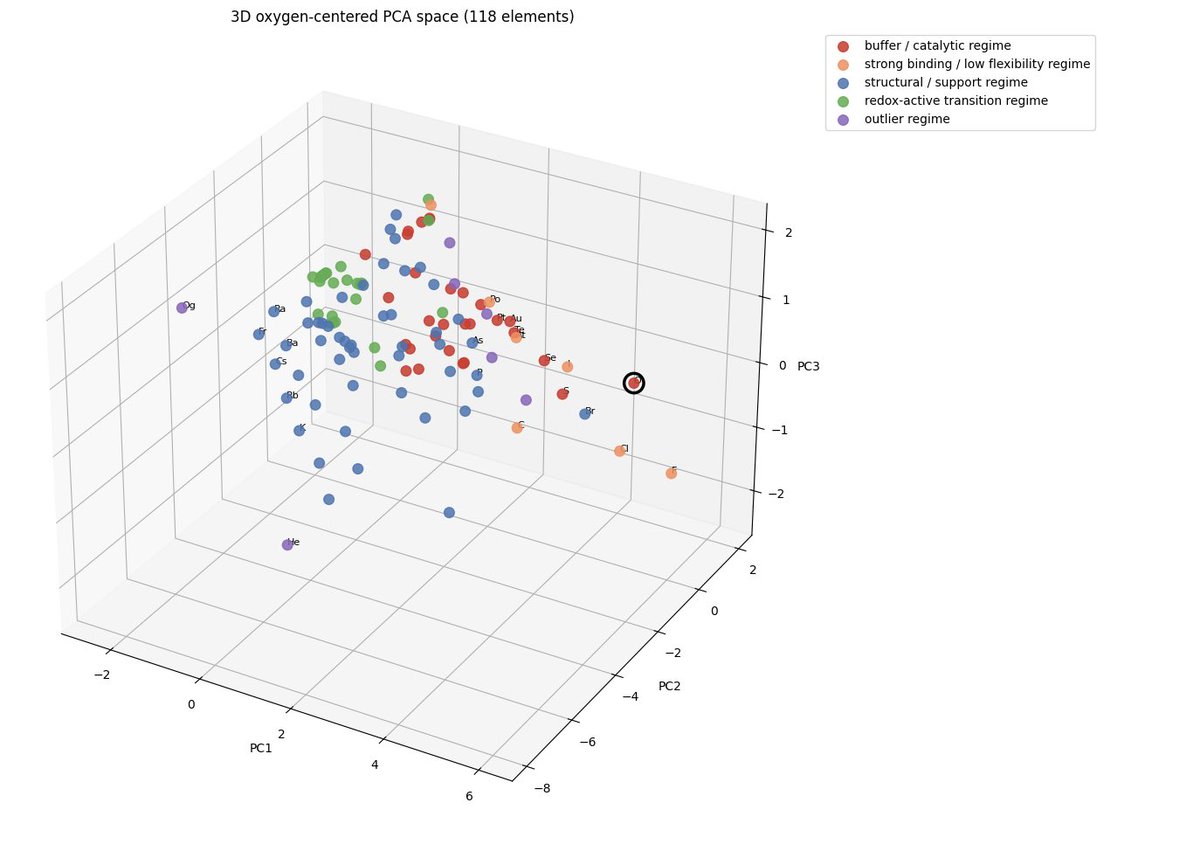
Oxygen may not occupy a random position in chemical space. Across multiple PCA variants, its nearest neighborhood remains enriched in sulfur-family elements, halogens, and catalytic metals. The strongest result is not that oxygen has nearby elements. It is that this local

Oxygen may not occupy a random position in chemical space.

Across multiple PCA variants, its nearest neighborhood remains enriched in sulfur-family elements, halogens, and catalytic metals.

The strongest result is not that oxygen has nearby elements.

It is that this local
Jaime (@jaimeojedas) 's Twitter Profile Photo

Oxygen and sulfur appear to occupy almost the same local neighborhood in chemical space. Across 2D, 3D, reduced-variable, and high-confidence PCA variants, the same core structure keeps reappearing. The interesting difference may not be the neighborhood itself. It may be that

Oxygen and sulfur appear to occupy almost the same local neighborhood in chemical space.

Across 2D, 3D, reduced-variable, and high-confidence PCA variants, the same core structure keeps reappearing.

The interesting difference may not be the neighborhood itself.

It may be that
Jaime (@jaimeojedas) 's Twitter Profile Photo

Local similarity may not imply global stability. Some elements remain oxygen-like across multiple geometric regimes. Others only appear similar within a narrow neighborhood. oxygenstates.org

Jaime (@jaimeojedas) 's Twitter Profile Photo

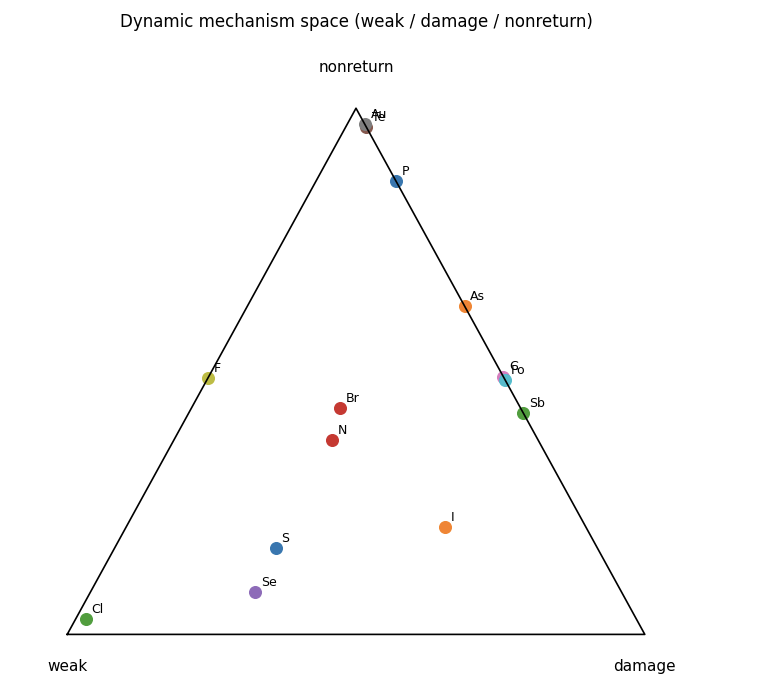
That earlier view was mostly about proximity and stability. But separation from oxygen may not be one-dimensional. It may unfold across distinct regimes: – reversible perturbation – structural damage – loss of recoverability Same distance. Different mechanism. This triangle

That earlier view was mostly about proximity and stability.

But separation from oxygen may not be one-dimensional.

It may unfold across distinct regimes:
– reversible perturbation
– structural damage
– loss of recoverability

Same distance. Different mechanism.

This triangle
Jaime (@jaimeojedas) 's Twitter Profile Photo

Systems may not fail when structure breaks, but when they lose the ability to enforce return. What shows up first isn’t divergence, but a loss of temporal coherence. In this case, that signal appears ~30–40% before collapse, and stays stable across different noise regimes.

Jaime (@jaimeojedas) 's Twitter Profile Photo

Interesting outcome. It doesn’t always look like accessibility degrades before failure. Some systems seem to hold fully consistent recovery right up to the edge. That contrast might be key to understanding when “loss of access” actually becomes the limiting factor.

Jaime (@jaimeojedas) 's Twitter Profile Photo

The summit exists. The paths exist. But whether it is reached may depend on the interaction between timing, conditions, and recovery capacity — not just on structure. Same system. Same possible paths. Different dynamics → different outcomes. Total effort (AUC) can be

The summit exists.
The paths exist.

But whether it is reached may depend on the interaction between timing, conditions, and recovery capacity — not just on structure.

Same system. Same possible paths.
Different dynamics → different outcomes.

Total effort (AUC) can be
Jaime (@jaimeojedas) 's Twitter Profile Photo

Water is often described as an active medium in chemistry. Proton states interconvert. Redox dynamics propagate. But that may not be the key point. What may matter is whether those states remain dynamically accessible under real conditions. Same reactions. Same overall load.

Water is often described as an active medium in chemistry.

Proton states interconvert.
Redox dynamics propagate.

But that may not be the key point.

What may matter is whether those states remain dynamically accessible under real conditions.

Same reactions. Same overall load.
Jaime (@jaimeojedas) 's Twitter Profile Photo

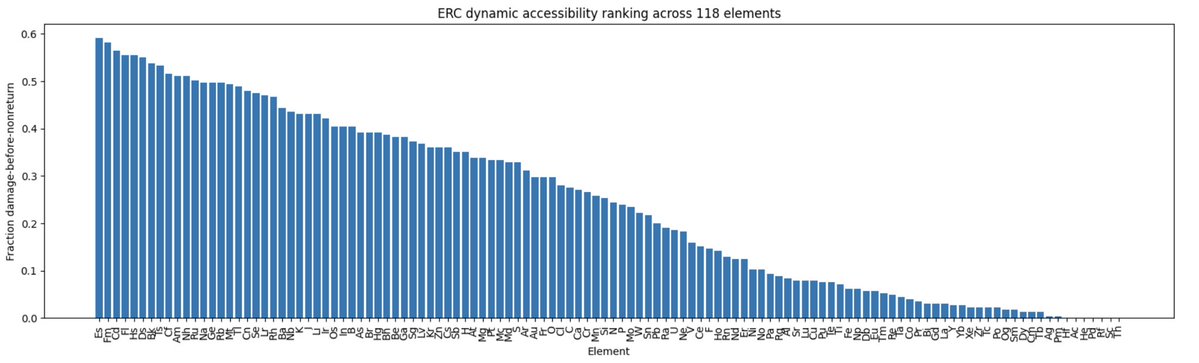
This structure may not just reflect similarity, it may reflect which chemical states remain dynamically accessible relative to oxygen. The stability of the local neighborhood across PCA variants suggests this accessibility is not arbitrary. Same elements. Same interactions.

This structure may not just reflect similarity, it may reflect which chemical states remain dynamically accessible relative to oxygen.

The stability of the local neighborhood across PCA variants suggests this accessibility is not arbitrary.

Same elements. Same interactions.
Jaime (@jaimeojedas) 's Twitter Profile Photo

Same system. Same states. What changes is whether the system can still return in time. A sharp boundary appears, where recovery exists in principle, but becomes unreachable in practice.

Same system. Same states.

What changes is whether the system can still return in time.

A sharp boundary appears, where recovery exists in principle, but becomes unreachable in practice.
Jaime (@jaimeojedas) 's Twitter Profile Photo

This may not just reflect similarity. It may reflect which states remain dynamically accessible relative to oxygen, as distinct recoverability regimes appear across distance. Same elements — but distinct recoverability pathways emerge.

This may not just reflect similarity.

It may reflect which states remain dynamically accessible relative to oxygen, as distinct recoverability regimes appear across distance.

Same elements — but distinct recoverability pathways emerge.
Jaime (@jaimeojedas) 's Twitter Profile Photo

Same outcome, different mechanisms, but do they remain dynamically distinguishable from within the system? In a minimal model, a sharp boundary appears: recovery still exists in principle, yet becomes effectively unreachable in time. Minimal model + data: Admissibility vs