Firman Simanjuntak (@firmangasa) 's Twitter Profile
Firman Simanjuntak

@firmangasa

Lecturer at Electronics & Computer Science, University of Southampton. PhD in Materials Sci. & Eng.

ID: 935146694093684737

calendar_today27-11-2017 14:02:00

204 Tweet

97 Followers

282 Following

Eric Pop (@profericpop) 's Twitter Profile Photo

Good for 2D semiconductors. imec puts "atomic channels" on their technology roadmap in 2036. Many puzzles to solve till then! There is growing consensus that atomically thin 2D semiconductors are the main post-Si option. CFET = stacked NMOS and PMOS. tomshardware.com/news/imec-reve…

Open Neuromorphic (@openneuromorph) 's Twitter Profile Photo

Computing, since its inception, has been processor-centric, with memory separated from compute. Inspired by the organic brain and optimized for inorganic silicon, NorthPole, the new chip from IBM, is a neural inference architecture that blurs this boundary.

Computing, since its inception, has been processor-centric, with memory separated from compute. Inspired by the organic brain and optimized for inorganic silicon, 
NorthPole, the new chip from <a href="/IBM/">IBM</a>, is a neural inference architecture that blurs this boundary.
Firman Simanjuntak (@firmangasa) 's Twitter Profile Photo

A nice collaborative work (KCL, U’Edinburgh & U’Southampton) led by Mari Napari. An ultrathin HfOx film inserted in Zener diode cell could induce switching and synaptic behaviors. This design could simplify the functional memory arrays as the building block of AI hardware.

Selina La Barbera (@selinitter) 's Twitter Profile Photo

Researchers from UT Austin report an ultra-fast #memristor based on thin sheets of hexagonal Boron Nitride exhibiting the shortest observed switching #speed (120 ps) among #2D #memristors and low switching #energy (2pJ). Now out👉Nature Communications nature.com/articles/s4146…

Selina La Barbera (@selinitter) 's Twitter Profile Photo

Inspired by the human cochlea, Milozzi et al. NEDL - NanoElectronic Device Lab develop #neuromorphic #circuits for #memristive tonotopic mapping via #volatile resistive switching #memory devices. Now out 👉Nature Communications nature.com/articles/s4146…

Eric Pop (@profericpop) 's Twitter Profile Photo

This IEEE Spectrum article written by Mark Liu (TSMC chairman) and my colleague, Philip Wong (H.-S. Philip Wong), is required reading for anyone working on semiconductors and AI today. spectrum.ieee.org/trillion-trans…

Selina La Barbera (@selinitter) 's Twitter Profile Photo

Researchers from Sandia National Labs, Seoul National University and Texas A&M University experimentally demonstrate that tunable #stochastic #memristors can perform #cryptographic key generation and #energyefficient #encryption and #computing. Now out 👉Nature Communications nature.com/articles/s4146…

Selina La Barbera (@selinitter) 's Twitter Profile Photo

Wang et al. report a nanoscale #LED with memory #electroluminescence, which can realize multiple action potentials combinations through a single optical channel in bio-inspired #afferent #nerves. Now out 👉 Nature Communications nature.com/articles/s4146…

Selina La Barbera (@selinitter) 's Twitter Profile Photo

Prof. Duygu Kuzum and colleagues from UC San Diego report a filament-free trilayer metal-oxide bulk switching #RRAM technology for #edge #computing for an #autonomous #navigation task. Now out Nature Communications 👉 nature.com/articles/s4146…


Brad Aimone (@jbimaknee) 's Twitter Profile Photo

"Neurons are noisy" is one of the bigger (and for neural computing, detrimental...) misconceptions around the brain. Everything about brains' development and anatomy is so intricate, why would communication be random and unpredictable? Any variation is there for a reason.

Melika Payvand (@melikapayvand) 's Twitter Profile Photo

Check out "DenRAM", the first implementation of delay-based dendritic architecture using #RRAM+CMOS technology, which we show is a natural match for efficient temporal signal processing Nature Communications. paper: nature.com/articles/s4146… code: github.com/EIS-Hub/DenRAM Thread 🧵
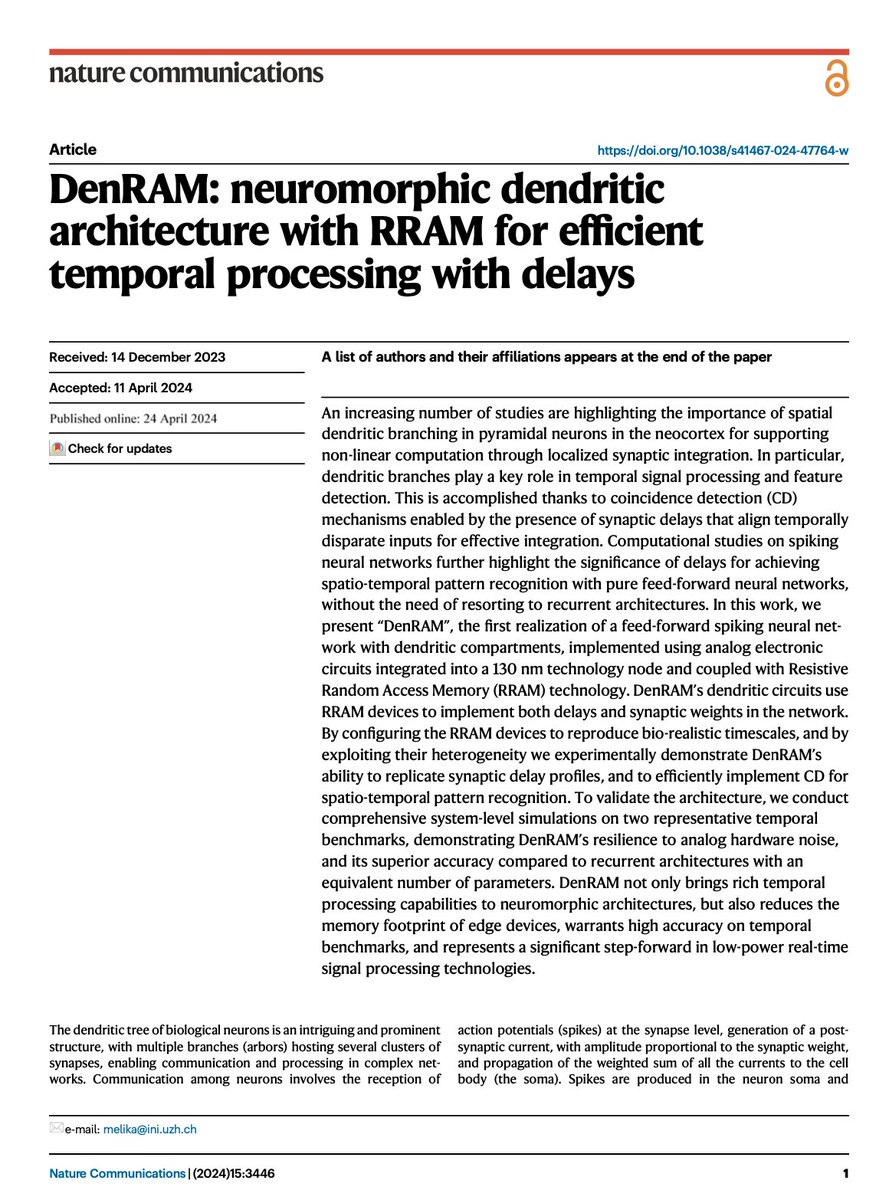

Check out "DenRAM", the first implementation of delay-based dendritic architecture using #RRAM+CMOS technology, which we show is a natural match for efficient temporal signal processing <a href="/NatureComms/">Nature Communications</a>.
paper: nature.com/articles/s4146…
code: github.com/EIS-Hub/DenRAM
Thread 🧵
Selina La Barbera (@selinitter) 's Twitter Profile Photo

Researchers from Fudan University develop bio-inspired firing feature-driven #neuralcircuits with scalable #memristive neurons for #robotic obstacle avoidance. Now out👉Nature Communications nature.com/articles/s4146…

Firman Simanjuntak (@firmangasa) 's Twitter Profile Photo

Most low-temperature fabricated devices are not CMOS compatible because they wont survive back-end thermal process which induce element intermixing, damaging interfaces. In this paper, we intentionally exploit the intermixing to make better devices for #AI applications!

Most low-temperature fabricated devices are not CMOS compatible because they wont survive back-end thermal process which induce element intermixing, damaging interfaces. In this paper, we intentionally exploit the intermixing to make better devices for #AI applications!
Firman Simanjuntak (@firmangasa) 's Twitter Profile Photo

Another paper has been published led by my MSc students. We propose a new statistical metric “Fluctuation Factor (FF)” to predict how likely the circuit is to produce good random bits by quantifying variations in the switching process, which other commonly used metrics can’t.

Another paper has been published led by my MSc students.

We propose a new statistical metric “Fluctuation Factor (FF)” to predict how likely the circuit is to produce good random bits by quantifying variations in the switching process, which other commonly used metrics can’t.