Yann (@leguenyann) 's Twitter Profile
Yann

@leguenyann

@Stanford_Neuro @stanford_qsu Deciphering the genetics causes of neurogenerative diseases.

ID: 827554508

calendar_today16-09-2012 18:42:24

143 Tweet

241 Followers

506 Following

Timothy Raben (@timothyraben) 's Twitter Profile Photo

The UK Biobank (UKB) has been an amazing field changing resource for the past decade. Unfortunately, and very suddenly, they have decided that to work with their data you now *must* use their “Research Analysis Platform” (RAP). UK Biobank I guess there have been general warning
Hamilton Oh (@hammy_oh) 's Twitter Profile Photo

I'm excited to share 2 of our new studies now out as preprints on BioRxiv! biorxiv.org/content/10.110… biorxiv.org/content/10.110… From Tony Wyss-Coray lab in collaboration with many amazing groups including... 1/5
Michael Belloy (@belloymichael) 's Twitter Profile Photo

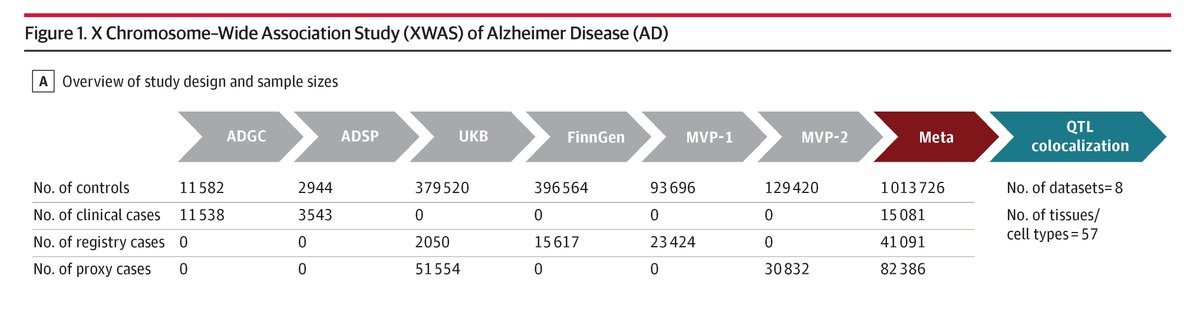
For nearly 2 decades, Alzheimer’s disease (AD) “genome-wide” association studies only covered the autosomes. Today we unveil the X chromosome and prioritize SLC9A7, a.k.a. NHE7, as an AD risk gene. Article: jamanetwork.com/journals/jaman… Editorial: jamanetwork.com/journals/jaman…

For nearly 2 decades, Alzheimer’s disease (AD) “genome-wide” association studies only covered the autosomes. Today we unveil the X chromosome and prioritize SLC9A7, a.k.a. NHE7, as an AD risk gene.
Article: jamanetwork.com/journals/jaman…
Editorial: jamanetwork.com/journals/jaman…
JAMA Neurology (@jamaneuro) 's Twitter Profile Photo

This X chromosome-wide association study of Alzheimer disease (AD) across 1,152,284 individuals identified SLC9A7 as a novel risk locus and provides initial insights into the role of X chromosome in sex-based differences in AD. ja.ma/3XCfhLE

This X chromosome-wide association study of Alzheimer disease (AD) across 1,152,284 individuals identified SLC9A7 as a novel risk locus and provides initial insights into the role of X chromosome in sex-based differences in AD. 

ja.ma/3XCfhLE
Stanford Neurology & Neurological Sciences (@stanford_neuro) 's Twitter Profile Photo

Celebrating our neurology postdoctoral scholars during National Postdoc Appreciation Week #NPAW2024! Our faculty mentors know that postdocs are the backbone of innovation and progress and their dedication, knowledge, and creativity drive our research forward.

Celebrating our neurology postdoctoral scholars during National Postdoc Appreciation Week #NPAW2024! Our faculty mentors know that postdocs are the backbone of innovation and progress and their dedication, knowledge, and creativity drive our research forward.
Oliver Hahn (@oliver__hahn) 's Twitter Profile Photo

Huge publication in nature by Calico disentangling the contribution of genetic diversity to dietary interventions! Treasure chest of results - like the observation that the biggest determinant of lifespan extension are immune- but not metabolism-related shorturl.at/vASeP

Yann (@leguenyann) 's Twitter Profile Photo

At #ASHG2024 this week, message me if you are around and would like to meet. Stanford Quantitative Sciences Unit is looking for someone with hands-on spatial transcriptomics experience ASHG

At #ASHG2024 this week, message me if you are around and would like to meet.

<a href="/stanford_qsu/">Stanford Quantitative Sciences Unit</a> is looking for someone with hands-on spatial transcriptomics experience 

 <a href="/GeneticsSociety/">ASHG</a>
Yann (@leguenyann) 's Twitter Profile Photo

Another excellent and well-designed proteomics study with Hamilton Oh, this time identifying a protein in CSF which is associated with cognitive impairments and predicts cognitive decline remarkably well

Stanford Department of Medicine (@stanforddeptmed) 's Twitter Profile Photo

In one of the largest genetic studies of its kind, Michael Greicius (Stanford Neurology & Neurological Sciences), Yann (#StanDOM) & team uncover the impact of rare genetic mutations that may be responsible for shortening lifespans, even in those who appear healthy. stanford.io/43Zn61p

Stanford Knight Initiative for Brain Resilience (@brainresilience) 's Twitter Profile Photo

A newly discovered biomarker in spinal fluid—the YWHAG:NPTX2 ratio—may indicate who will develop dementia and how quickly it will progress, according to a Nature Medicine study led by Hamilton Oh and senior author Tony Wyss-Coray. brainresilience.stanford.edu/news/new-prote…

A newly discovered biomarker in spinal fluid—the YWHAG:NPTX2 ratio—may indicate who will develop dementia and how quickly it will progress, according to a <a href="/NatureMedicine/">Nature Medicine</a> study led by <a href="/hammy_oh/">Hamilton Oh</a> and senior author <a href="/wysscoray/">Tony Wyss-Coray</a>. 

brainresilience.stanford.edu/news/new-prote…
Hamilton Oh (@hammy_oh) 's Twitter Profile Photo

I'm thrilled to share our new study out in Nature Medicine! We show that a blood test can estimate how aged or youthful one’s organs are and that these organ ages predict future disease and lifespan. Final paper from my PhD in the Tony Wyss-Coray lab. 🧵1/12 🔗 nature.com/articles/s4159…