Daniel Pérez-Pinedo (@ediacaradani) 's Twitter Profile
Daniel Pérez-Pinedo

@ediacaradani

PhD. @MUN_EarthSci 🇨🇦. From Paleogene pollen 🌺 to Ediacaran fossils 🪨. Sedimentology, taxonomy, statistics, and fluid dynamics.

ID: 3392113443

calendar_today28-07-2015 14:59:36

225 Tweet

202 Followers

396 Following

nature (@nature) 's Twitter Profile Photo

Falling behind: postdocs in their thirties tire of putting life on hold. Read the results of Nature’s second global survey of postdoctoral researchers go.nature.com/3Qtd4hI

Daniel Pérez-Pinedo (@ediacaradani) 's Twitter Profile Photo

🚨‼️ Two graduate student positions available to work on Precambrian fossils. #PhDposition Come work with us on the Ediacaran Avalon Assemblage. The oldest complex animal (?) remains on Earth! We are a very versatile paleobiology group based in St. John’s, NL 🇨🇦.

Daniel Pérez-Pinedo (@ediacaradani) 's Twitter Profile Photo

Phd position announced! Come work with us on Ediacaran paleobiology. Unique material, good environment, and a prolific research team!

Emily G Mitchell (@egmitchell) 's Twitter Profile Photo

Delighted that Nile's first paper is now out NatureEcoEvo nature.com/articles/s4155… which investigates the driving forces behind the evolution of early metazoans from the Ediacaran time period ~565 million years ago.

Delighted that Nile's first paper is now out <a href="/NatureEcoEvo/">NatureEcoEvo</a> nature.com/articles/s4155… which investigates the driving forces behind the evolution of early metazoans from the Ediacaran time period ~565 million years ago.
Dr. Rod Taylor (@fossilrod) 's Twitter Profile Photo

This #FossilFriday: Charnia cf. gracilis (left) and Arborea spinosus, from the recently discovered #Ediacaran Inner Meadow surface in #Newfoundland. This incredible site will be rewarding us with new discoveries for decades to come! Photo: shorturl.at/4W2Ed

This #FossilFriday: Charnia cf. gracilis (left) and Arborea spinosus, from the recently discovered #Ediacaran Inner Meadow surface in #Newfoundland. This incredible site will be rewarding us with new discoveries for decades to come!

Photo: shorturl.at/4W2Ed
Chris McKean (@mcchris1993) 's Twitter Profile Photo

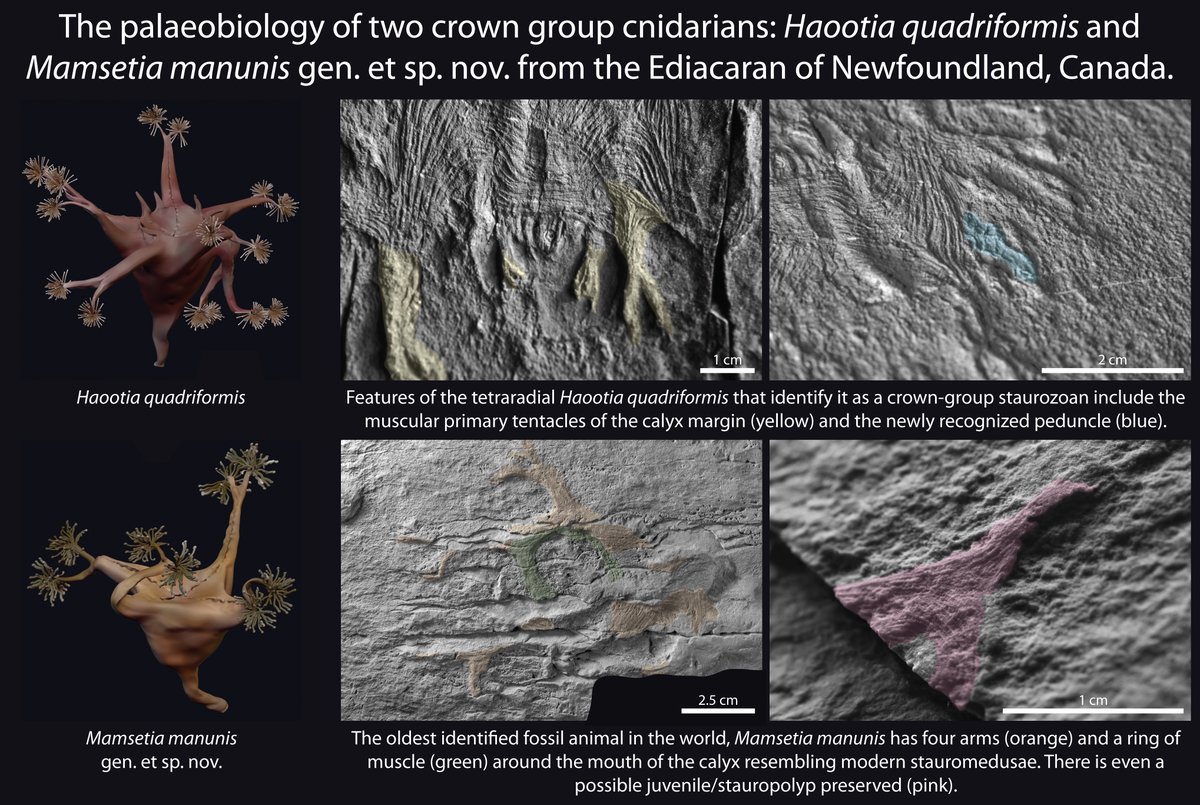
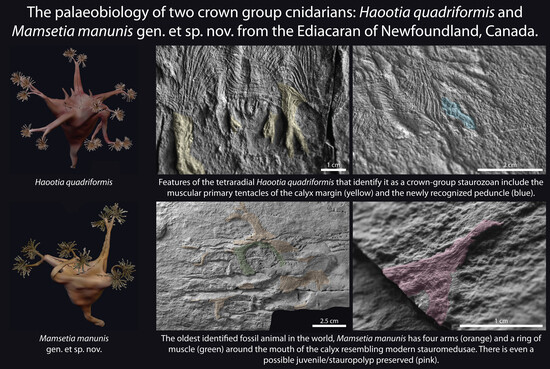
Say hello to the oldest animals in the fossil record - #Haootia quadriformis and INTRODUCING #Mamsetia manunis These crown-group cnidarians were found within the @DiscoveryGEONL and are vital to the story of life on Earth Read about them in our new paper mdpi.com/2075-1729/14/9…

Say hello to the oldest animals in the fossil record - #Haootia quadriformis and INTRODUCING #Mamsetia manunis
These crown-group cnidarians were found within the @DiscoveryGEONL and are vital to the story of life on Earth
Read about them in our new paper mdpi.com/2075-1729/14/9…
Life MDPI (@life_mdpi) 's Twitter Profile Photo

👉Featured Paper: The Palaeobiology of Two Crown Group Cnidarians: Haootia quadriformis and Mamsetia manunis gen. et sp. nov. from the Ediacaran of Newfoundland, Canada 🧑‍🔬By D. McIlroy et al., from Memorial University of Newfoundland, Canada 🔗mdpi.com/2075-1729/14/9…

👉Featured Paper:
The Palaeobiology of Two Crown Group Cnidarians: Haootia quadriformis and Mamsetia manunis gen. et sp. nov. from the Ediacaran of Newfoundland, Canada

🧑‍🔬By D. McIlroy et al., from Memorial University of Newfoundland, Canada

🔗mdpi.com/2075-1729/14/9…
Ian Hughes (@chemosymbiosis) 's Twitter Profile Photo

I’m pumped to share my latest paper out today in Current Biology with Scott Evans and mary droser describing the first Ediacaran ecdysozoan body fossil! (free via this link: authors.elsevier.com/a/1k7J73QW8S6G…)

The Royal Society (@royalsociety) 's Twitter Profile Photo

#OnThisDay in 1859, Charles Darwin's landmark book 'On the Origin of Species' was first published. The work is one of the foundations of evolutionary biology, and one of the most important scientific works of the 19th century. #HistoryOfScience

#OnThisDay in 1859, Charles Darwin's landmark book 'On the Origin of Species' was first published. The work is one of the foundations of evolutionary biology, and one of the most important scientific works of the 19th century. #HistoryOfScience