

Anna Lena Dueren
@dueren_al
Psychologist, student, interested in touch and fluffy things
ID: 1425825949459783686
12-08-2021 14:26:27
33 Tweet
37 Followers
89 Following

A whole paper on hugs? Warms my heart 🥺🥰 Anna Lena Dueren sciencedirect.com/science/articl…
There's a lot of touch research nowadays, but not much on hugs. Even though hugs are so common in everyday life! So we thought it is time to look at hugging styles :) with Chris Edgar and Michael Banissy sciencedirect.com/science/articl…





Excited to share our new paper on the beneficial effects of hugging together with Gesa Berretz and Sebastian Ocklenburg. We used the Socially Evaluated Cold Pressor Test (SECPT) to induce a stress response and investigated the stress-buffering effects of hugs in romantic partners. 1/4🧵
New preprint on my favorite topic together with @MaikeLuhmann and Sebastian Ocklenburg ! In this preprint, we investigated the associaton between hugging and well-being prior and during the COVID-19 pandemic. A thread 🧵 psyarxiv.com/dpvkx/

Happy to see our EMA study on the association between hugging, mood and life satisfaction together with @MaikeLuhmann and Sebastian Ocklenburg published in the Journal of Nonverbal Behavior. A short thread 🧵

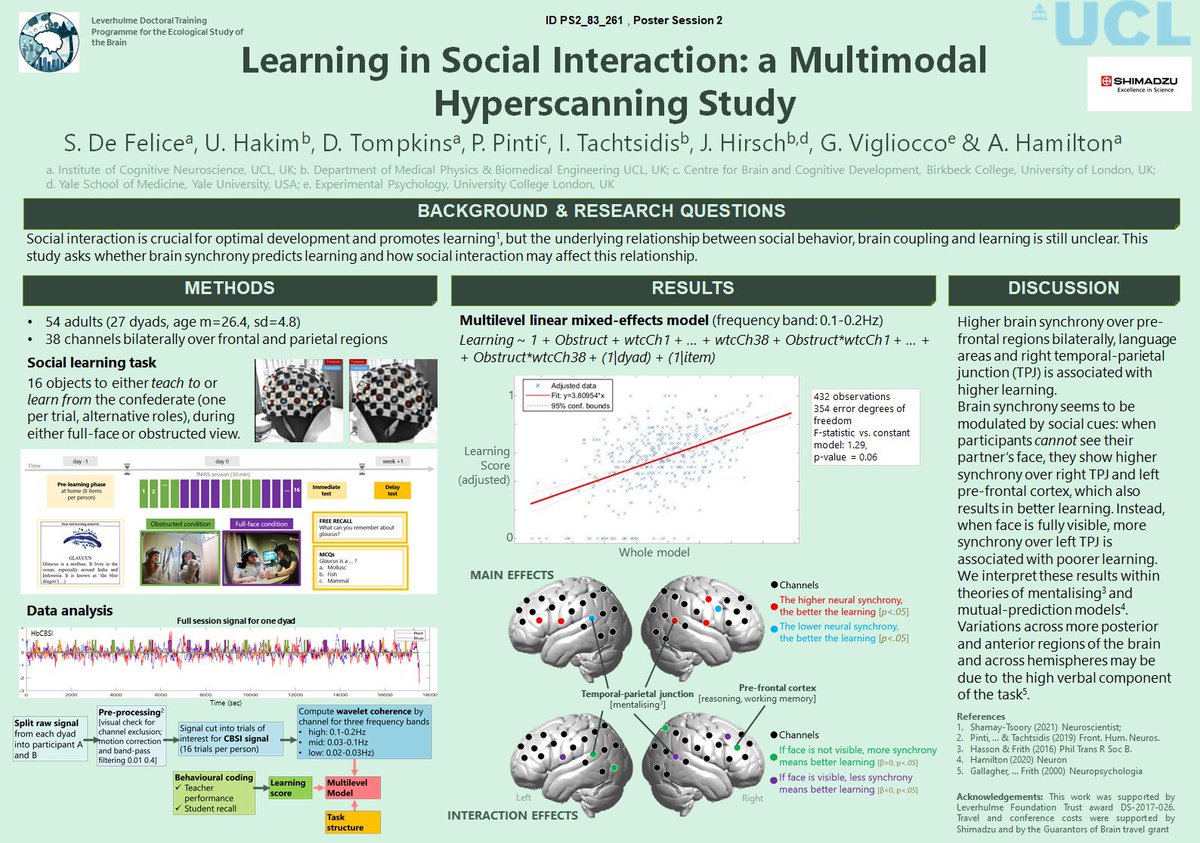
And if you cannot join in person, here is an online version. As anything high quality in science, this is a team effort: @D_Tompkins020 @uzhakim Ilias Tachtsidis Paola Pinti Joy Hirsch Prof. Gabriella Vigliocco Antonia Hamilton A bit cheesy but I’m truly grateful to be part of this team 💥

We often sleep next to another - but know little about how interpersonal touch is associated w sleep. This was examined in a paper led by Anna Lena Dueren with Michael Banissy Claudia Hammond Juan José Madrid Val and Aikaterini Vafeiadou onlinelibrary.wiley.com/doi/10.1111/js…
1/3 Affective touch has been reported for its calming effects. Still, we know less about the impact on sleep. Latest publication from the Touch Test explores this: bit.ly/3Uqmv1a. w/ Anna Lena Dueren Natalie Bowling Katerina Vafeiadou 🍉 Alice Gregory Claudia Hammond Juan José Madrid Val
3/3 Big thanks to all involved, esp Anna Lena Dueren for leading this project.
Do you sleep better when touching your partner during sleep onset? We asked this and some more questions about sleep and touch in our new Touch Test paper. Thanks to Natalie Bowling Katerina Vafeiadou 🍉 Alice Gregory Claudia Hammond Juan José Madrid Val Michael Banissy onlinelibrary.wiley.com/doi/10.1111/js…
2/2 Extraversion and attachment style were important factors in explaining how different people felt about touch in treatment. People with more positive attitudes to touch in treatment settings also showed greater wellbeing. Led by Katerina Vafeiadou 🍉 W/ Natalie Bowling Claudia Hammond