Danqi7 (@danqiliao73090) 's Twitter Profile
Danqi7

@danqiliao73090

AI for BioScience. CS Ph.D. @ Yale.

Prev: Northwestern 18', Meta 20', Princeton 22'.

ID: 1739396171393536000

calendar_today25-12-2023 21:22:38

50 Tweet

43 Followers

198 Following

Danqi7 (@danqiliao73090) 's Twitter Profile Photo

Tim is an incredible mentor that I've learned a lot from. If you’re interested in a PhD in ML, AI safety, or statistical ML, don’t miss this opportunity. :)

Danqi7 (@danqiliao73090) 's Twitter Profile Photo

Listening to Ilya Sutskever recent chat with Dwarkesh Patel on how we are moving from age of scaling to age of research, I just realized that research is literally "re"-"search". Like if existing ideas are explored local minimum, the job now is to search again, to explore new directions
Krishnaswamy Lab (@krishnaswamylab) 's Twitter Profile Photo

(1/n) Just in time for New Years! #ImmunoStruct, our multimodal model that predicts class I peptide-MHC immunogenicity is out at Nature Machine Intelligence ! nature.com/articles/s4225…
Danqi7 (@danqiliao73090) 's Twitter Profile Photo

Coding in the AI agent era is framed more as the discriminator than the generator. But, to be a solid discriminator, you have to become a good generator first. You cannot build the muscles to become either if you outsource the learning, which is often tempting because it's the

Ming "Tommy" Tang (@tangming2005) 's Twitter Profile Photo

The real bottlenecks in drug development: - Target validation. Is this protein actually the right one to go after? - Clinical trials. Does the drug work in actual patients?

Yulu Gan (@yule_gan) 's Twitter Profile Photo

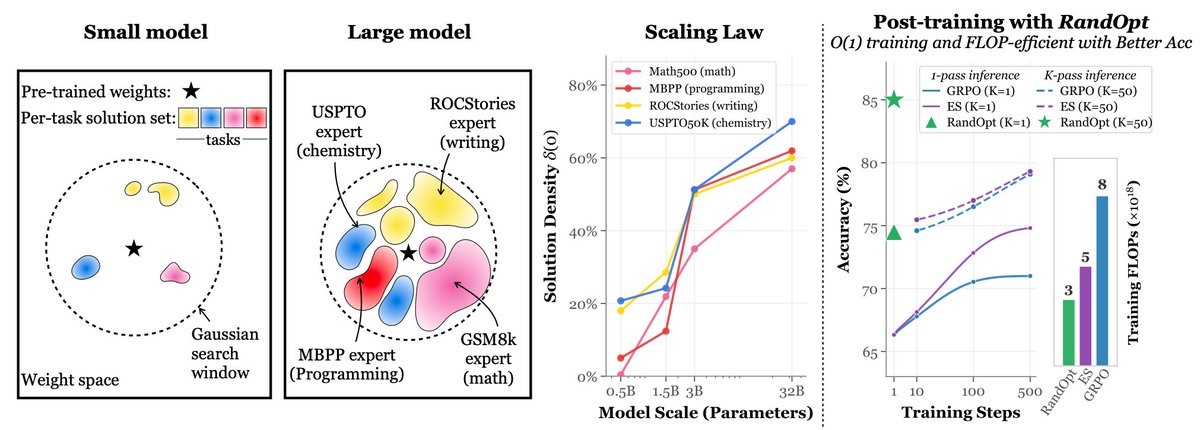
Simply adding Gaussian noise to LLMs (one step—no iterations, no learning rate, no gradients) and ensembling them can achieve performance comparable to or even better than standard GRPO/PPO on math reasoning, coding, writing, and chemistry tasks. We call this algorithm RandOpt.

Simply adding Gaussian noise to LLMs (one step—no iterations, no learning rate, no gradients) and ensembling them can achieve performance comparable to or even better than standard GRPO/PPO on math reasoning, coding, writing, and chemistry tasks. We call this algorithm RandOpt.
Danqi7 (@danqiliao73090) 's Twitter Profile Photo

The hype around OpenClaw (especially in China) reminded me that fear is still the #1 driver of behavior. FOMO. Fear of being replaced. Fear of missing the next wave. Social media amplifies and profits from fear far more effectively than hope or curiosity.

Danqi7 (@danqiliao73090) 's Twitter Profile Photo

“Engineers will be replaced.” “Doctors won’t be needed.” “AI will replace humans.” Fear grabs attention → attention drives adoption → adoption fuels hype. In StarCraft lore the Zerg need an Overmind to coordinate the swarm. Humans don’t need an Overmind. Fear works just fine.

Danqi7 (@danqiliao73090) 's Twitter Profile Photo

More perturbation data 👀 With the recent surge in cell perturbation / state transition models, excited to see what people build with it

Danqi7 (@danqiliao73090) 's Twitter Profile Photo

This is interesting and kinda reminds me of this recent talk from Jeff Dean on making multiple passes on the same data youtube.com/watch?v=g8BuAt…

Krishnaswamy Lab (@krishnaswamylab) 's Twitter Profile Photo

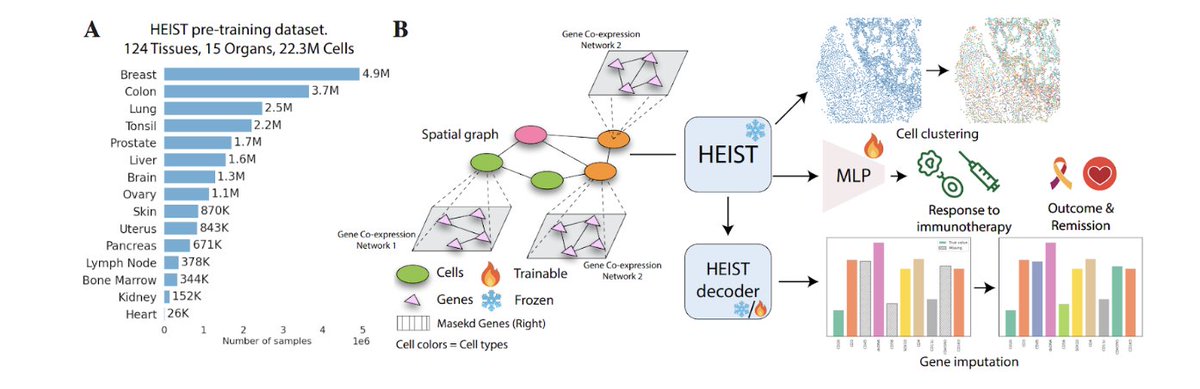
(1/n) 🎉 Excited to share our paper "HEIST: Hierarchical Embeddings for Spatial Transcriptomics" to be presented at #ICLR202! Heist is a foundation model for spatial-omics data, trained on 22.3M cells from 124 tissues across 15 organs, that jointly models spatial proximity AND

(1/n) 🎉 Excited to share our paper "HEIST: Hierarchical Embeddings for Spatial Transcriptomics" to be presented at #ICLR202! Heist is a foundation model for spatial-omics data, trained on 22.3M cells from 124 tissues across 15 organs, that jointly models spatial proximity AND
Danqi7 (@danqiliao73090) 's Twitter Profile Photo

Tried the same query for three AI scientists platform and the results and the reasoning steps are very much similar. 👀

Danqi7 (@danqiliao73090) 's Twitter Profile Photo

The GPT-2 replication tutorial by Andrej Karpathy might be the best technical video on the internet. I watched every second. One thing that surprised me: padding the tokenizer to an even number of total tokens actually speeds up training. The whole speedup section is packed with gems
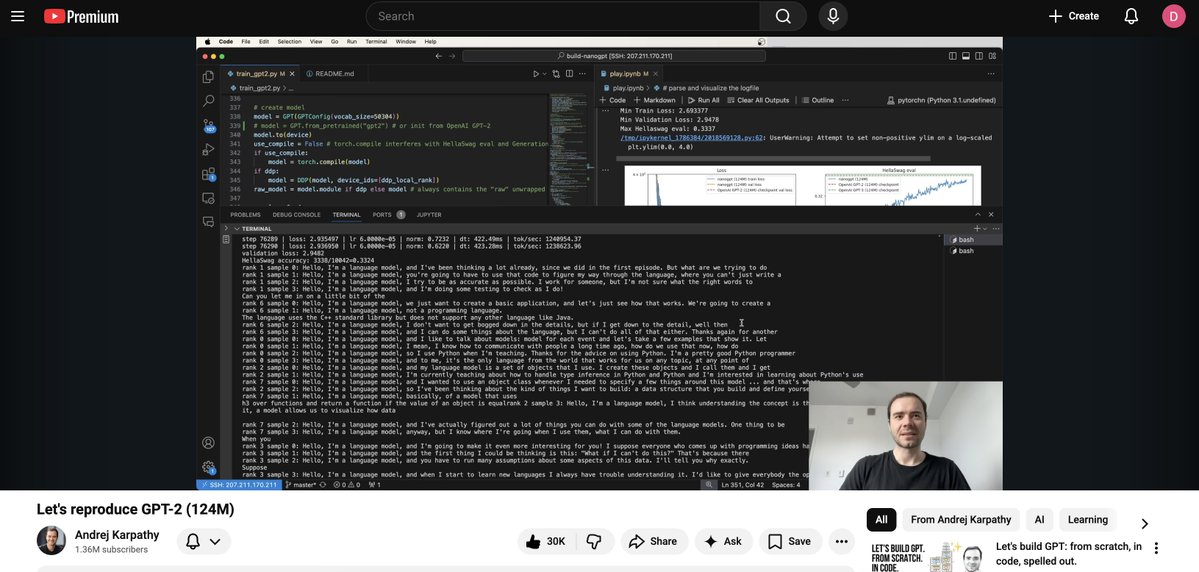
The GPT-2 replication tutorial by <a href="/karpathy/">Andrej Karpathy</a> might be the best technical video on the internet. I watched every second.  One thing that surprised me: padding the tokenizer to an even number of total tokens actually speeds up training. The whole speedup section is packed with gems
Danqi7 (@danqiliao73090) 's Twitter Profile Photo

I think model/training is just as important as data here. There's no shortage of bio data (quality aside), but the modeling paradigm, especially for cells, hasn't even converged yet. LLMs were able to scale up even on low-quality data once the field converged on the right

Danqi7 (@danqiliao73090) 's Twitter Profile Photo

Yeah we need more than just 150M cells from CELLxGENE. And we need more temporal data in addition to static cell snapshots