
Coby Viner (@cobyviner) 's Twitter Profile
Coby Viner

@cobyviner

Postdoc, Biology, UPenn

ID: 2796875636

linkhttps://www.cs.toronto.edu/~cviner/ calendar_today07-09-2014 23:58:16

1,1K Tweet

333 Takipçi

867 Takip Edilen

Coby Viner (@cobyviner) 's Twitter Profile Photo

Almost every ⁦WestJet⁩ flight, out of Calgary this evening (YYC) is delayed. The Customer Service lineup, directly below this sign, has a massive line of well over 50 people. What an unfortunate mess.

Almost every ⁦<a href="/WestJet/">WestJet</a>⁩ flight, out of Calgary this evening (YYC) is delayed. The Customer Service lineup, directly below this sign, has a massive line of well over 50 people. 

What an unfortunate mess.
Michael Hoffman @michaelhoffman.bsky.social (@michaelhoffman) 's Twitter Profile Photo

Coby is looking for a postdoc opportunity in the U.S. next and wants to pivot from computational genomics to molecular evolution and has an interest in performant algorithms. If you have any leads I hope you will chat with him! #KSChromatin23 #KSEpigenetics23

Coby Viner (@cobyviner) 's Twitter Profile Photo

My posters are located next to each-other, with the (fewer) Q8/#KSChromatin23 posters, in the far back of Salon C. Looking forward to chatting about them! #KSChromatin23 #KSEpigenetics23 Keystone Symposia
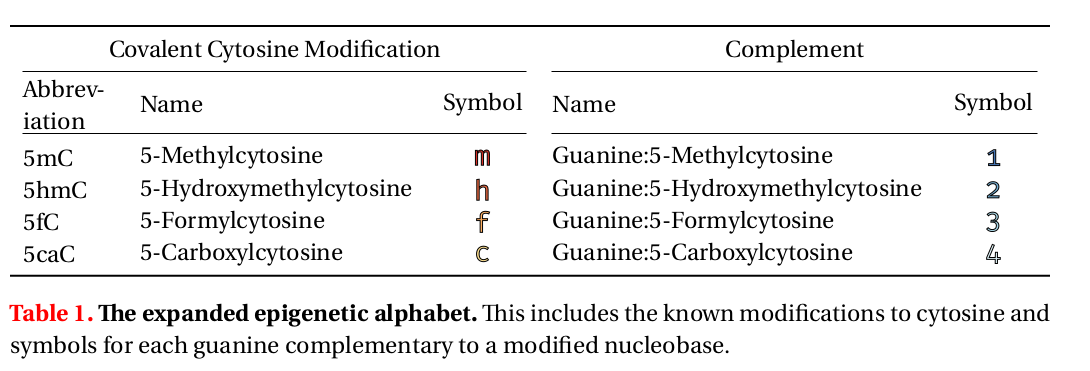
Michael Hoffman @michaelhoffman.bsky.social (@michaelhoffman) 's Twitter Profile Photo

4/We developed a method to explicitly model how cytosine modifications on one side of a base pair or the other might affect transcription factor binding. To do this we simply expand the alphabet, adding m for methylcytosine, h for hydroxymethylcytosine, and so on.

4/We developed a method to explicitly model how cytosine modifications on one side of a base pair or the other might affect transcription factor binding. To do this we simply expand the alphabet, adding m for methylcytosine, h for hydroxymethylcytosine, and so on.
Michael Hoffman @michaelhoffman.bsky.social (@michaelhoffman) 's Twitter Profile Photo

11/For example, while previous literature reported that JUND is "uniformly inhibited by 5mC", our analysis suggests that a minority of JUND motifs have a slight preference for 5mC.

11/For example, while previous literature reported that JUND is "uniformly inhibited by 5mC", our analysis suggests that a minority of JUND motifs have a slight preference for 5mC.
Michael Hoffman @michaelhoffman.bsky.social (@michaelhoffman) 's Twitter Profile Photo

13/For OCT4, our expanded alphabet analysis revealed a potential preference for 5-hydroxymethylcytosine. Unlike some of the other preferences described above, we could not find this described in the literature.

13/For OCT4, our expanded alphabet analysis revealed a potential preference for 5-hydroxymethylcytosine. Unlike some of the other preferences described above, we could not find this described in the literature.
Michael Hoffman @michaelhoffman.bsky.social (@michaelhoffman) 's Twitter Profile Photo

17/This methodology gives us evidence of the epigenetic modification state of the DNA that is actually bound to OCT4. And, as it turns out, OCT4 motifs are indeed preferentially bound when the sequence is hydroxymethylated!

17/This methodology gives us evidence of the epigenetic modification state of the DNA that is actually bound to OCT4. And, as it turns out, OCT4 motifs are indeed preferentially bound when the sequence is hydroxymethylated!
Princess Margaret Cancer Centre Research (@pmresearch_uhn) 's Twitter Profile Photo

Expanded DNA alphabet for gene regulation🧬 Beyond A/C/G/T, a study by Coby Viner and collaborators, led by Michael Hoffman @michaelhoffman.bsky.social University Health Network, added symbols like “m” and “h” to the genetic alphabet as a new way to study epigenetic regulation. >>genomebiology.biomedcentral.com/articles/10.11…


Expanded DNA alphabet for gene regulation🧬

Beyond A/C/G/T, a study by <a href="/cobyviner/">Coby Viner</a>  and collaborators, led by <a href="/michaelhoffman/">Michael Hoffman @michaelhoffman.bsky.social</a> <a href="/UHN/">University Health Network</a>, added symbols like “m” and “h” to the genetic alphabet as a new way to study epigenetic regulation.

&gt;&gt;genomebiology.biomedcentral.com/articles/10.11…