Alejandro Benítez-Llambay (@bllalejandro) 's Twitter Profile
Alejandro Benítez-Llambay

@bllalejandro

Astrophysicist. Interested in numerical cosmology, dark matter, galaxy formation. Computer graphics enthusiast. Assistant Professor at @unimib.

ID: 2769645875

linkhttp://alejandrobll.github.io calendar_today14-09-2014 03:59:16

237 Tweet

264 Followers

125 Following

Alejandro Benítez-Llambay (@bllalejandro) 's Twitter Profile Photo

Proud of the first paper led by Davide Tornotti, which is now published in Nature! nature.com/articles/s4155…. Keep up the excellent work!

Alejandro Benítez-Llambay (@bllalejandro) 's Twitter Profile Photo

This month’s Nature Astronomy cover features our recent paper led by Davide Tornotti, in which we image a filament connecting 2 QSOs. The cover was created in seconds using our new py-sphviewer 2.0 code, which renders N-body simulations with unprecedented spatial dynamic range.

William (Will) Cerny (@wcerny_astro) 's Twitter Profile Photo

Interested in helping find new Milky Way satellite galaxies? Join "DELVE Dwarf Galaxy Quest: Milky Way Neighbors" on Zooniverse to classify potential candidates! zooniverse.org/projects/ywyh/…

Alejandro Benítez-Llambay (@bllalejandro) 's Twitter Profile Photo

Our new Hubble observations of Cloud-9, an HI cloud near M94, find no galaxy with mass > 3,000 solar masses, making it the strongest candidate yet for a starless dark matter halo, long predicted, but never observed! Exciting! arxiv.org/abs/2508.20157

Our new <a href="/NASAHubble/">Hubble</a> observations of Cloud-9, an HI cloud near M94, find no galaxy with mass &gt; 3,000 solar masses, making it the strongest candidate yet for a starless dark matter halo, long predicted, but never observed! Exciting! arxiv.org/abs/2508.20157
Pablo Benitez Llambay (@pabllam) 's Twitter Profile Photo

From preprint to final publication! The journey for this review on planet-disk interaction is complete. The officially published version is now available online. I hope it serves as a useful resource for the community! Published version: doi.org/10.1016/B978-0…

Pablo Benitez Llambay (@pabllam) 's Twitter Profile Photo

Our new paper with Ximena Ramos on a comoving framework for planet migration is on arXiv! Simulating planets moving through their disk is computationally expensive. Our new method solves this by keeping the planet fixed, making simulations over >10x faster!

Space Telescope Science Institute (@spacetelescope) 's Twitter Profile Photo

Scientists trained Hubble’s sharp vision on a starless, gas-rich, dark-matter cloud and identified a new type of astronomical object—a failed galaxy that never produced stars. Nicknamed Cloud-9, it is considered a fossil from the early universe: news.stsci.edu/4bdj2Ov #AAS247

National Radio Astronomy Observatory | NRAO (@thenrao) 's Twitter Profile Photo

NEW from #AAS247: NSF NRAO Radio Telescopes Help Reveal Cloud-9, a Starless Dark-Matter “Failed Galaxy” Near M94 public.nrao.edu/news/starless-… 📸 Credit: NASA, ESA, NSF VLA, Gagandeep Anand (STScI), Alejandro Benitez-Llambay (University of Milano-Bicocca), Joseph DePasquale (STScI)

Alejandro Benítez-Llambay (@bllalejandro) 's Twitter Profile Photo

Another excellent write-up of our results via Sky & Telescope. Arielle Frommer did a fantastic job summarizing the physics at play and properly contextualizing the alternative interpretations we explored.
Alejandro Benítez-Llambay (@bllalejandro) 's Twitter Profile Photo

I had a wonderful interview for Our Narratives, a platform dedicated to sharing original stories, artwork, and research. It was a pleasure to be part of this experience. You can read the interview here: ournarratives.net/cloud-9-the-fa…

Space Telescope Science Institute (@spacetelescope) 's Twitter Profile Photo

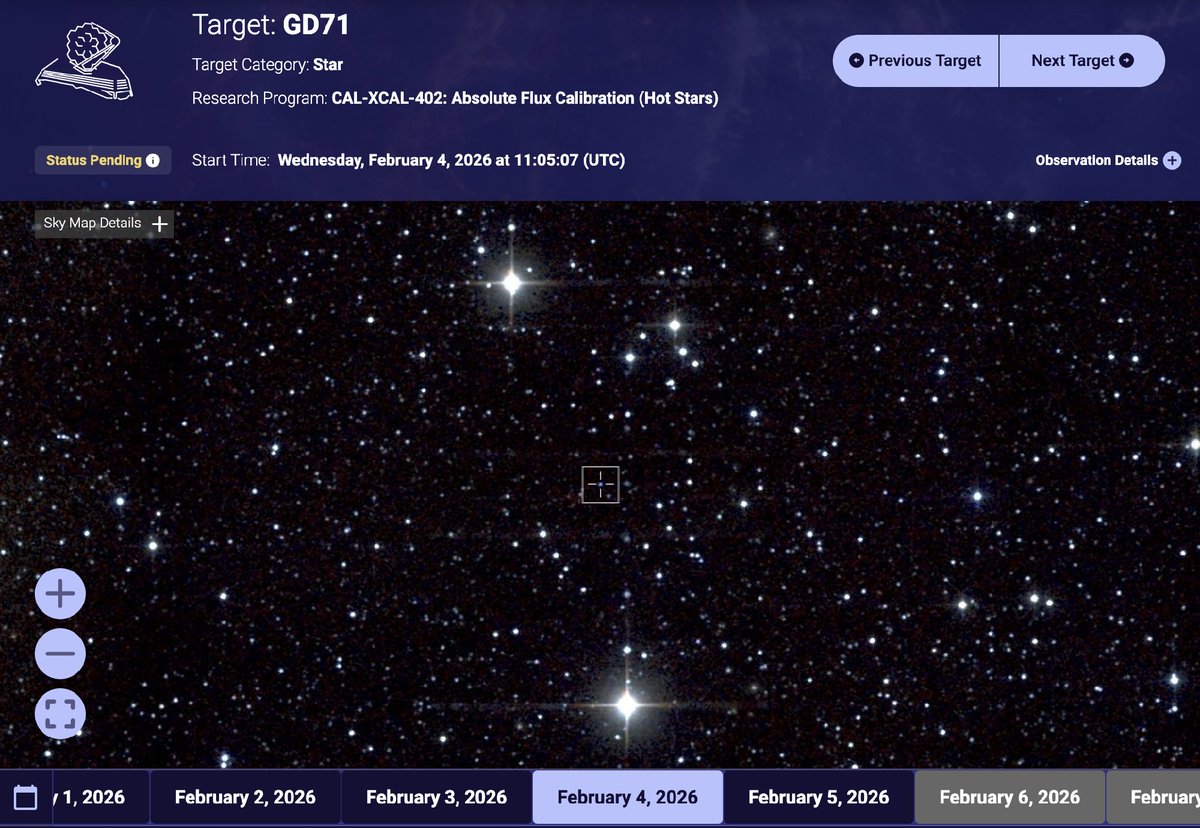
If you've ever wondered what Hubble and Webb were observing at any time? 👀 Space Telescope Live can show you what the telescopes are looking at now and what the next planned observation will be, all in one space (pun intended 😁): spacetelescopelive.org

If you've ever wondered what Hubble and Webb were observing at any time? 👀 

Space Telescope Live can show you what the telescopes are looking at now and what the next planned observation will be, all in one space (pun intended 😁): spacetelescopelive.org
Hugh Ross (@rtb_hross) 's Twitter Profile Photo

Astronomers confirm a major prediction of the big bang creation model where dark energy is the universe's dominant component & cold dark matter is the 2nd most abundant component. They found a starless massive gas cloud in M94's halo. The hydrogen gas in this cloud has a mass

Alejandro Benítez-Llambay (@bllalejandro) 's Twitter Profile Photo

py-sphviewer 2.0 is now live on GitHub. Rebuilt with a novel super fast algorithm. Native C++ multithreading. Native rotations and panning. Deferred Rendering, and more. Is it worth a try? Ask Grok 😉 Source, Intallation & Tutorials here: github.com/alejandrobll/p…

Scientific American (@sciam) 's Twitter Profile Photo

The galaxy, also known as Messier 104, gets its nickname from its central bulge and outer dust trail, which gives it a sombrero-like appearance from our vantage point spklr.io/6019EK9QU