Adkirf (@adkirf) 's Twitter Profile
Adkirf

@adkirf

GTM Engineer at b2b AI startup. honest opinions about whats works & what doesn't. 'Pragmatic Automation' with n8n.

ID: 1474147337459097606

calendar_today23-12-2021 22:38:18

466 Tweet

138 Followers

62 Following

Adkirf (@adkirf) 's Twitter Profile Photo

Many agentic workflows need to reliably call deterministic tools without diluting the context. n8n works well for this, as it gives you perfect insight into how a tools was used and what happened. Targeted iterations of tools. Less AI cost. Faster speed. Control over what output

Adkirf (@adkirf) 's Twitter Profile Photo

In other words: The biggest AI prize is compounding isolated AI outputs into production systems. karpathy: "The biggest prize is in figuring out how you can keep ascending the layers of abstraction to set up long-running orchestrators with all of the right tools, memory and

Adkirf (@adkirf) 's Twitter Profile Photo

5% error rate doesn't sound bad until you do the math. A workflow that runs 100 times with 5 failures isn't always a problem. Depends entirely on what kind of failure. Some failures are just lost value. The enrichment step returns nothing, but the the contract draft still goes

5% error rate doesn't sound bad until you do the math.

A workflow that runs 100 times with 5 failures isn't always a problem. Depends entirely on what kind of failure.

Some failures are just lost value. The enrichment step returns nothing, but the the contract draft still goes
Adkirf (@adkirf) 's Twitter Profile Photo

Your automation either improves or deteriorates over time. Incrementalism can be your friend or enemy. The difference is whether you're watching the outcome. The question to always ask yourself, “Are you cooking… Stone soup?” start small, let reality contribute, end up with a

Adkirf (@adkirf) 's Twitter Profile Photo

Don't aim for perfect automation on day one. Flag everything uncertain. Only write to the CRM when you're 120% sure. Route everything else to a human with a direct link and enough context to fix it in 30 seconds. Let the workflow tell you what it can't handle yet.

Adkirf (@adkirf) 's Twitter Profile Photo

"If you're digging your grave, don't dig it faster.” - Elon Musk The manual workflow is often slow, repetitive, and error-prone. But it's still better than a bad automation.

Adkirf (@adkirf) 's Twitter Profile Photo

Copy-pasting nodes between workflows is a red flag. It means you have duplicated knowledge. When that logic changes, you'll update it in one place and forget the other four. Restructuring and Sub-workflows are the fix. Treat them like utility functions.

Adkirf (@adkirf) 's Twitter Profile Photo

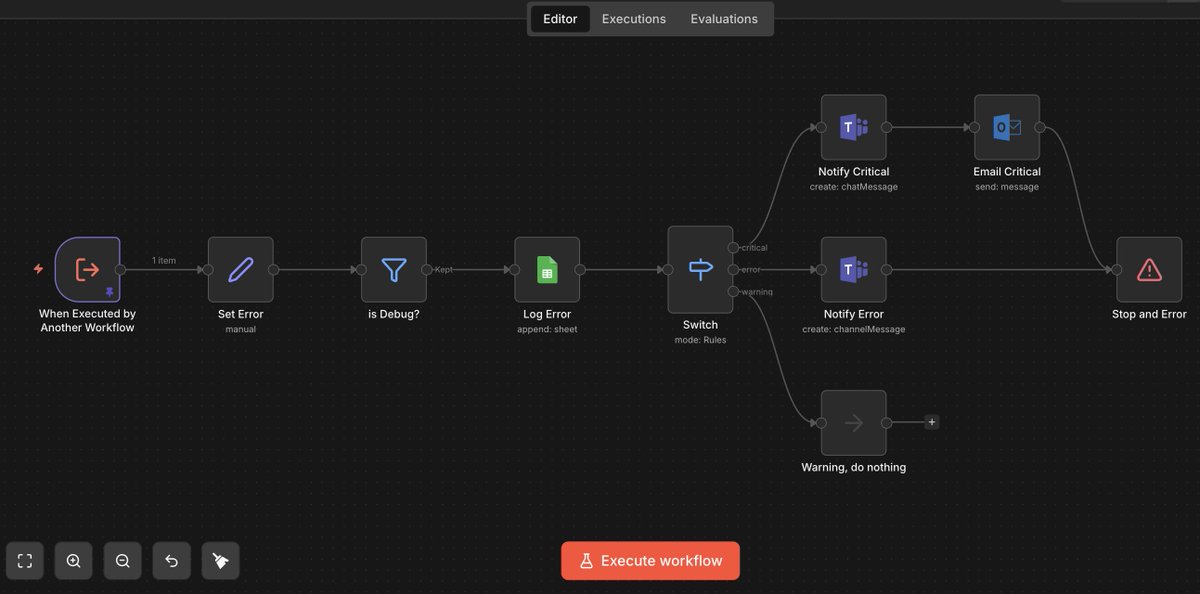
Every logged error or warning is a roadmap. Once you have installed a robust error handling with warnings (log but continue), errors (log and stop execution), criticals (log, stop and direct notification) you have a automatic roadmap builder. Review them weekly. Each one either

Adkirf (@adkirf) 's Twitter Profile Photo

Don't Repeat Yourself isn’t just for software code Most developers apply it to code. Pragmatic automators apply it to business logic. Your deduplication rules, scoring criteria, routing logic. One place. Not five.

Adkirf (@adkirf) 's Twitter Profile Photo

Learn how to distinguish these two types of automation failures. Warnings. Partially lost value, but nothing break or produces wrong output. These failures are actually ok, and can be useful to get the automation going and improve on real world issues. The enrichment step

Adkirf (@adkirf) 's Twitter Profile Photo

The only automation where you actually need 100% reliability: your error handler. Keep it dead simple. Every extra node is a new failure point.

Adkirf (@adkirf) 's Twitter Profile Photo

The one question to keep in the back of your head while building. "How badly can this fail, and what does fixing it cost?"

Adkirf (@adkirf) 's Twitter Profile Photo

Will this automation make the next one easier, or harder to manage? This is the most important question for a pragmatic automator. If you have dozens of workflows active in parallel, from small 5 nodes to large workflows with sub-workflows, maintaining and improving