Adam Farris (@adam_farris1) 's Twitter Profile
Adam Farris

@adam_farris1

ID: 1205937092540264448

calendar_today14-12-2019 19:46:30

3,3K Tweet

951 Followers

823 Following

alexis.toumi (@alexistoumi) 's Twitter Profile Photo

It's really knot my expertise but one thing DisCoPy would be strong at is computational knot theory: apply a functor on two knot diagrams, if the result is different then the knots are too! We just need to find an efficient implementation of a tortile category!

It's really knot my expertise but one thing DisCoPy would be strong at is computational knot theory: apply a functor on two knot diagrams, if the result is different then the knots are too!

We just need to find an efficient implementation of a tortile category!
Leo Du (@leoduw) 's Twitter Profile Photo

The PCFG community is well aware of this fact, and has a name for the PCFGs that sum to less than 1 over all finite trees. These are called non-tight PCFGs. One might ask the same question for LMs. 2/n

Cristian Bodnar (@crisbodnar) 's Twitter Profile Photo

🚀Today, I successfully defended my PhD thesis on Topological Deep Learning Cambridge Computer Science📖. I was honoured to discuss my work with my examiners, Max Welling and Jose Miguel Hernández-Lobato. Very grateful to everyone who has been part of this journey and in particular to Pietro Lio'!
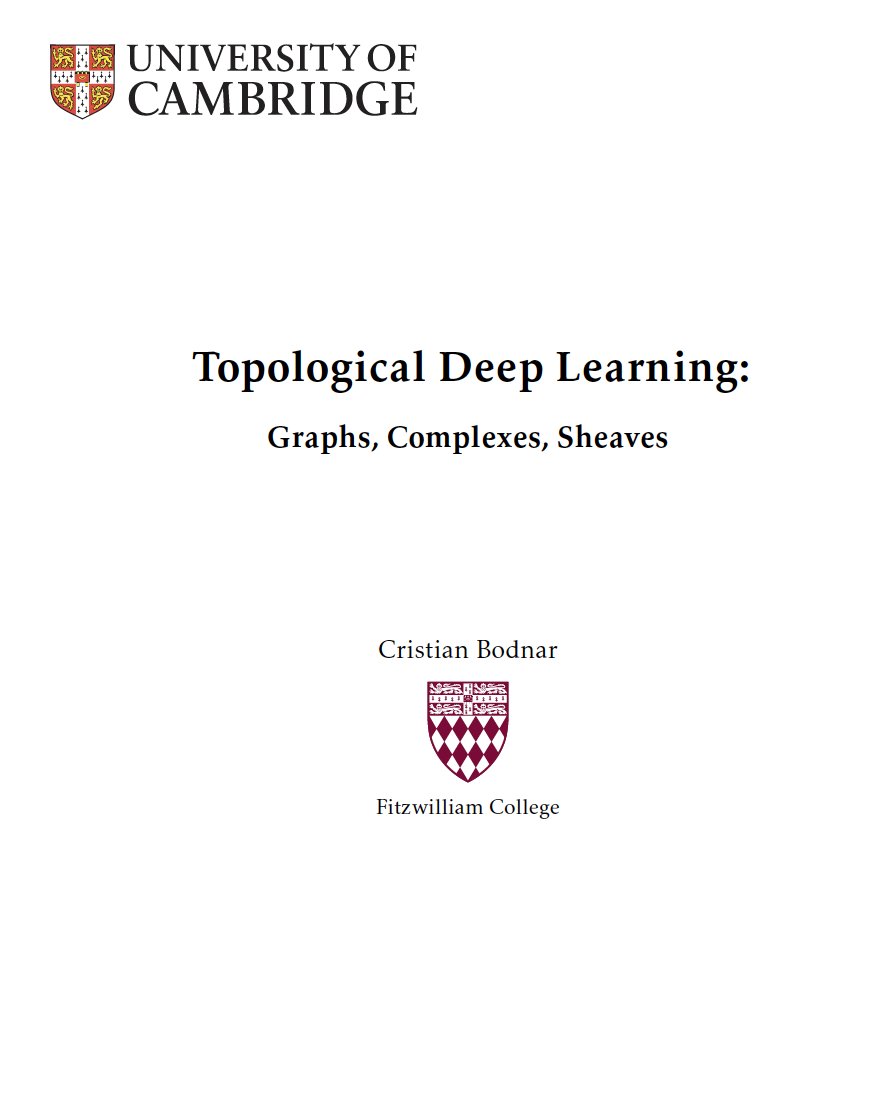
🚀Today, I successfully defended my PhD thesis on Topological Deep Learning <a href="/Cambridge_CL/">Cambridge Computer Science</a>📖. 

I was honoured to discuss my work with my examiners, <a href="/wellingmax/">Max Welling</a> and <a href="/jmhernandez233/">Jose Miguel Hernández-Lobato</a>. Very grateful to everyone who has been part of this journey and in particular to <a href="/pl219_Cambridge/">Pietro Lio'</a>!
Johannes Brandstetter (@jo_brandstetter) 's Twitter Profile Photo

Geometric Clifford Algebra Networks (GCANs) are a new learning paradigm where symmetry group transformations are encoded as geometric templates into neural network layers.

Jason Hise (@jasonhise64) 's Twitter Profile Photo

So you’ve heard of the Fourier transform. It lets you express a function as a sum of sines and cosines of increasing frequency. Is there an equivalent 3D Hopf transform? Where any incompressible 3D fluid motion can be expressed as a sum of families of linked toroidal velocities?

Brendan ⚣ (@grassmannian) 's Twitter Profile Photo

@taz_chu you can develop a theory of smooth manifolds via their rings of global smooth functions! see the book Smooth Manifolds and Observables by Jet Nestruev

Anindita Maiti (@aninditamaiti7) 's Twitter Profile Photo

Excited to share our new work on field theories in neural network architectures - arxiv.org/abs/2307.03223. We investigate origin of non-Gaussianities, construction of field actions, and aspects of local Lagrangians. Had fun on this project with Jim Halverson and others!

Miloš Stanojević (@milosstanojevic) 's Twitter Profile Photo

Today we are open-sourcing SynJax which is a JAX library for efficient probabilistic modeling of structured objects (sequences, segmentations, alignments, trees...). It can compute everything you would expect from a probability distribution: argmax, samples, marginals, entropy...

Matteo Capucci (@mattecapu) 's Twitter Profile Photo

This preprint has an exuberant energy, I love it. There's some technical bits here and there to iron out but the idea is that entropy is an insanely general functional you can define on basically any indexed monoidal category!

Simon Pepin Lehalleur (@plain_simon) 's Twitter Profile Photo

The log-canonical threshold (lct) is a subtle invariant of embedded singularities in complex geometry. It is a purely analytic invariant, but it also expresses common properties of resolution of singularities, and can also surprisingly be computed by reduction mod large primes.

Some theorems (@cihanpoststhms) 's Twitter Profile Photo

The complex analytic surface â„‚* x â„‚* admits continuum many pairwise non-isomorphic algebraic (variety) structures.

Some theorems (@cihanpoststhms) 's Twitter Profile Photo

Given complex K3 surfaces X,Y, TFAE: (1) There is a Hodge isometry H²(X;ℤ) ≅ H²(Y;ℤ). (2) X ≅ Y.