Yui Takeshita
@takeshitalab
ID: 824335576098697216
25-01-2017 19:18:11
42 Tweet
233 Followers
43 Following
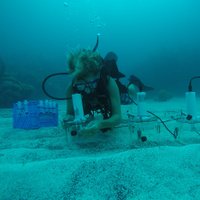
Sighting of the rare and enigmatic 𝑺𝒄𝒊𝒆𝒏𝒕𝒊𝒇𝒊𝒄𝒖𝒔 𝒅𝒊𝒗𝒆𝒓𝒖𝒔 searching for their instruments in Mission Bay this morning. Yui Takeshita Melissa Ward
We just published a review paper on the advancements of autonomous observations of the marine carbonate system over the last 5 years or so. Enjoy! @SethBushinsky Dr. Nancy Williams link.springer.com/article/10.100…
Congratulations to our Director of Communications Heidi Cullen who shares the 2019 National Center for Science Education Friend of the Planet award, for her work with Climate Parents -- helping families and teachers talk about #climatechange: ow.ly/4BLJ50uoZT9 #SciComm

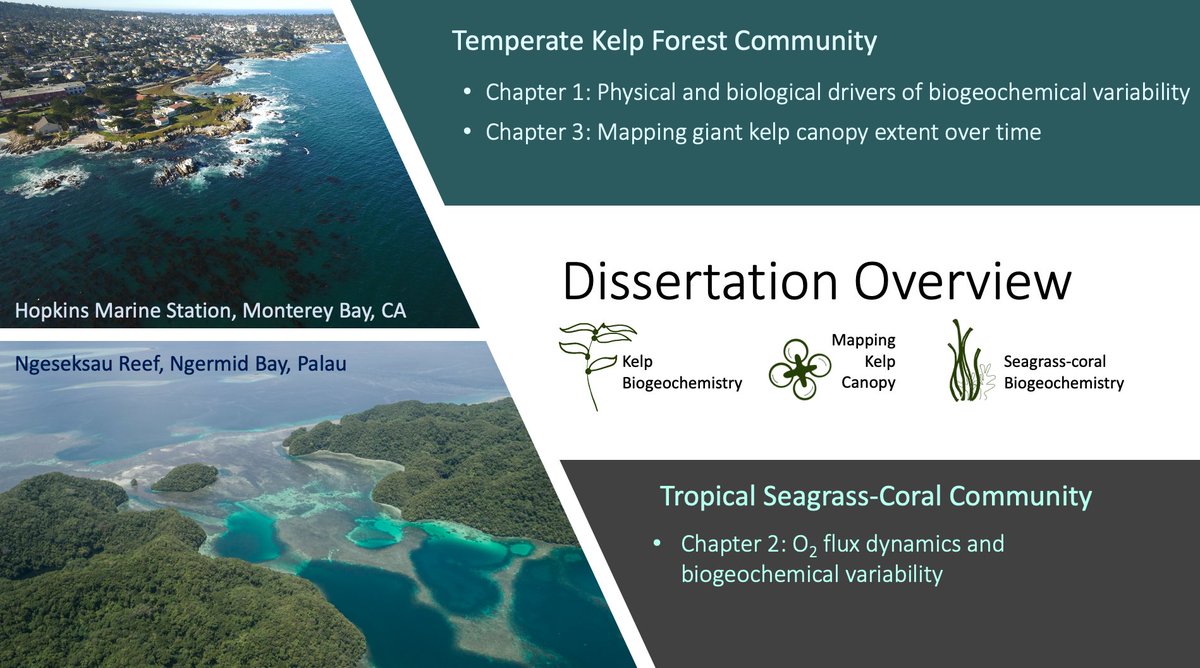
Congratulations Dr. Heidi Hirsh for her excellent paper on exploring the potential for kelp forests to locally ameliorate ocean acidification stress! agupubs.onlinelibrary.wiley.com/doi/10.1029/20… Kerry J. Nickols @StanfordEarth Dr. Sarah Traiger MBARI
Another press release for the paper by Dr. Heidi Hirsh!
Our paper led by Dr. Phil Bresnahan on a self-calibrating ISFET pH sensor is out! Our hope is to address the challenges associated with calibrating ISFET sensors for more effective sensor observational networks for ocean acidification! aslopubs.onlinelibrary.wiley.com/doi/full/10.10…
Our paper describing the performance of pH sensors on Spray gliders just came out! It also includes a simple method to calibrate O2 optodes in air, with 1% accuracy, and assessment of algorithms to correct for pH sensor drift along the CCS. Check it out! journals.ametsoc.org/view/journals/…
Check out our new paper led by @RomanoOrte demonstrates that algae communities on recently dead corals can calcify as fast as corals during the day! What does this mean for using net calcification rate measurements as a proxy for reef health? aslopubs.onlinelibrary.wiley.com/doi/10.1002/ln…
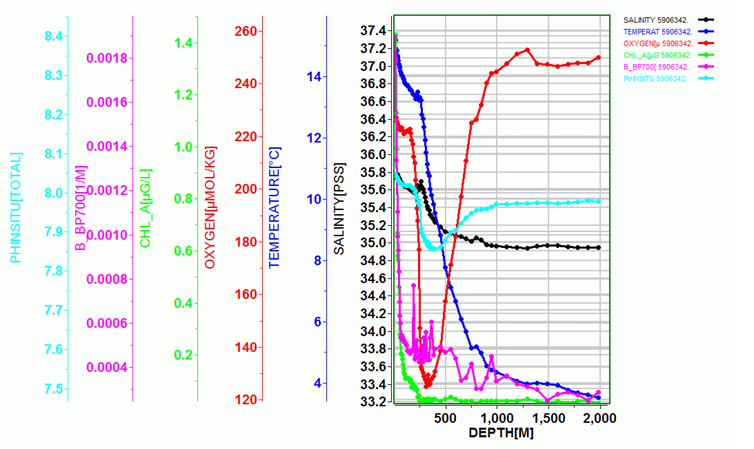
The first float was launched thanks to the support of the US GO-SHIP program and researchers aboard the A20 Expedition in the North Atlantic and has already sent data back to shore. Yui Takeshita quickly plotted the first profile so the team could begin tracking the data.
The most extensive study yet of how seagrasses—marine plants that form lush underwater meadows and provide critical food and habitat for myriad ocean life—can buffer ocean acidification was published today by UC Davis, UC Santa Cruz Science, and MBARI scientists: mbari.org/seagrasses-tur…
A new paper, led by Dr. Aurora M Ricart, shows the strong potential for seagrass meadows in California to buffer against ocean acidification stress, based on sensor deployments over multiple years. Check it out! UC Davis Bodega Marine Laboratory UC Santa Cruz Science MBARI onlinelibrary.wiley.com/doi/full/10.11…