Graphsignal (@graphsignalai) 's Twitter Profile
Graphsignal

@graphsignalai

Inference Observability

ID: 1102178345725374466

linkhttps://graphsignal.com calendar_today03-03-2019 12:06:09

77 Tweet

345 Takipçi

373 Takip Edilen

Graphsignal (@graphsignalai) 's Twitter Profile Photo

Learn how to trace, monitor and debug #LlamaIndex applications in production and development. graphsignal.com/blog/tracing-a…

Rich Stone (@rstone57) 's Twitter Profile Photo

66% of organizations report their technology investments will be easier to justify if they support a #GenAI initiative bit.ly/3FtFKRm via Enterprise Strategy Group

elvis (@omarsar0) 's Twitter Profile Photo

Improving Information Retrieval in LLMs One effective way to use open-source LLMs is for search tasks, which could power many other applications. This work explores the use of instruction tuning to improve a language model's proficiency in information retrieval (IR) tasks.

Improving Information Retrieval in LLMs

One effective way to use open-source LLMs is for search tasks, which could power many other applications.

This work explores the use of instruction tuning to improve a language model's proficiency in information retrieval (IR) tasks.
Graphsignal (@graphsignalai) 's Twitter Profile Photo

#AI observability is evolving. Today's tools not only monitor AI performance but also unravel complex model behaviors, enhancing transparency and reliability.

Graphsignal (@graphsignalai) 's Twitter Profile Photo

Learn how to measure and analyze LLM streaming performance using time-to-first-token metrics and traces ➡️ graphsignal.com/blog/measuring…

Learn how to measure and analyze LLM streaming performance using time-to-first-token metrics and traces

➡️ graphsignal.com/blog/measuring…
Graphsignal (@graphsignalai) 's Twitter Profile Photo

New post: AI Debugging and Optimization For Production Inference graphsignal.com/blog/ai-debugg… Use Claude Code to debug and optimize AI systems with rich production context from Graphsignal

dstack (@dstackai) 's Twitter Profile Photo

Now Graphsignal integrates with dstack — add SGLang profiling, tracing, and GPU metrics to your inference services. pip install 'graphsignal[cu12]' + wrap with graphsignal-run. That's it. graphsignal.com/docs/integrati…

Now <a href="/GraphsignalAI/">Graphsignal</a> integrates with dstack — add <a href="/sgl_project/">SGLang</a> profiling, tracing, and GPU metrics to your inference services.

pip install 'graphsignal[cu12]' + wrap with graphsignal-run. That's it.

graphsignal.com/docs/integrati…
dstack (@dstackai) 's Twitter Profile Photo

Agent orchestration is evolving fast! Agents + orchestration + telemetry → closed-loop systems. Our friends at GraphSignal show how this unlocks continuous inference optimization in production — across heterogeneous hardware. This is where things get interesting.

Andrey Cheptsov (@andrey_cheptsov) 's Twitter Profile Photo

Config tuning is just the start. The same loop can optimize inference code and even custom CUDA kernels. It all depends on what tools the agent can use.

dstack (@dstackai) 's Twitter Profile Photo

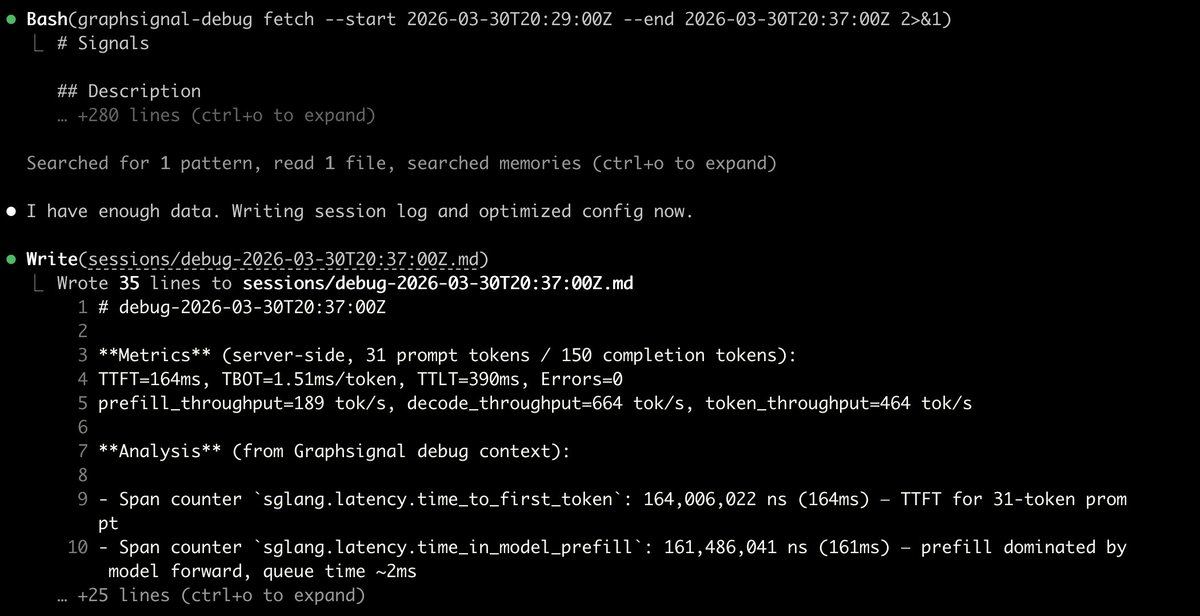
autodebug by Graphsignal is a closed-loop system for inference optimization. It uses dstack to provision GPUs and redeploy services on each pass through the loop: benchmark → read profiling telemetry → tweak config → redeploy → repeat. What's interesting here is

autodebug by <a href="/GraphsignalAI/">Graphsignal</a> is a closed-loop system for inference optimization. 

It uses <a href="/dstackai/">dstack</a> to provision GPUs and redeploy services on each pass through the loop: 

benchmark → read profiling telemetry → tweak config → redeploy → repeat. 

What's interesting here is