
Grant Kinsler
@grantkinsler
Postdoc with @arjunrajlab. Thinking about mutations, cells, and evolution. PhD with @PetrovADmitri. He/him.
ID: 3528986723
https://www.seas.upenn.edu/~gkinsler/ 03-09-2015 01:26:05
713 Tweet
715 Takipçi
687 Takip Edilen

I’m very excited to share my PhD work on how age impacts tumor development and suppression. A huge thank you to Monte Winslow's Lab, Dmitri Petrov and all the co-authors for their support, wisdom, and patience (aging takes time!) over the past 5+ years. biorxiv.org/content/10.110… (1/n)
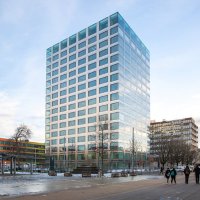
Exciting news: Yuping Li and David Brückner (David Brückner) have been appointed as new Assistant Professors Biozentrum, University of Basel University of Basel. Li studies bacteria-jumbophage interactions, and Brückner explores the dynamics of multicellular systems. ow.ly/UlqP50StwWV


Now out in MBE! Fitness assays often involve barcoding, but barcode-dependent amplification bias can cause fitness misestimates. We present a method to detect/remove such bias with no changes to the exp. protocol. doi.org/10.1093/molbev… Ryan Seamus McGee Grant Kinsler Dmitri Petrov 1/2




Join us! The Machado Lab at Cambridge University is looking for an enthusiastic RA to be a core member of the team and lead the lab's data generation efforts, seeking to understand how tumour and immune cells co-evolve and contribute to cancer progression. jobs.cam.ac.uk/job/47922/

Is there more than one mechanism underlying resistance to an antifungal drug? How many mechanisms are there? Kara Schmidlin and Sam Apodaca explore these questions in their paper out today in final form at eLife - the journal! elifesciences.org/articles/94144 (1/9)

It looks like I never posted anything (*but see below) on what are probably the most surprising results my lab obtained so far. Anyway, this work—led by an outstanding former PhD student Sarah Ardell in collaboration with Milo Johnson—is now published: science.org/doi/10.1126/sc…




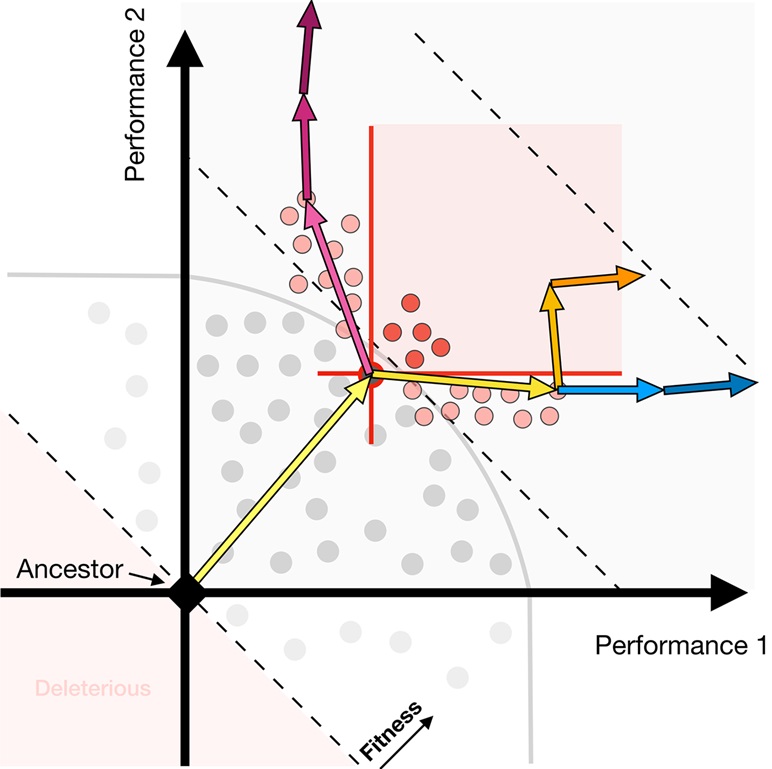
Two stages of evolution... Grant Kinsler Gavin Sherlock Dmitri Petrov use #ExperimentalEvolution in yeast to show that while 1st-step mutants appear pleiotropic in nature, 2nd-step mutations show a shift towards modular adaptation #PLOSBiology plos.io/4glXoXJ