Katelyn Cranney (@cranneykatelyn) 's Twitter Profile
Katelyn Cranney

@cranneykatelyn

@StanfordEcon Stanford Econ PhD Student, Former Research Assistant @HarvardHBS

ID: 1656327579622850565

linkhttps://www.katelyncranney.com calendar_today10-05-2023 15:57:32

27 Tweet

149 Takipçi

771 Takip Edilen

Tim Stearns (@stearnslab) 's Twitter Profile Photo

Postdocs aren’t prepared for leadership roles in academia and industry. We’re doing something about it at Rockefeller University! Great three-day workshop put on by Rem Koning and Kyle Myers from Harvard Business School and Solene Delecourt from UC Berkeley Haas on “Managing Science & Scientists”


Postdocs aren’t prepared for leadership roles in academia and industry. We’re doing something about it at <a href="/RockefellerUniv/">Rockefeller University</a>! 

Great three-day workshop put on by <a href="/orgRem/">Rem Koning</a> and Kyle Myers from <a href="/HarvardHBS/">Harvard Business School</a> and <a href="/solenedelecourt/">Solene Delecourt</a> from <a href="/BerkeleyHaas/">UC Berkeley Haas</a> on “Managing Science &amp; Scientists”
Laura K Gee (@laurakgee) 's Twitter Profile Photo

I struggle to identity as a "mom" (oddly easier to identify as an Economist). My worlds are colliding as my go-to for parenting advice Emily Oster highlighted my research with kristy buzard & Olga Stoddard on gender inequality in demands for involvement parentdata.org/why-schools-al…

Olga Shurchkov (@olgashurchkov) 's Twitter Profile Photo

Disclosing higher salary increases salary offers; women are penalized less for not disclosing past salary than men are Laura K Gee presenting her work with Amanda Agan and Bo Cowgill at NBER SI #nbersi2023


Disclosing higher salary increases salary offers; women are penalized less for not disclosing past salary than men are <a href="/LauraKGee/">Laura K Gee</a> presenting her work with <a href="/AmandaYAgan/">Amanda Agan</a> and <a href="/bocowgill/">Bo Cowgill</a> at <a href="/nberpubs/">NBER</a> SI #nbersi2023
NBER (@nberpubs) 's Twitter Profile Photo

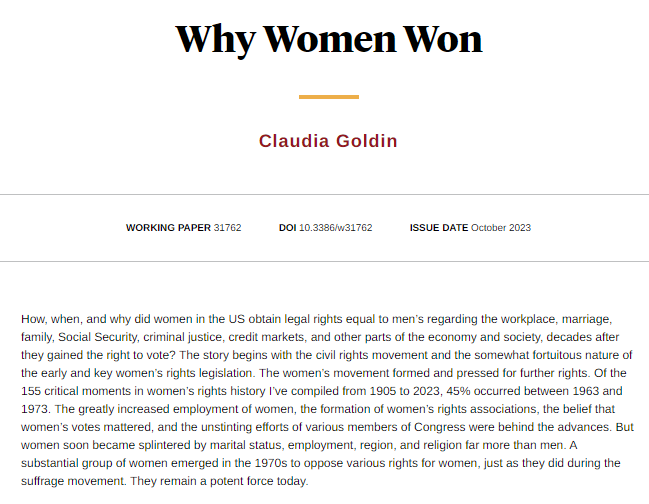
How, when, and why women in the US obtained legal rights equal to men’s regarding the workplace, marriage, family, SS, credit markets, and elsewhere in the economy, from Claudia Goldin nber.org/papers/w31762

How, when, and why women in the US obtained legal rights equal to men’s regarding the workplace, marriage, family, SS, credit markets, and elsewhere in the economy, from <a href="/PikaGoldin/">Claudia Goldin</a> nber.org/papers/w31762
Johanna Rickne (@johannarickne) 's Twitter Profile Photo

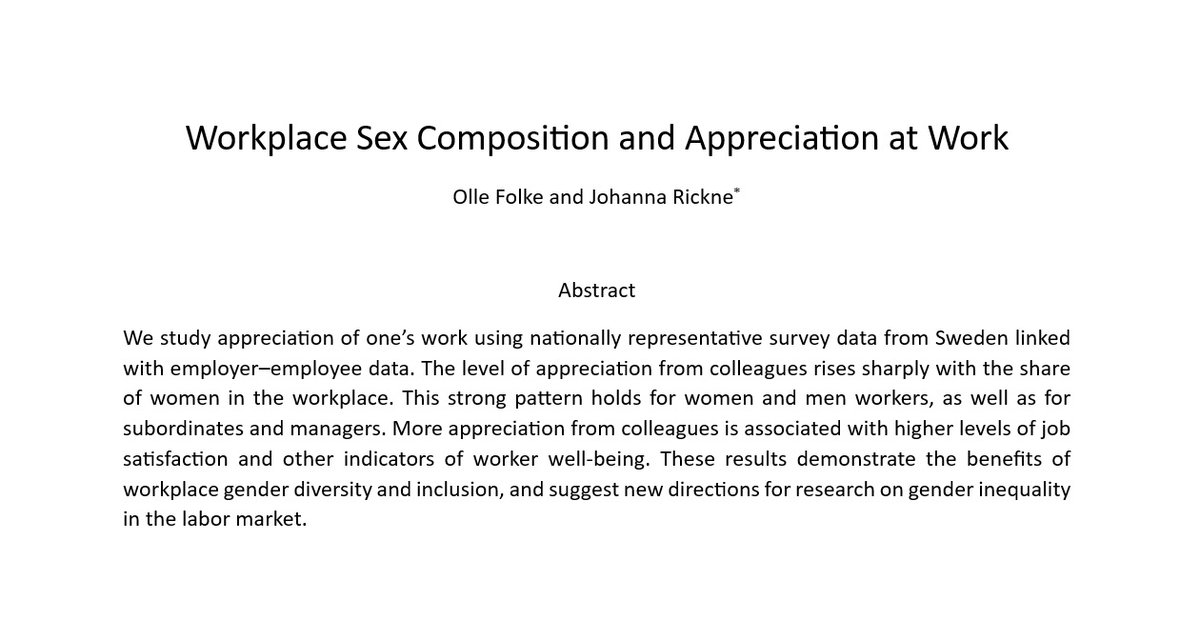
“Women spend so much more energy being nice to people in the workplace! When will they ever get credit for that?!” This audience question is common in our public talks about research on gender equality in the labor market. Our new paper gives striking evidence on this point. 1/7

“Women spend so much more energy being nice to people in the workplace! When will they ever get credit for that?!” This audience question is common in our public talks about research on gender equality in the labor market. Our new paper gives striking evidence on this point. 1/7
Johanna Rickne (@johannarickne) 's Twitter Profile Photo

People in workplaces with a larger share of women are much more likely to say that they receive appreciation for their work. This is true for both women and men employees in workplaces with more women, and for people who manage these workplaces. 2/7

People in workplaces with a larger share of women are much more likely to say that they receive appreciation for their work. This is true for both women and men employees in workplaces with more women, and for people who manage these workplaces. 2/7
Olga Stoddard (@olgastoddard) 's Twitter Profile Photo

🥳🥹 Almost nine (!!) years after the first pilot, this paper with Chris Karpowitz, Stephen D. O'Connell & Jessica Preece is accepted JPE! It's been one of my favorite and most impactful projects, so including a short 🧵 below. Full paper here: tinyurl.com/bzhzmvj3
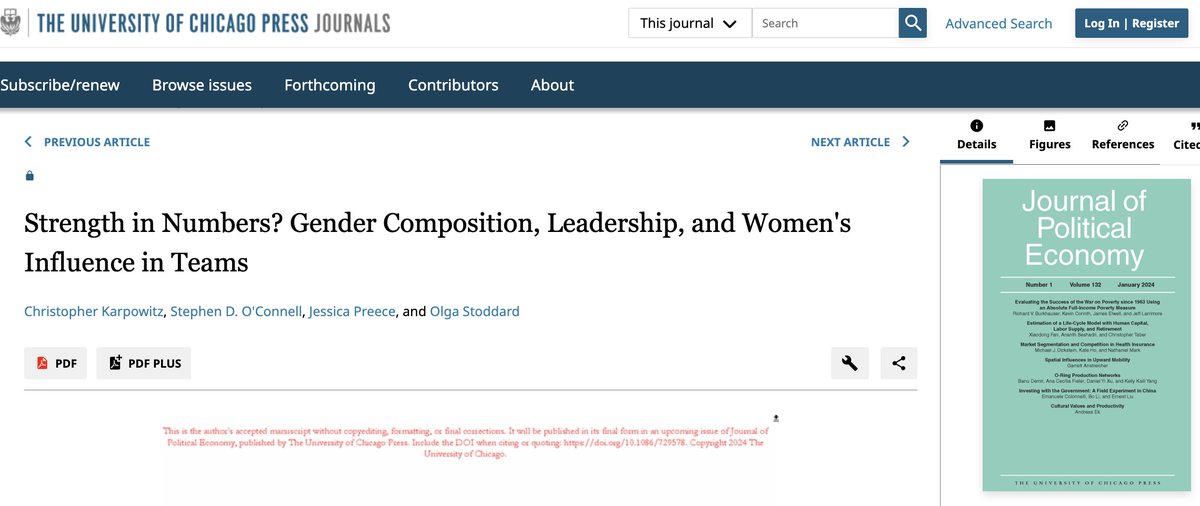
🥳🥹 Almost nine (!!) years after the first pilot, this paper with <a href="/ProfKarpo/">Chris Karpowitz</a>, <a href="/steveoconnell1/">Stephen D. O'Connell</a> &amp; <a href="/jrpjrpjrp/">Jessica Preece</a> is accepted <a href="/JPolEcon/">JPE</a>!

It's been one of my favorite and most impactful projects, so including a short 🧵 below. Full paper here:
tinyurl.com/bzhzmvj3

Olga Stoddard (@olgastoddard) 's Twitter Profile Photo

Can formal leadership structure reduce disparities in influence? YES! Halfway through the study, we randomly assign a team leader & find that the gender of the leader make a BIG difference. Female leaders improve women's influence, male leaders make things slightly worse. 6/n

Can formal leadership structure reduce disparities in
influence? YES! 

Halfway through the study, we randomly assign a team leader &amp; find that the gender of the leader make a BIG difference. Female leaders improve women's influence, 
male leaders make things slightly worse. 6/n
Ethan Mollick (@emollick) 's Twitter Profile Photo

Research keeps findings a large and puzzling gender gap in AI adoption, "from mothers in Mumbai to managers in Madrid." Even in an experiment where men and women get equal access, men use AI more. Why is unclear. Given that AI experience makes you good at AI, this is a big issue

Research keeps findings a large and puzzling gender gap in AI adoption, "from mothers in Mumbai to managers in Madrid." Even in an experiment where men and women get equal access, men use AI more. Why is unclear.

Given that AI experience makes you good at AI, this is a big issue