Brain Energy (@brainenergylab) 's Twitter Profile
Brain Energy

@brainenergylab

We are the Brain Energy Lab at the University of Sussex, led by Dr Catherine Hall. We use several imaging techniques to probe neurovascular function.

ID: 806783304359813120

linkhttp://www.brainenergylab.com calendar_today08-12-2016 08:51:43

329 Tweet

638 Takipçi

711 Takip Edilen

Anusha Mishra (@mishra_cbf_lab) 's Twitter Profile Photo

Our lab's FIRST paper showing neurovascular coupling is impaired after stroke in regions outside the infarct due to increased 20-HETE is finally out!! Fantastic work by Zhenzhou Li, Heather Heather McConnell, PhD, Teresa Teresa Stackhouse 🏳️‍🌈 and colleagues! SO proud! frontiersin.org/articles/10.33…

Dr Osman Shabir (@shabir_osman) 's Twitter Profile Photo

Our paper is now out in eLife - the journal! elifesciences.org/articles/68242 Assessment of #neurovascular coupling and cortical spreading depression (#CSD) in mixed mouse models of #atherosclerosis and #Alzheimer’s disease Neuroscience Institute @ShefUni_IICD Sheffield Neurovascular Lab Healthy Lifespan Institute The University of Sheffield

Catherine Hall (@cathnaledi) 's Twitter Profile Photo

Thanks Brain Energy Matt Hammond-Haley Dr. Silvia Anderle @kirashaw and everyone else, including Davina Amin, who took the first images for this paper too many years ago. Sorry it's taken so long to put it all together!

Dr. Silvia Anderle (@anderlesilvia) 's Twitter Profile Photo

Out today! Check out our paper to learn that neurovascular function and mural cell types down the cerebrovascular network change gradually, therefore indicating that there is not a clear boundary between arteriole and capillaries. frontiersin.org/article/10.338…

Brain Energy (@brainenergylab) 's Twitter Profile Photo

Check out our lab's latest paper! We used novel and existing data to show that there is a gradual change in vascular function and mural cell population across the vascular network, indicating that there isn't a clear boundary between arterioles and capillaries.

Dr Oli Steele (@ogsteele) 's Twitter Profile Photo

Echoing a 4-year (?!) old tweet that still resonates; mine & Alex Stuart’s new review (onlinelibrary.wiley.com/doi/full/10.11…), out in European Journal of Neuroscience, agrees ApoE does literally everything and suggests a novel multi-hit hypothesis of APOE4 mediated pathology … a thread (1/14)


Dr. Axel Montagne, PhD (@axl_montagne) 's Twitter Profile Photo

🚨 Happy to launch a new Research Topic in Frontiers in Aging Neuroscience! 😃 👇🏻👇🏻👇🏻👇🏻👇🏻👇🏻 Imaging of the blood-brain barrier in Alzheimer's disease and related disorders frontiersin.org/research-topic… Feel free to reach out if interested and please RT 🙏🏻

British Neuroscience Association (@britishneuro) 's Twitter Profile Photo

🌟#BNA2023 REGISTRATION & ABSTRACT SUBMISSION opens TOMORROW! 🏖️Don't miss out on the #neuroscience event of 2023: take your first look at the international programme & get ready to book your spot at the seaside! 🧠Programme here: ow.ly/1Lcv50KNA4J

🌟#BNA2023 REGISTRATION & ABSTRACT SUBMISSION opens TOMORROW!
🏖️Don't miss out on the #neuroscience event of 2023: take your first look at the international programme & get ready to book your spot at the seaside!
🧠Programme here: ow.ly/1Lcv50KNA4J
Dr. Silvia Anderle (@anderlesilvia) 's Twitter Profile Photo

Next Sunday I am running the London marathon and I'm fundraising for Alzheimer's Research UK. Check out my JustGiving page and please donate if you can. Thank you! #JustGiving justgiving.com/fundraising/si…

Catherine Hall (@cathnaledi) 's Twitter Profile Photo

Exciting news! I’m recruiting a PhD student to find out what happens to microglia when the brain’s oxygen levels fall. It’s a very cool project working with me and the excellent @DgnLab - in vivo imaging and omics! Get in touch if you’re interested or know someone who might be!!

Catherine Hall (@cathnaledi) 's Twitter Profile Photo

You can now apply for my PhD project with @DgnLab looking at how microglia respond to hypoxia! Details here: southcoastbiosciencesdtp.ac.uk/project/microg… and apply here: southcoastbiosciencesdtp.ac.uk/apply/ Please get in touch if you’re interested, address here profiles.sussex.ac.uk/p348374-cather…
Tiago Peçanha (@tiagopecanha) 's Twitter Profile Photo

Grear talk by Catherine Hall at the ECSS The University of Manchester on the differences between visual cortex and hippocampus in neurovascular function and implications for disease. Hippocampus seem to be more prone and sensitive to hypoxia, which might be relevant for the development of AD.

Grear talk by <a href="/cathnaledi/">Catherine Hall</a> at the ECSS <a href="/OfficialUoM/">The University of Manchester</a> on the differences between visual cortex and hippocampus in neurovascular function and implications for disease. 

Hippocampus seem to be more prone and sensitive to hypoxia, which might  be relevant for the development of AD.
Catherine Hall (@cathnaledi) 's Twitter Profile Photo

Our #LongCOVID mechanisms, risk factors and recovery review is out! It follows on from the The Physiological Society online conference of the same name earlier in the year. Hats of to all the amazing contributors ... physoc.onlinelibrary.wiley.com/doi/10.1113/EP…
Miguel Maravall (@mmaravall) 's Twitter Profile Photo

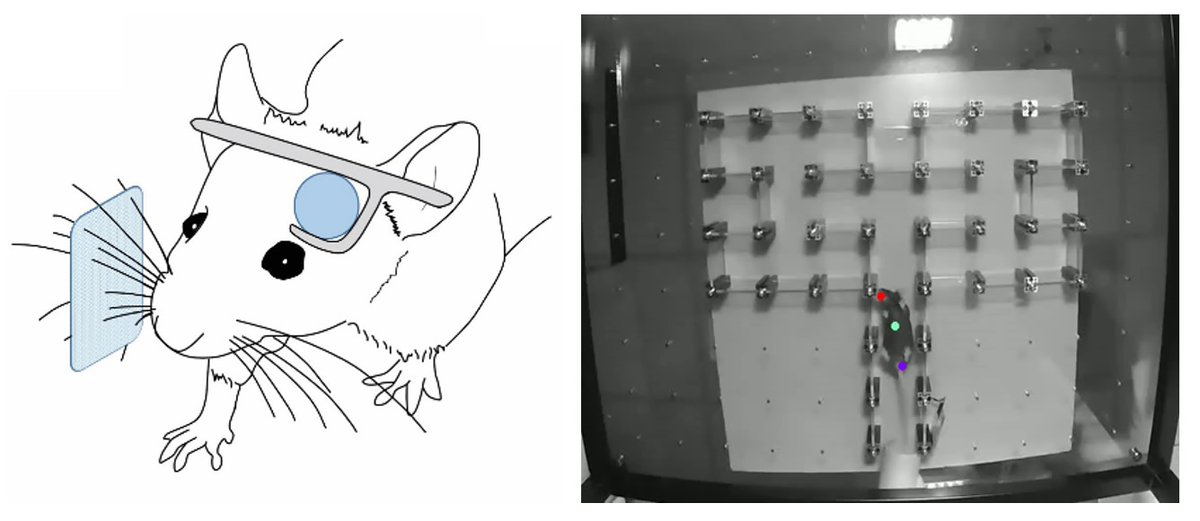
New postdoc in my lab funded by BBSRC! Project will investigate behaviour and neuronal responses in mice performing goal-directed tasks guided by whisker input, either in head-fixed configuration combined with two-photon imaging, or in a novel freely-exploring configuration

New postdoc in my lab funded by BBSRC! Project will investigate behaviour and neuronal responses in mice performing goal-directed tasks guided by whisker input, either in head-fixed configuration combined with two-photon imaging, or in a novel freely-exploring configuration
Tyler Sloan (@quorumetrix) 's Twitter Profile Photo

I’ve made this video as an intuition pump for the density of #synapses in the #brain. This volume ~ grain of sand, has >3.2 million synapses (orange cubes). Peeling them away leaves only inputs on 2 #neurons. Zooming in, we see the synapses localized to the dendritic spines. #b3d

Adam Institoris (@adaminstitoris) 's Twitter Profile Photo

Our paper is out! nature.com/articles/s4146… With genetic Ca2+ clamping and chemogenetic activation of astrocytes, we show that astrocytes enhance neurovascular coupling when neuronal activation is sustained but not when activation is brief.

Our paper is out! 
nature.com/articles/s4146…
With genetic Ca2+ clamping and chemogenetic activation of astrocytes, we show that astrocytes enhance neurovascular coupling when neuronal activation is sustained but not when activation is brief.