Bertrand Russell (@bertranrussell) 's Twitter Profile
Bertrand Russell

@bertranrussell

No la gente no gusta que uno tenga su propria fe

ID: 1092111811170717696

calendar_today03-02-2019 17:25:21

198 Tweet

257 Takipçi

103 Takip Edilen

Cortecs (@collectifcortex) 's Twitter Profile Photo

En Avril, David et Nicolas, piqués par une étrange mouche, ont animé aux REC deux ateliers "science et politique". Retour sur ces ateliers « La science est-elle politique ? » 1/2 - On pose des questions tabous aux REC, et ça se passe bien ! cortecs.org/politique-soci…

En Avril, David et Nicolas, piqués par une étrange mouche, ont animé aux REC deux ateliers "science et politique". Retour sur ces ateliers

« La science est-elle politique ? » 1/2 - On pose des questions tabous aux REC, et ça se passe bien !

cortecs.org/politique-soci…
Adam Grant (@adammgrant) 's Twitter Profile Photo

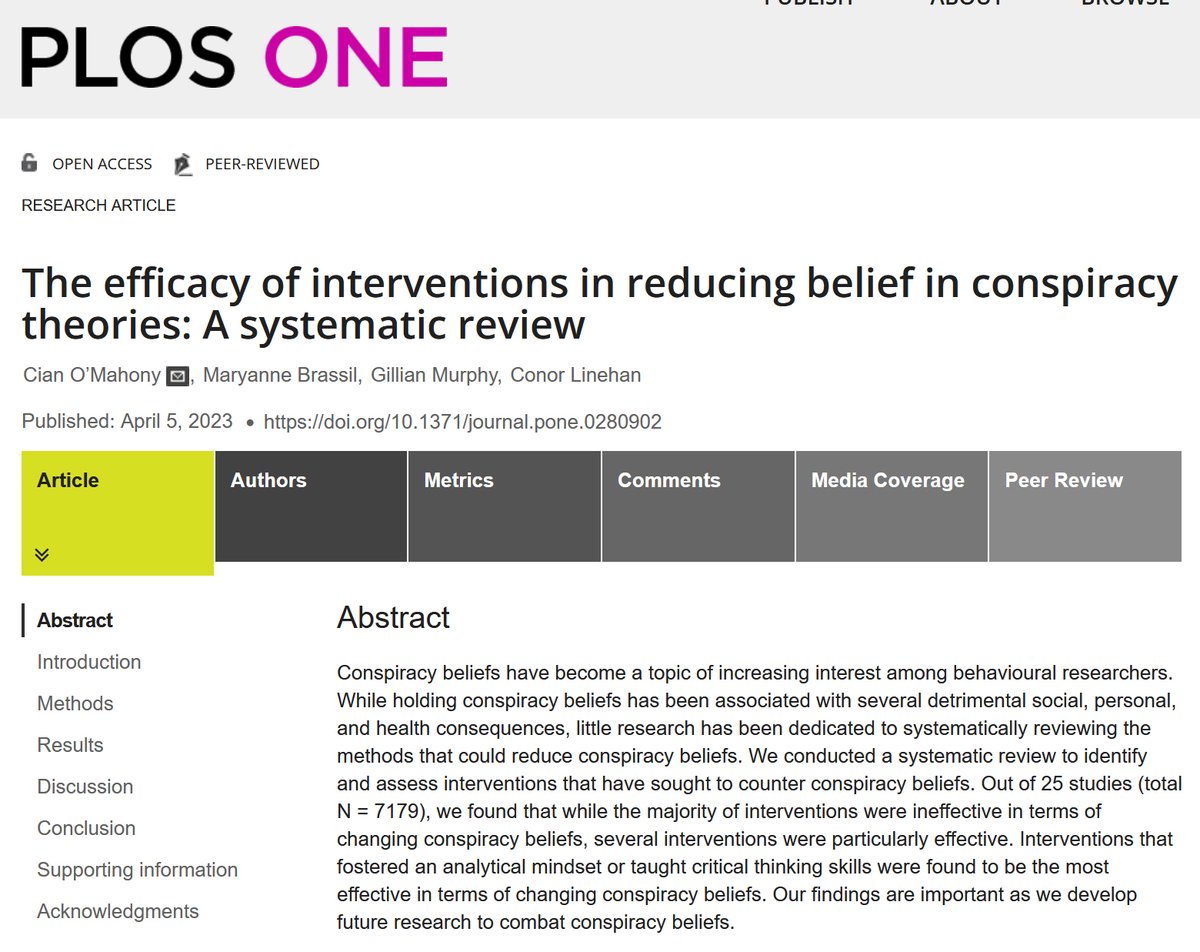
With false claims, debunking is less effective than prebunking. 25 studies: rebuttals and fact checks don't do much to change minds. We're better off training people to spot flaws in logic and data. The most important part of education is teaching critical thinking skills.

With false claims, debunking is less effective than prebunking.

25 studies: rebuttals and fact checks don't do much to change minds. We're better off training people to spot flaws in logic and data.

The most important part of education is teaching critical thinking skills.
Enthalpiste (@enthalpiste) 's Twitter Profile Photo

Y a un concept dont le milieu "éducation aux média" et "esprit critique" s'est emparé, selon moi, un peu vite et sur lequel il raconte pas mal de merde, c'est l'idée de bulle de filtre sur internet. Et y a un papier intéressant qui vient de sortir dans Nature sur le sujet.⤵️

Dan Williams (@danwilliamsphil) 's Twitter Profile Photo

A better question is how anybody ever managed to form true beliefs about an unimaginably complex, counter-intuitive reality to which they mostly have no direct access and are forced to learn about via vast, opaque chains of testimony. And the answer is that they mostly didn’t.

Jay Van Bavel, PhD (@jayvanbavel) 's Twitter Profile Photo

We have a new paper on "Social Media and Morality" in Annual Reviews | annualreviews.org/doi/10.1146/an… Nearly five billion people around the world now use social media, and this number continues to grow. One of the primary goals of social media platforms is to capture and monetize human
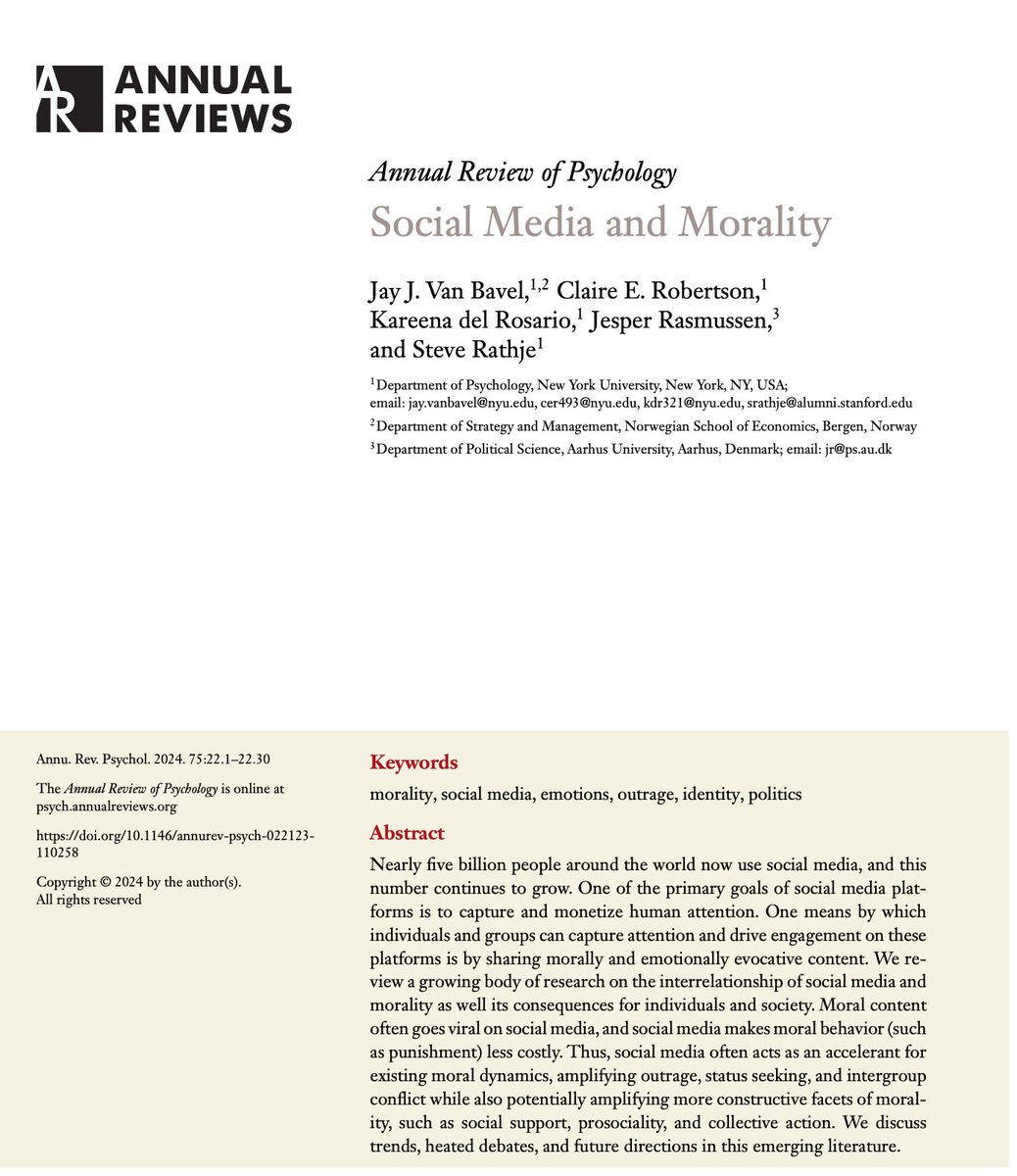

We have a new paper on "Social Media and Morality" in <a href="/AnnualReviews/">Annual Reviews</a> | annualreviews.org/doi/10.1146/an…
Nearly five billion people around the world now use social media, and this number continues to grow. One of the primary goals of social media platforms is to capture and monetize human
Steve Stewart-Williams (@stevestuwill) 's Twitter Profile Photo

Predictors of Conspiratorial Thinking Positive correlations imply that higher scores on the predictor are associated with more conspiratorial thinking; negative correlations imply that higher scores are associated with less.

Predictors of Conspiratorial Thinking

Positive correlations imply that higher scores on the predictor are associated with more conspiratorial thinking; negative correlations imply that higher scores are associated with less.
Emma Hoes (@emmahoes93) 's Twitter Profile Photo

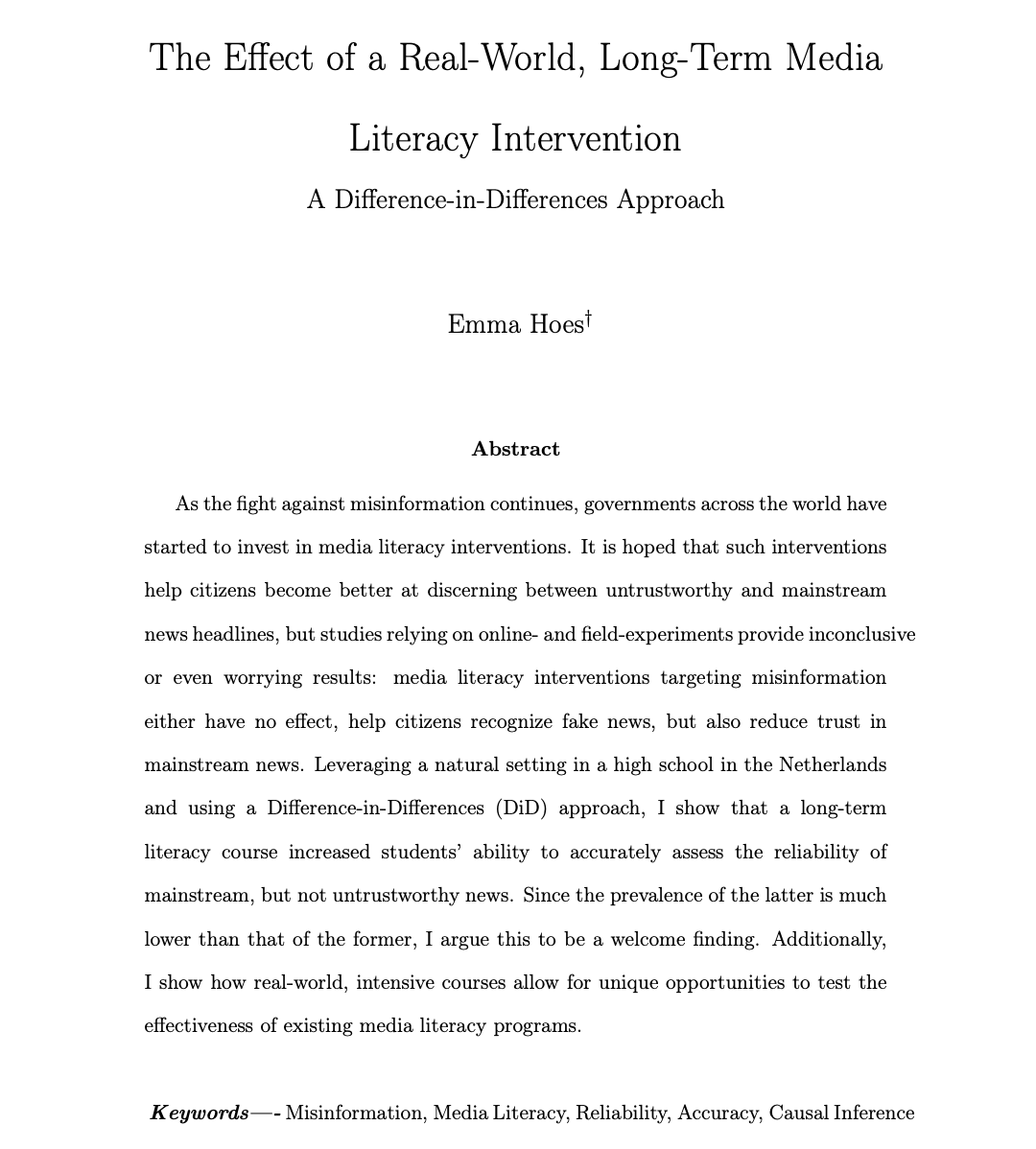
🚨 New pre-print 📢 In this study, I used a difference-in-differences design to evaluate how a long-term media literacy course affects students' ability to judge news accuracy. Unlike many short-term interventions, this course was integrated into the school curriculum. 🧑‍🎓🏫

🚨 New pre-print 📢 

In this study, I used a difference-in-differences design to evaluate how a long-term media literacy course affects students' ability to judge news accuracy. 

Unlike many short-term interventions, this course was integrated into the school curriculum. 🧑‍🎓🏫
Gale Sinatra ☮️ (@galesinatra) 's Twitter Profile Photo

One effective method for confronting science #misinformation: refute it. The effectiveness of refutation text in confronting scientific misconceptions: A meta-analysis tandfonline.com/doi/full/10.10…

Brehove (@brehove) 's Twitter Profile Photo

More evidence that uncritical use of ChatGPT in the classroom can hurt learning. We have to be clear-eyed about what works and what doesn’t.

More evidence that uncritical use of ChatGPT in the classroom can hurt learning. We have to be clear-eyed about what works and what doesn’t.
Dries Bostyn (@dhbostyn) 's Twitter Profile Photo

Psychologists love asking people how they think about trolley dilemmas to study moral decision-making: "Should you kill a person to save five?". But thinking about a dilemma is not the same thing as actually confronting one in real life. We developed a lab-based real-life

Psychologists love asking people how they think about trolley dilemmas to study moral decision-making: "Should you kill a person to save five?". 

But thinking about a dilemma is not the same thing as actually confronting one in real life. 

We developed a lab-based real-life
Michael Morris, Professor at Columbia University (@michaelmorriscu) 's Twitter Profile Photo

Keeping an open mind is not about lacking moral conviction. It’s about maintaining intellectual humility. The people who leave their echo chambers are the ones who know their knowledge is incomplete. A key to lifelong learning is engaging with others who disagree with you.

Keeping an open mind is not about lacking moral conviction. It’s about maintaining intellectual humility.
 
The people who leave their echo chambers are the ones who know their knowledge is incomplete.
 
A key to lifelong learning is engaging with others who disagree with you.
Sacha Altay (@sacha_altay) 's Twitter Profile Photo

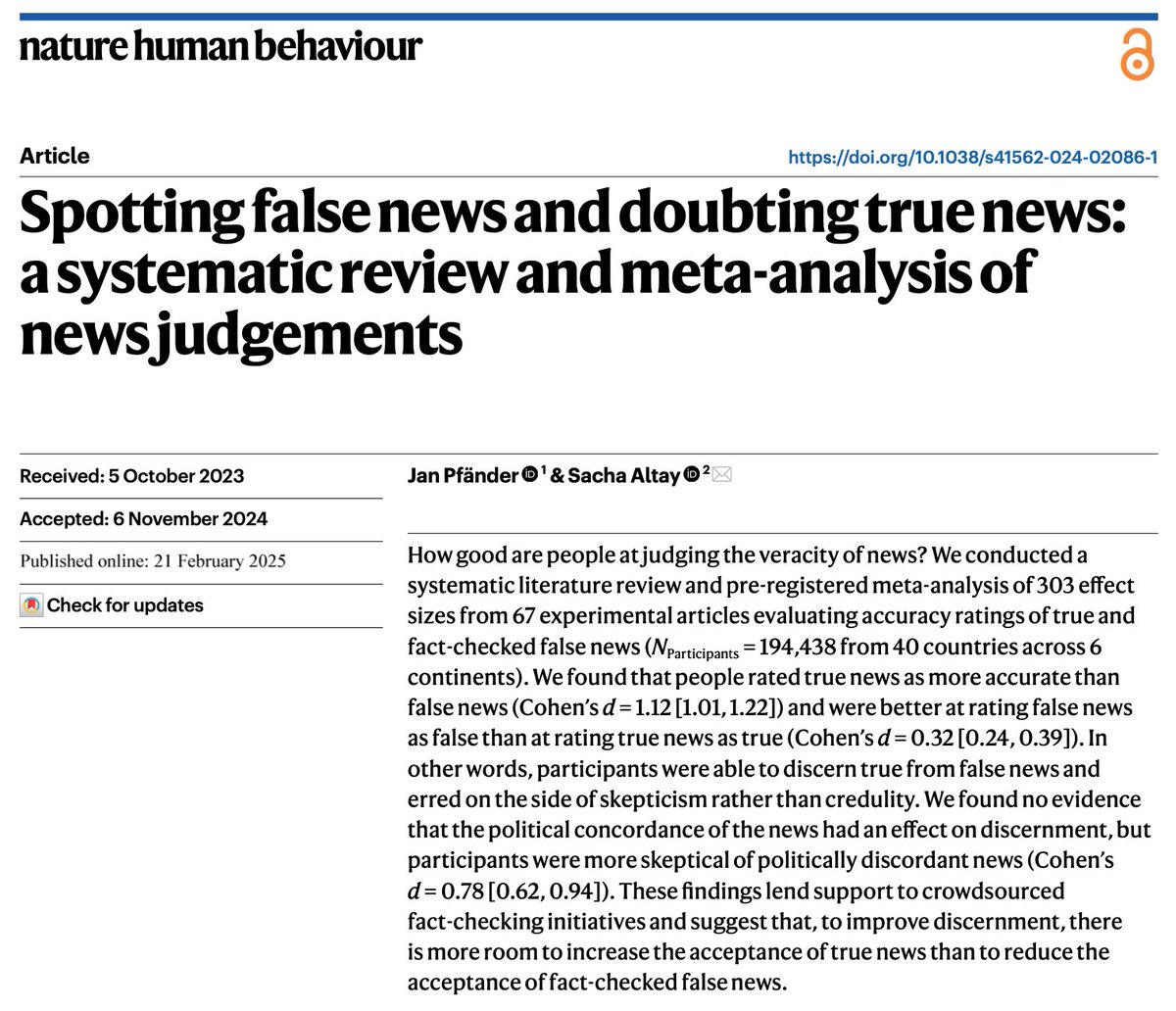
Out in Nature Human Behaviour 🔥 Can people tell true from false news? Yes! Our meta-analysis shows that people rate true news as more accurate than false news (d = 1.12) and were better at spotting false news than at recognizing true news (d = 0.32).

Out in Nature Human Behaviour 🔥

Can people tell true from false news? 

Yes! Our meta-analysis shows that people rate true news as more accurate than false news (d = 1.12) and were better at spotting false news than at recognizing true news (d = 0.32).