wohnblogAT 🌍 #LeistbaresWohnenJETZT (@wohnblogat) 's Twitter Profile
wohnblogAT 🌍 #LeistbaresWohnenJETZT

@wohnblogat

WOHNEN • BAUEN • LEBEN Österreich
Private & gemeinnnützige Wohnungswirtschaft Energie Mobilität Klima
wohnblog.at/impressum.html @[email protected] A G Auinger

ID: 59402677

linkhttps://www.wohnblog.at calendar_today23-07-2009 08:40:50

50,50K Tweet

1,1K Followers

4,4K Following

Nurder Koch (@nurderk) 's Twitter Profile Photo

„Werdet von Zustimmenden zu Handelnden. Von Zuhörenden zu Erzählenden. Von Zuschauenden zu Akteuren. Wo immer das euch möglich ist! Es macht sonst einfach fast niemand.“ Sebastian Seiffert

Reinhard @steurer.bsky.social (@reisteurer) 's Twitter Profile Photo

Ich will auch nicht mehr so tun, als würden wir das schaffen. Die Aufgabe von Wissenschaftlerinnen ist es, die Realität möglichst korrekt zu beschreiben und nicht eine Illusion zu erzeugen, damit man sich besser fühlt. Illusionen sind tödlich, besonders in existenziellen Krisen.

Joeri Rogelj (@joerirogelj) 's Twitter Profile Photo

Another year, another climate gap. 🌍🔥🌡️ It's the 15th time I joined the lead author team of the UN Environment Programme #Emissionsgap report. How high are global emissions? What have countries pledged? And is this all aligned with the Paris Agreement? Let’s dig in with a 🧵/1

Another year, another climate gap. 🌍🔥🌡️

It's the 15th time I joined the lead author team of the <a href="/UNEP/">UN Environment Programme</a> #Emissionsgap report.

How high are global emissions?
What have countries pledged?
And is this all aligned with the Paris Agreement?

Let’s dig in with a 🧵/1
Joeri Rogelj (@joerirogelj) 's Twitter Profile Photo

Launched today by Inger Andersen, the UN Environment Programme #emissionsgap report once again looks at the state of play of international climate action. 🌍🔥🌡️🇺🇳 This year's title: No more hot air … please! Let's have a look at what's inside /2

Launched today by <a href="/andersen_inger/">Inger Andersen</a>, the <a href="/UNEP/">UN Environment Programme</a> #emissionsgap report once again looks at the state of play of international climate action. 🌍🔥🌡️🇺🇳

This year's title: No more hot air … please! 

Let's have a look at what's inside /2
Joeri Rogelj (@joerirogelj) 's Twitter Profile Photo

Global greenhouse gas (GHG) emissions in 2023 amounted to 57.1 billion tons of CO2-equivalent emissions (GtCO2e) A 1.3 percent increase from 2022. /3

Global greenhouse gas (GHG) emissions in 2023 amounted to 57.1 billion tons of CO2-equivalent emissions (GtCO2e)
A 1.3 percent increase from 2022. /3
Joeri Rogelj (@joerirogelj) 's Twitter Profile Photo

The increase in total GHG emissions of 1.3 per cent from 2022 levels is above the average rate in the decade preceding the COVID-19 pandemic (2010–2019), when GHG emissions growth averaged 0.8 percent per year. Leading to a new record high in global GHG in 2023 /4

The increase in total GHG emissions of 1.3 per cent from 2022 levels is above the average rate in the decade preceding the COVID-19 pandemic (2010–2019), when GHG emissions growth averaged 0.8 percent per year.
Leading to a new record high in global GHG in 2023 /4
Joeri Rogelj (@joerirogelj) 's Twitter Profile Photo

A rebound in emissions from flights together with rapid (more than 2.5 percent per year) growth of fuel production (oil and gas, coal etc.), road transportation and energy-related industry emissions were the main contributors to this increase in GHG emissions. /5

Joeri Rogelj (@joerirogelj) 's Twitter Profile Photo

Meanwhile, countries have been submitting emission reduction pledges, known as Nationally Determined Contributions or NDCs. /6

Joeri Rogelj (@joerirogelj) 's Twitter Profile Photo

By now: - 91% of global emissions are covered by an NDC with a GHG reduction target - Only 23 NDCs cover all greenhouse gases (other only cover CO2 or a subset) - 134 NDCs (33% of global GHGs) set additional conditions for all pledges to be implemented (see table highlights) /7

By now:
- 91% of global emissions are covered by an NDC with a GHG reduction target
- Only 23 NDCs cover all greenhouse gases (other only cover CO2 or a subset)
- 134 NDCs (33% of global GHGs) set additional conditions for all pledges to be implemented
(see table highlights) /7
Joeri Rogelj (@joerirogelj) 's Twitter Profile Photo

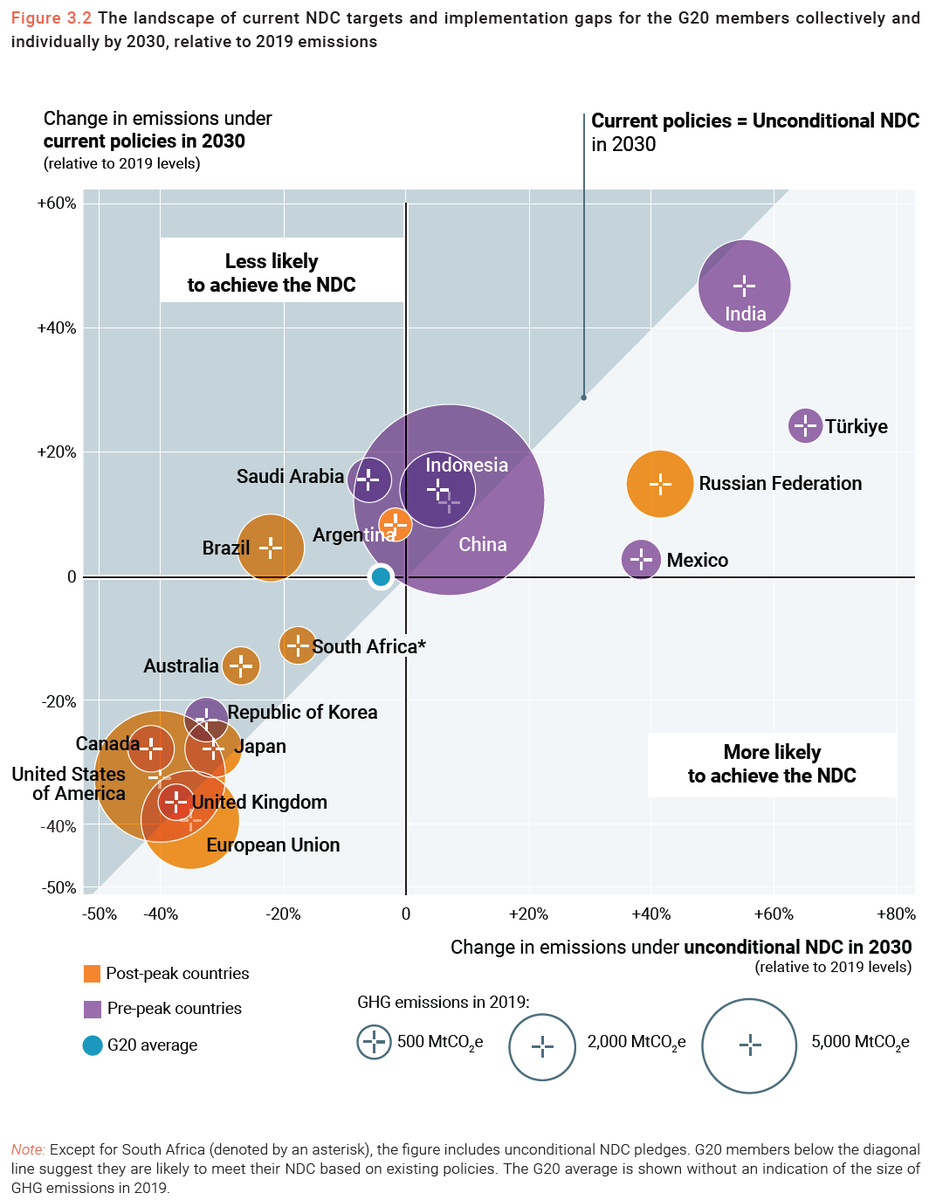
Some countries have put in place the policies to achieve their NDCs, while others still have work to do. In some cases, NDC targets were so weak that no new policies were needed to achieve them. /8

Some countries have put in place the policies to achieve their NDCs, while others still have work to do. In some cases, NDC targets were so weak that no new policies were needed to achieve them. /8
Joeri Rogelj (@joerirogelj) 's Twitter Profile Photo

The picture is therefore diverse. Countries in the top-left corner are less likely to achieve their NDC by 2030 based on the policies that they have currently on the books. Countries in the bottom-right more likely. /9

The picture is therefore diverse. Countries in the top-left corner are less likely to achieve their NDC by 2030 based on the policies that they have currently on the books. Countries in the bottom-right more likely. /9
Joeri Rogelj (@joerirogelj) 's Twitter Profile Photo

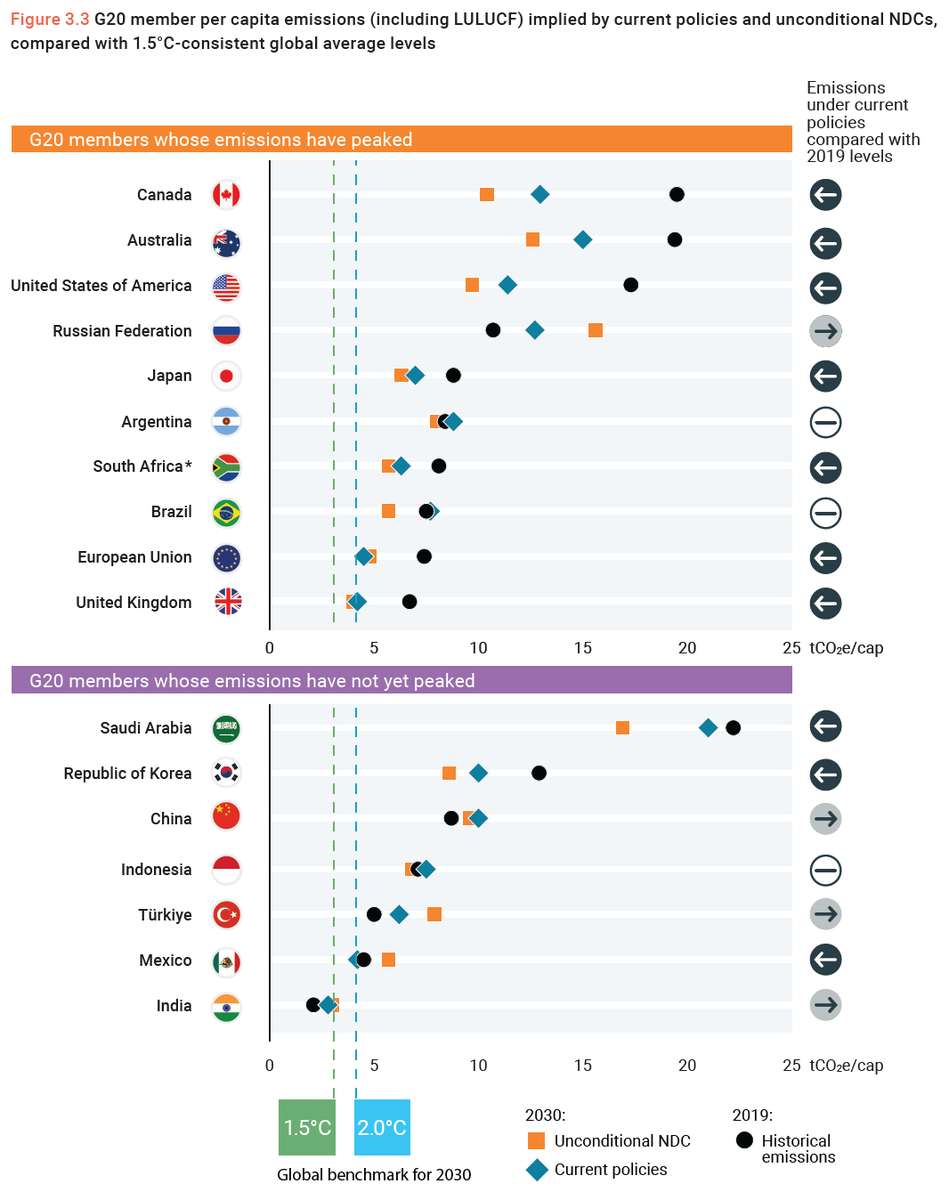
These trends should of course be understood in a context where different countries find themselves in quite different circumstances. The per capita emissions in 2019 (black dot) and projected under policies (teal diamond) and NDCs (orange square) illustrate these differences. /10

These trends should of course be understood in a context where different countries find themselves in quite different circumstances.
The per capita emissions in 2019 (black dot) and projected under policies (teal diamond) and NDCs (orange square) illustrate these differences. /10
Joeri Rogelj (@joerirogelj) 's Twitter Profile Photo

[In an earlier study in nature we provided a check list with a gold standard of setting net-zero targets. (with @Oliver_Geden Andy Reisinger and Anette Cowie) nature.com/articles/d4158… /12

Joeri Rogelj (@joerirogelj) 's Twitter Profile Photo

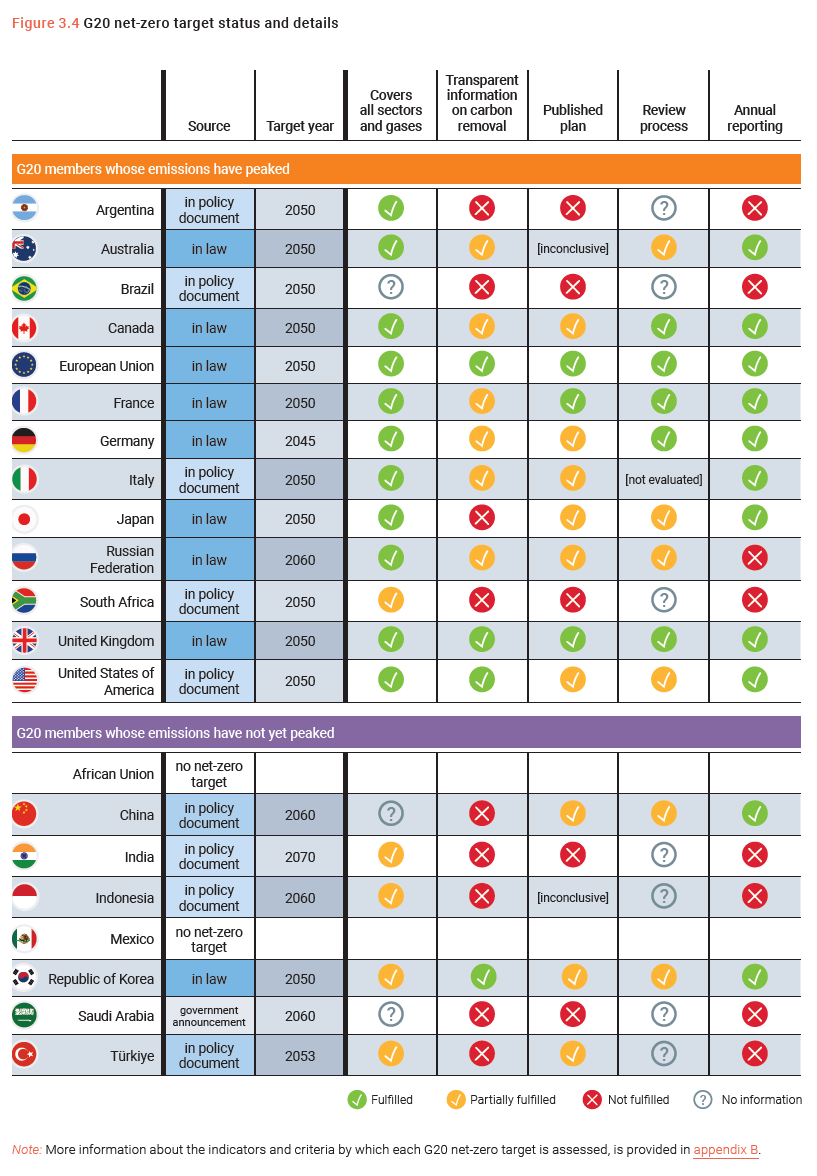
Looking only at G20 members that have already peaked their GHG emissions, we see that for many, their near-term NDC does not yet describe a robust path to meeting their long-term net-zero targets. Meanwhile other countries' NDCs do not yet imply a peak in their emissions. /13

Looking only at G20 members that have already peaked their GHG emissions, we see that for many, their near-term NDC does not yet describe a robust path to meeting their long-term net-zero targets. 

Meanwhile other countries' NDCs do not yet imply a peak in their emissions. /13
Joeri Rogelj (@joerirogelj) 's Twitter Profile Photo

This brings us to the question: what does this all add up to? Each year the UN Environment Programme #Emissionsgap report looks at where emissions are heading and where they should be going to limit warming to a given level. The difference between the two is the emissions gap. /14


Joeri Rogelj (@joerirogelj) 's Twitter Profile Photo

LT;DR: the gap is large and virtually unchanged from last year. NDCs are not adding up to a pathway in line with 1.5 or 2C (see orange & red lines compared bottom ranges). /15

LT;DR: the gap is large and virtually unchanged from last year.
NDCs are not adding up to a pathway in line with 1.5 or 2C (see orange &amp; red lines compared bottom ranges). /15
Christoph Dolna-Gruber 🇪🇺 (@chri_gru) 's Twitter Profile Photo

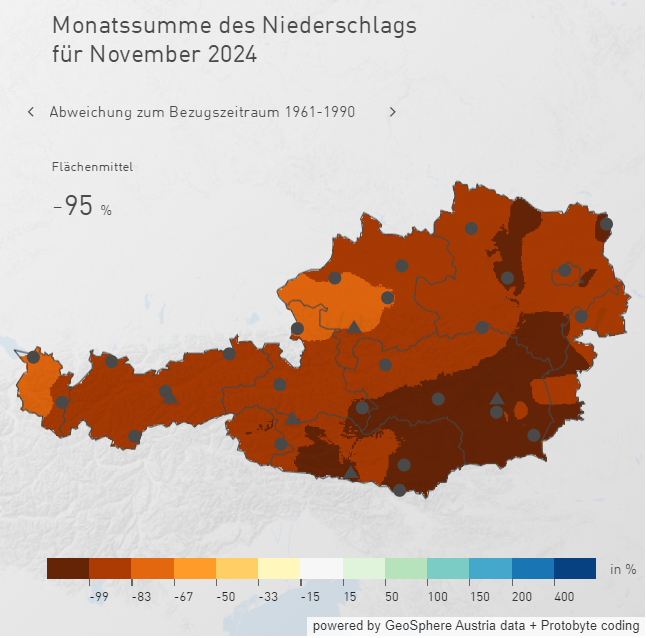
Gut, dass es heute wieder geregnet hat. Wir waren bisher 95% unter dem langjährigen Durchschnitt der Niederschläge für November. Das hatte auch zur Konsequenz, dass wir in den letzten Wochen ua wegen schwacher #Wasserkraft sehr viel #Gas für die Stromerzeugung einsetzen mussten.

Gut, dass es heute wieder geregnet hat. Wir waren bisher 95% unter dem langjährigen Durchschnitt der Niederschläge für November.

Das hatte auch zur Konsequenz, dass wir in den letzten Wochen ua wegen schwacher #Wasserkraft sehr viel #Gas für die Stromerzeugung einsetzen mussten.
Prof. Stefan Rahmstorf 🌏 🦣 (@rahmstorf) 's Twitter Profile Photo

Important new study shows that current climate models underestimate the human-caused slowing of the #AMOC (Atlantic Meridional Overturning Circulation), because they neglect freshwater influx from Greenland melt and other sources. /1 nature.com/articles/s4156…

wohnblogAT 🌍 #LeistbaresWohnenJETZT (@wohnblogat) 's Twitter Profile Photo

That is wrong, Mr. JD Vance: The Second World War ended with the unconditional surrender of Germany on May 8, 1945, and the surrender of Japan on August 15, and not through negotiations with Adolf Hitler.

That is wrong, Mr. <a href="/JDVance/">JD Vance</a>: The Second World War ended with the unconditional surrender of Germany on May 8, 1945, and the surrender of Japan on August 15, and not through negotiations with Adolf Hitler.