Tong (Tina) Liu (@tinaliutong) 's Twitter Profile
Tong (Tina) Liu

@tinaliutong

Cognitive neuroscientist | Assistant Professor in Neurology @Georgetown University Medical Center

ID: 340869716

linkhttp://vpplab.georgetown.edu calendar_today23-07-2011 12:17:21

170 Tweet

338 Takipçi

262 Takip Edilen

Icon-lab (@iconlaboratory) 's Twitter Profile Photo

The human brain leverages multiple codes to efficiently represent information, such as by organizing the relative timing of neuronal firing within a population of neurons. Learn more about this in our upcoming research article in nature!

Andreas Horn (@andreashorn_) 's Twitter Profile Photo

Fantastic, authoritative & comprehensive ‘roadmap’ article out in Nature Rev Neurosci by Segobin et al. about in vivo segmentation of the thalamus. nature.com/articles/s4158…

Fantastic, authoritative &amp; comprehensive ‘roadmap’ article out in <a href="/NatRevNeurosci/">Nature Rev Neurosci</a> by Segobin et al. about in vivo segmentation of the thalamus.

nature.com/articles/s4158…
Corey Ziemba (@cmziemba) 's Twitter Profile Photo

The long gestating final chapter of my thesis is out in SfN Journals this week as a featured cover article. Thanks to all my coauthors Goris Lab Gabe Stine Eero Simoncelli Tony Movshon and Richard Perez. Short preview below 1/7: doi.org/10.1523/JNEURO…


The long gestating final chapter of my thesis is out in
<a href="/SfNJournals/">SfN Journals</a> this week as a featured cover article.   
Thanks to all my coauthors <a href="/GorisLab/">Goris Lab</a> <a href="/gabrielmstine/">Gabe Stine</a> <a href="/EeroSimoncelli/">Eero Simoncelli</a> <a href="/TonyMovshon/">Tony Movshon</a> and Richard Perez.

Short preview below 1/7:

doi.org/10.1523/JNEURO…

hakwan lau 🇺🇦 @hakwan.bsky.social (@hakwanlau) 's Twitter Profile Photo

thanks to the great colleagues at CNIR-IBS, settling in Korea has been going well. it's time to hire! we're looking for postdocs, grad students, & RAs, to work on projects like e.g. inducing blindsight in NHP via electrical microstimulations, or similarly via optogenetics ... 1/

Ella Striem-Amit (@striemamit.bsky.social) (@striemamit) 's Twitter Profile Photo

Excited to share a new lab preprint - led by Flo, Yuqi Liu, in collaboration with @CulhamARI_Lab. We tested what drives the (re?)organization of motor tool-use areas in people born without hands, who use tools with their feet instead. biorxiv.org/content/10.110…

Gabriel Kreiman (@gkreiman) 's Twitter Profile Photo

Brains, Minds and Machines Summer Course 2025. Application deadline: Mar 24, 2025 mbl.edu/education/adva… See more information here: cbmm.mit.edu/summer-school/…

Heart Rhythm O2 (@hrs_o2journal) 's Twitter Profile Photo

Physical activity benchmarks for implantable loop recorder patients: the role of ILRs in cardiovascular disease management, by Maeve Sargeant and colleagues ECU Brody School of Medicine #EPeeps heartrhythmopen.com/article/S2666-…
Cambria Revsine (@crevsine) 's Twitter Profile Photo

New paper out in Nature Human Behaviour! In it, Wilma Bainbridge and I find that participants tend to remember and forget the same speakers' voices, regardless of speech content. We also predict the memorability of voices from their low-level features: nature.com/articles/s4156…
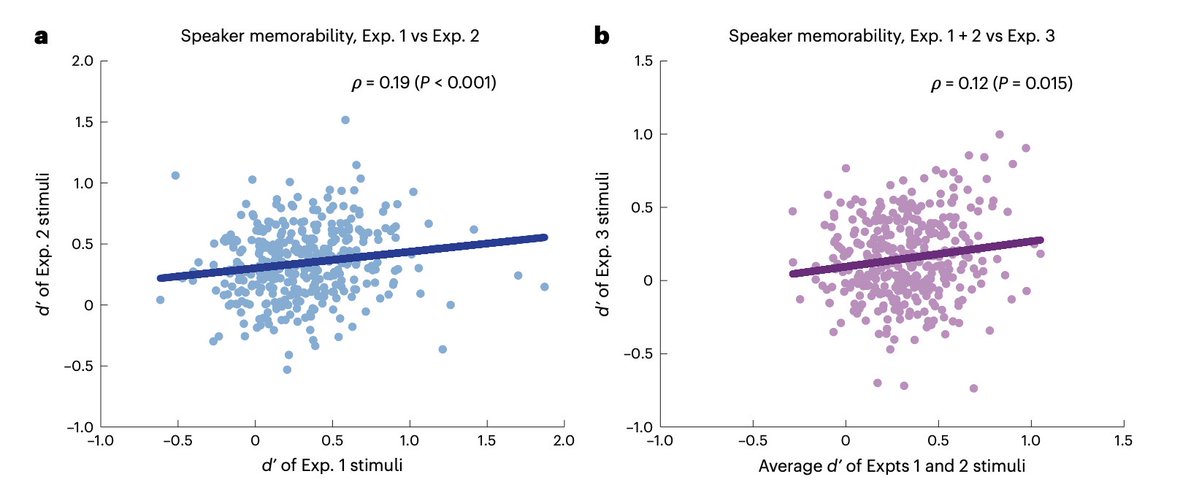
New paper out in Nature Human Behaviour!

In it, <a href="/WilmaBainbridge/">Wilma Bainbridge</a> and I find that participants tend to remember and forget the same speakers' voices, regardless of speech content. We also predict the memorability of voices from their low-level features: nature.com/articles/s4156…
Maeve Sargeant (@maevesargeant) 's Twitter Profile Photo

Out now in Progress in Pediatric Cardiology! A mindfulness-based intervention was feasible & improved psychosocial health & device acceptance in teen cardiology patients with CIEDs. sciencedirect.com/science/articl… Lisa Roelle PA-C Jen Silva, MD Starbucky #PedsCardio #EPeeps
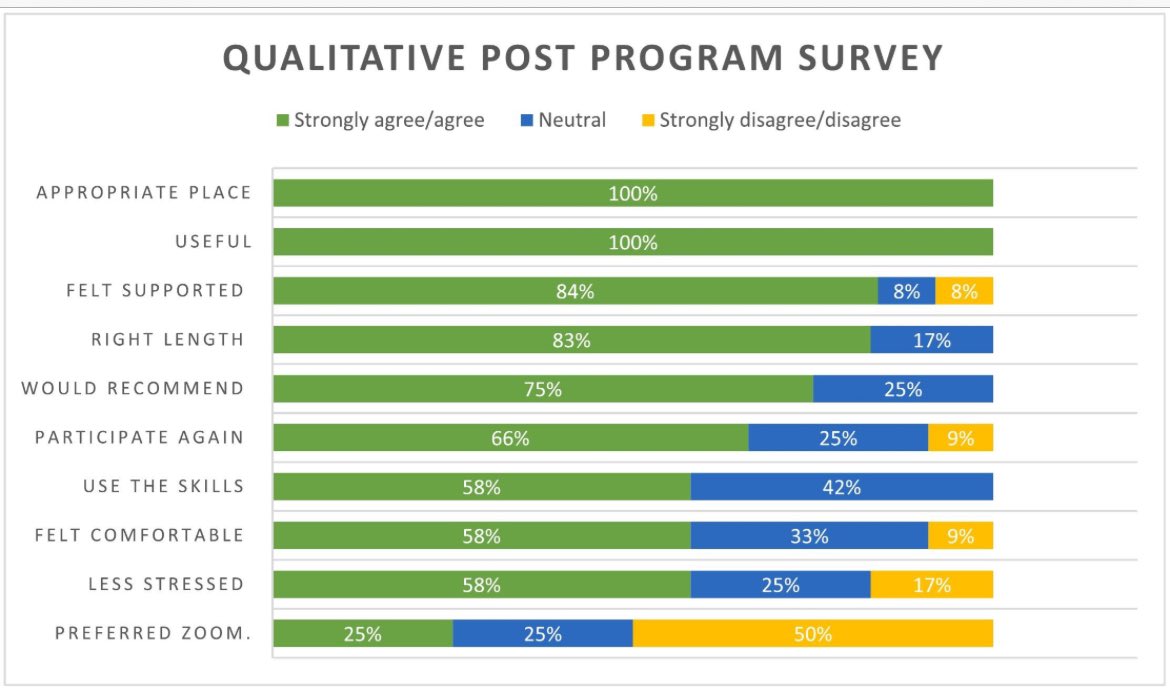

Out now in Progress in Pediatric Cardiology! A mindfulness-based intervention was feasible &amp; improved psychosocial health &amp; device acceptance in teen cardiology patients with CIEDs.

sciencedirect.com/science/articl…

<a href="/LisaRoelle/">Lisa Roelle PA-C</a> 
<a href="/jenniferavari/">Jen Silva, MD</a> 
<a href="/starbuckywow/">Starbucky</a> 

#PedsCardio #EPeeps
Ke Bo (@boke89707488) 's Twitter Profile Photo

Excited to share my co–first-authored paper with Jinxiao Zhang and teamwork with tor wager and @JamesGross in Trends in Cognitive Sciences! We discuss emerging findings and a potential framework of neural overlap between emotion generation and regulation cell.com/trends/cogniti…

UCLA Health (@uclahealth) 's Twitter Profile Photo

Scientists at UCLA Health have introduced a groundbreaking digital “translator” for brain studies—bridging communication between different brain atlases. @lucinauddin is the senior author of the study published in the journal Nature Communications. Learn more: ucla.in/4lkNMPZ

Scientists at UCLA Health have introduced a groundbreaking digital “translator” for brain studies—bridging communication between different brain atlases. @lucinauddin is the senior author of the study published in the journal <a href="/NatureComms/">Nature Communications</a>. Learn more: ucla.in/4lkNMPZ
Michael Granovetter, MD PhD (@mgranovetter) 's Twitter Profile Photo

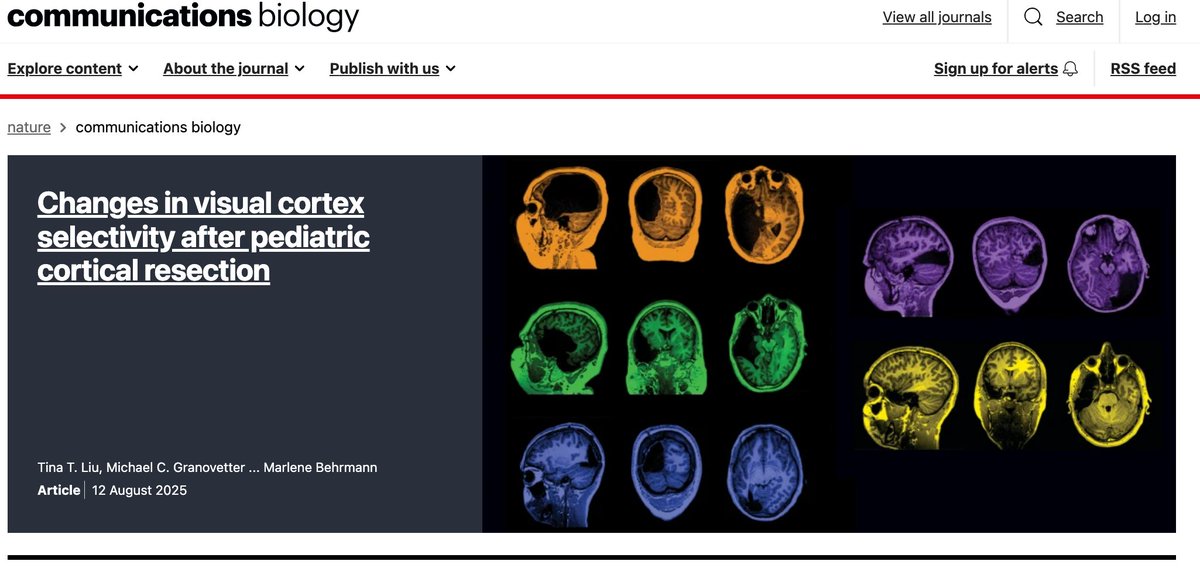
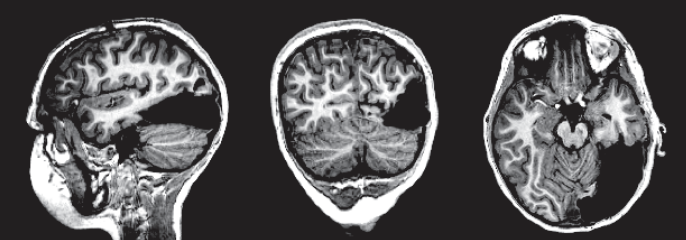
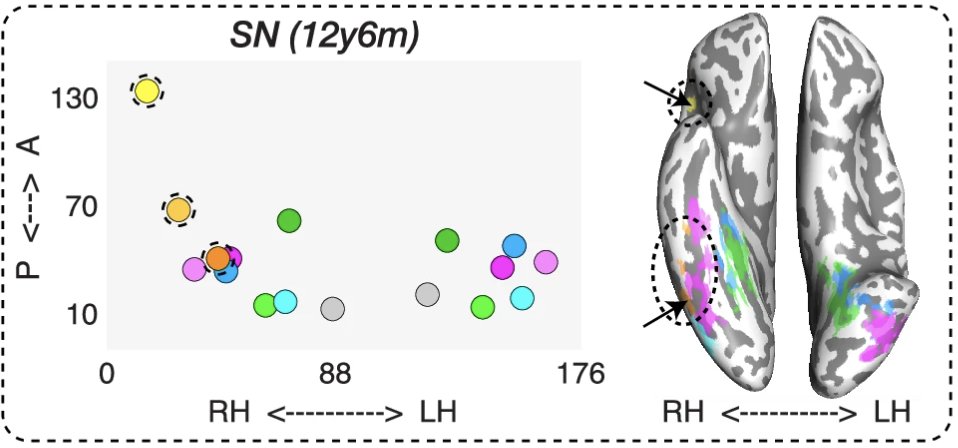
Co-first author paper with Tong (Tina) Liu out now in Communications Biology! Our longitudinal fMRI data of child epilepsy patients with occipitotemporal cortex (OTC) resection show deviations from the expected topography in preserved cortex, demonstrating plasticity. nature.com/articles/s4200…
Michael Granovetter, MD PhD (@mgranovetter) 's Twitter Profile Photo

Over typical development, representations for face and word stimuli become largely segregated across the two hemispheres, with representations for faces and words predominantly lateralizing to right and left OTC, respectively. The question is how malleable is this organization?

Michael Granovetter, MD PhD (@mgranovetter) 's Twitter Profile Photo

Pediatric patients with unilateral resection develop with only a single OTC. If the topographic emergence of visual stimulus representations is truly malleable, face and word representations may come to emerge in preserved OTC, contralateral to the site of resection.

Pediatric patients with unilateral resection develop with only a single OTC. If the topographic emergence of visual stimulus representations is truly malleable, face and word representations may come to emerge in preserved OTC, contralateral to the site of resection.
Michael Granovetter, MD PhD (@mgranovetter) 's Twitter Profile Photo

With the above in mind, here are a few highlights from our study: First, we show in several cases of LEFT pediatric OTC resection that word representations are in fact lateralized to the RIGHT hemisphere, both in right OTC and right language cortex (shaded yellow/orange here).

With the above in mind, here are a few highlights from our study:

First, we show in several cases of LEFT pediatric OTC resection that word representations are in fact lateralized to the RIGHT hemisphere, both in right OTC and right language cortex (shaded yellow/orange here).
Michael Granovetter, MD PhD (@mgranovetter) 's Twitter Profile Photo

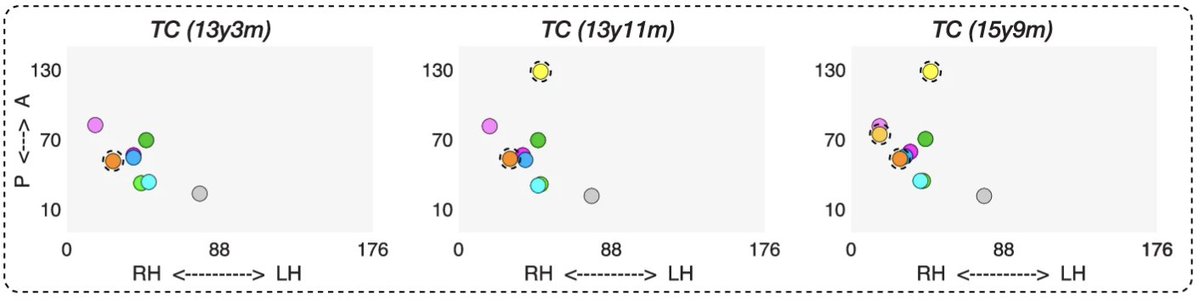
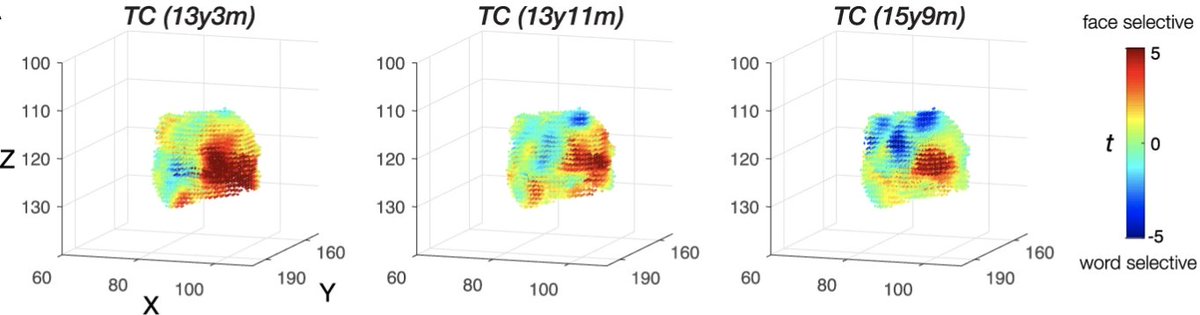
For one patient (TC), we imaged her pre-surgery (at age 13y3m) and twice post-surgery (months and then years after surgery). While we cannot map word representations in superior temporal gyrus (light orange) or inferior frontal gyrus (yellow) PRE-surgery, we can POST-surgery.

For one patient (TC), we imaged her pre-surgery (at age 13y3m) and twice post-surgery (months and then years after surgery). While we cannot map word representations in superior temporal gyrus (light orange) or inferior frontal gyrus (yellow) PRE-surgery, we can POST-surgery.
Michael Granovetter, MD PhD (@mgranovetter) 's Twitter Profile Photo

Notably, we see that over time & pre- to post-surgery, voxels in TC's right OTC "switch allegiance" from representing faces to representing words. That is, word representations emerge in RIGHT OTC after LEFT OTC resection, a complete deviation from the standard topography.

Notably, we see that over time &amp; pre- to post-surgery, voxels in TC's right OTC "switch allegiance" from representing faces to representing words. That is, word representations emerge in RIGHT OTC after LEFT OTC resection, a complete deviation from the standard topography.
Michael Granovetter, MD PhD (@mgranovetter) 's Twitter Profile Photo

We see a similar pattern in patient UD. UD had a RIGHT OTC resection, and we observe face representations emerging in LEFT OTC, with voxels in his left OTC also "switching allegiance" from words to faces, an extension of Tong (Tina) Liu's prior work: cell.com/cell-reports/f…


We see a similar pattern in patient UD. UD had a RIGHT OTC resection, and we observe face representations emerging in LEFT OTC, with voxels in his left OTC also "switching allegiance" from words to faces, an extension of <a href="/TinaLiuTong/">Tong (Tina) Liu</a>'s prior work: cell.com/cell-reports/f…
Hunter Schone (@hunterschone) 's Twitter Profile Photo

Now out in Nature Neuroscience What happens to the brain’s body map when a body-part is removed? Scanning patients before and up to 5 yrs after undergoing an arm amputation, we discovered the brain’s body map is strikingly preserved despite amputation nature.com/articles/s4159… 🧵1/18