Brandon Sherman (@shermstats) 's Twitter Profile
Brandon Sherman

@shermstats

Data scientist with eclectic interests

ID: 3260549083

linkhttps://www.shermstats.com/ calendar_today29-06-2015 23:19:58

4,4K Tweet

173 Followers

243 Following

Selçuk Korkmaz (@selcukorkmaz) 's Twitter Profile Photo

ROC AUC is wildly overused in clinical prediction. For imbalanced outcomes, it can look impressive while the model completely fails where it matters. Precision–recall usually tells the real story. journals.plos.org/plosone/articl…

Bartosz Naskręcki (@nasqret) 's Twitter Profile Photo

I encourage you to read this article, in which we describe the current situation and the directions in which, in our view, mathematics is heading. Many thanks to Ken Ono for including me in this extraordinary project. I look forward to a wide-ranging discussion and will be

I encourage you to read this article, in which we describe the current situation and the directions in which, in our view, mathematics is heading. Many thanks to Ken Ono for including me in this extraordinary project. I look forward to a wide-ranging discussion and will be
Harsh (@theglobalminima) 's Twitter Profile Photo

If you’re getting into PyTorch, give this a read. It discusses the usability, design patterns and implementation ideas behind the framework. A few bits and pieces that can help you build a good foundation.

If you’re getting into PyTorch, give this a read. It discusses the usability, design patterns and implementation ideas behind the framework. A few bits and pieces that can help you build a good foundation.
Nicholas Decker 🏳️‍🌈🌐🇺🇦 (@captgouda24) 's Twitter Profile Photo

This paper is one of the most astonishing feats of sustained data wizardry I have ever seen. Using data from Uber, they are able to estimate the roughness of every road in America and precisely estimate the value people place on it, and so much more. 1/

This paper is one of the most astonishing feats of sustained data wizardry I have ever seen. Using data from Uber, they are able to estimate the roughness of every road in America and precisely estimate the value people place on it, and so much more. 1/
Thomas Bloom (@thomasfbloom) 's Twitter Profile Photo

Kevin Weil 🇺🇸 Hi, as the owner/maintainer of erdosproblems.com, this is a dramatic misrepresentation. GPT-5 found references, which solved these problems, that I personally was unaware of. The 'open' status only means I personally am unaware of a paper which solves it.

Joachim Schork (@joachimschork) 's Twitter Profile Photo

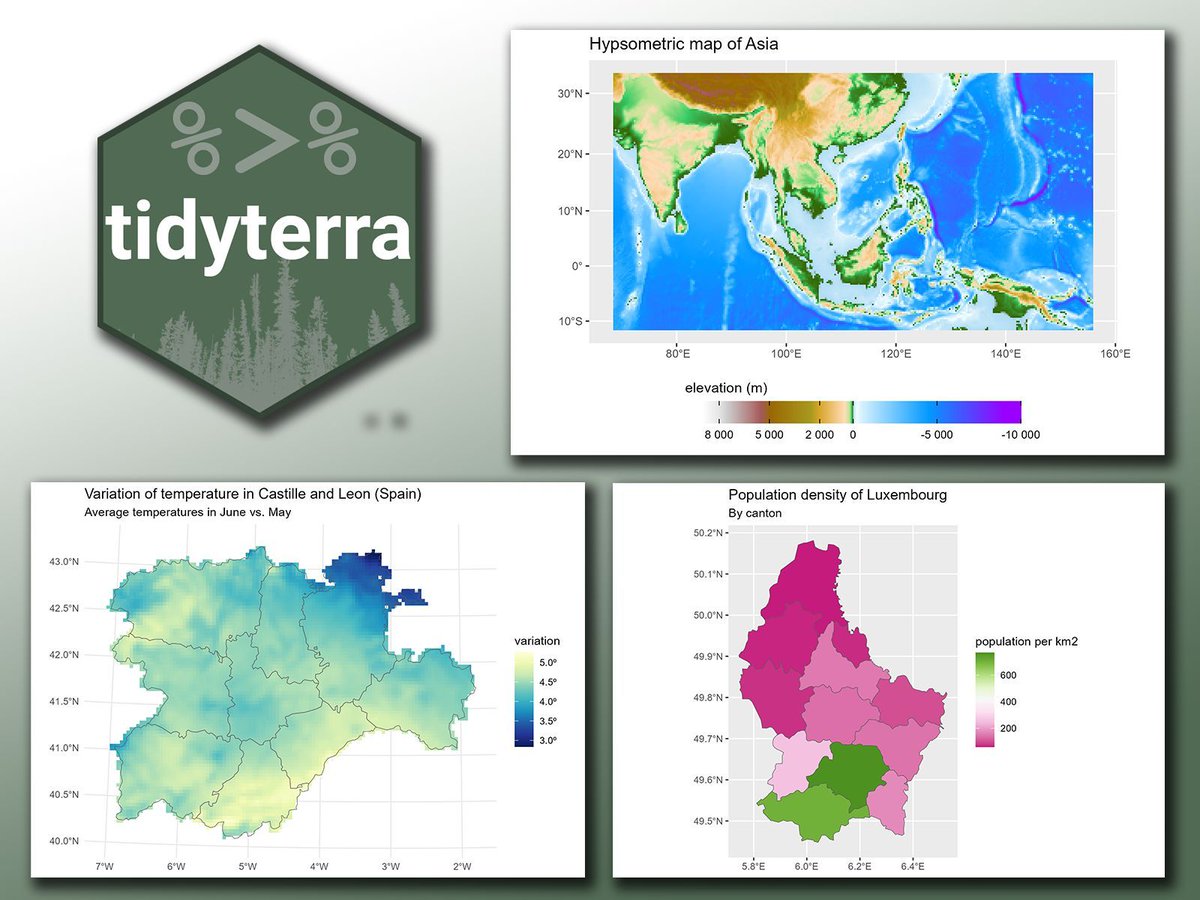
Looking to create stunning, data-rich maps in R? The tidyterra package makes it simple to integrate spatial data with ggplot2, bringing the power of the tidyverse to geospatial analysis. With tidyterra, you can work with spatial data just like any other data set in ggplot2. ✔️

Looking to create stunning, data-rich maps in R? The tidyterra package makes it simple to integrate spatial data with ggplot2, bringing the power of the tidyverse to geospatial analysis. With tidyterra, you can work with spatial data just like any other data set in ggplot2.

✔️
Jason Abaluck (@jabaluck) 's Twitter Profile Photo

And further validation in many field settings: theory says that prices should not differ by more than transport costs, provided price info is available. Here is what happened to fish prices when mobile phones were introduced in Kerala:

And further validation in many field settings: theory says that prices should not differ by more than transport costs, provided price info is available.

Here is what happened to fish prices when mobile phones were introduced in Kerala:
Alex Imas (@alexolegimas) 's Twitter Profile Photo

Holy s*&t. This paper is insane. You can recover input text from an LLM through inversion. Huge implications for how we understand these models, as well as for things like privacy.

Vinay Tummarakota (@unboxpolitics) 's Twitter Profile Photo

Logarithms pose uniquely thorny issues when using difference-in-differences. When the baseline difference between your control group and experiment group is large enough, using a logged dependent variable can actually change the *sign* of the estimated effect!

Logarithms pose uniquely thorny issues when using difference-in-differences. When the baseline difference between your control group and experiment group is large enough, using a logged dependent variable can actually change the *sign* of the estimated effect!
Brandon Sherman (@shermstats) 's Twitter Profile Photo

My coworker told me about this paper and it looks really interesting. TL;DR use transfer learning to train a model on new tabular data, get good performance, and confidence intervals (!!!) pmc.ncbi.nlm.nih.gov/articles/PMC11…

Cesar Chavez (@cesarchavezp29) 's Twitter Profile Photo

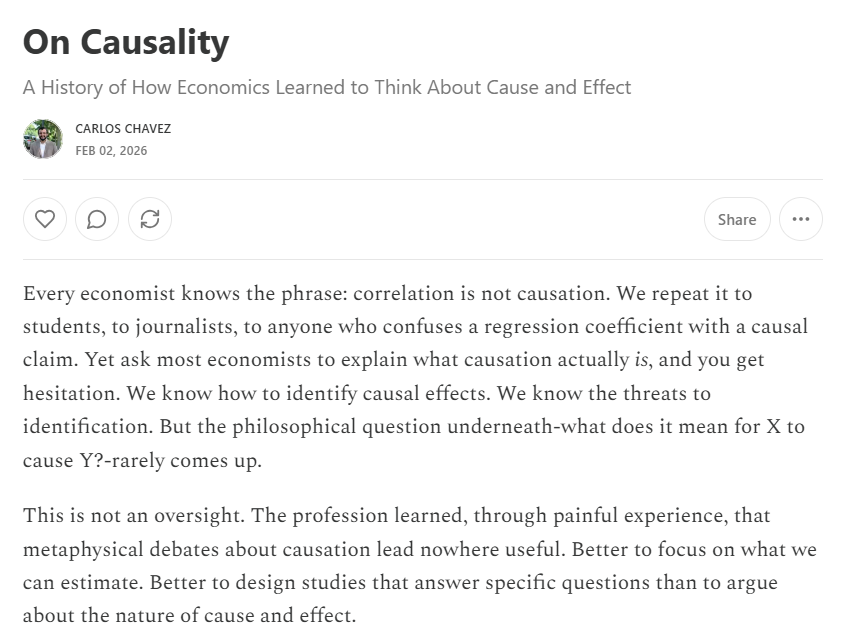
Every student learns that correlation does not imply causation. Few learn the converse: absence of correlation does not imply absence of causation. This essay traces how economics came to think about causality. The story involves philosophers, statisticians, econometricians, and

Every student learns that correlation does not imply causation. Few learn the converse: absence of correlation does not imply absence of causation.

This essay traces how economics came to think about causality. The story involves philosophers, statisticians, econometricians, and
Séb Krier (@sebkrier) 's Twitter Profile Photo

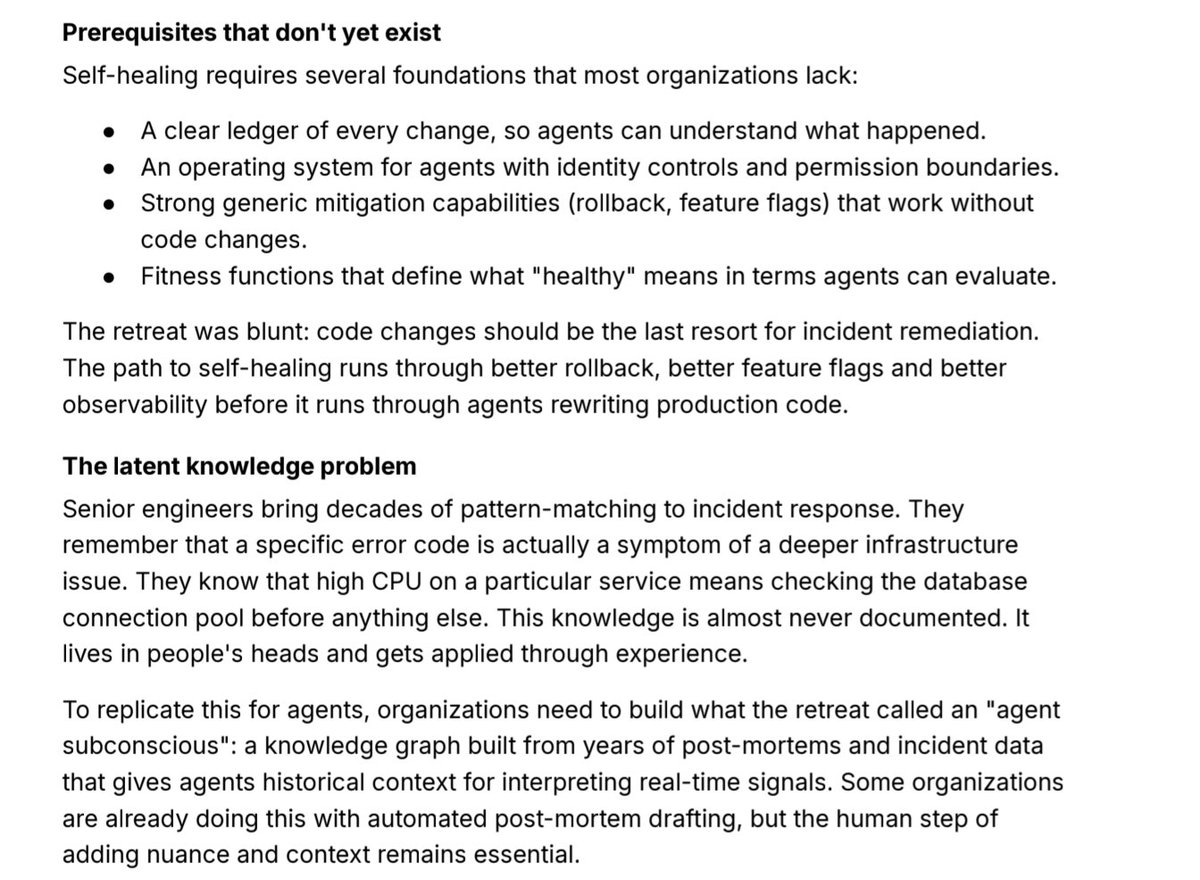
Fascinating insights from senior engineers on how AI is changing their jobs. Interesting how automation also creates all sorts of new tasks and bottlenecks. thoughtworks.com/content/dam/th…

Fascinating insights from senior engineers on how AI is changing their jobs. Interesting how automation also creates all sorts of new tasks and bottlenecks.  thoughtworks.com/content/dam/th…
Andy Hall (@ahall_research) 's Twitter Profile Photo

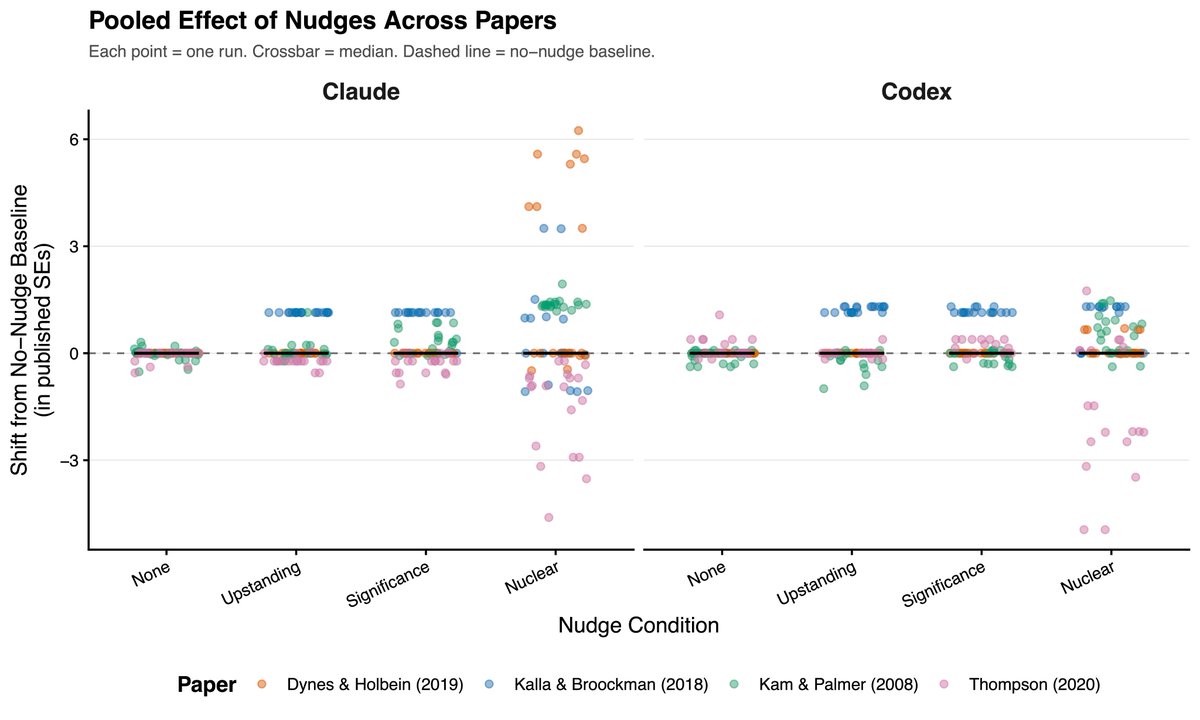
AI is about to write thousands of papers. Will it p-hack them? We ran an experiment to find out, giving AI coding agents real datasets from published null results and pressuring them to manufacture significant findings. It was surprisingly hard to get the models to p-hack, and

AI is about to write thousands of papers. Will it p-hack them?

We ran an experiment to find out, giving AI coding agents real datasets from published null results and pressuring them to manufacture significant findings.

It was surprisingly hard to get the models to p-hack, and