Shawn Im (@shawnim00) 's Twitter Profile
Shawn Im

@shawnim00

PhD Student @UWMadison. Prev @MIT
shawn-im.github.io

ID: 1580062097312026624

calendar_today12-10-2022 05:05:51

36 Tweet

106 Takipçi

145 Takip Edilen

Changdae Oh (@changdae_oh) 's Twitter Profile Photo

Does anyone want to dig deeper into the robustness of Multimodal LLMs (MLLMs) beyond empirical observations Happy to serve this exactly through our new #ICML2025 paper "Understanding Multimodal LLMs Under Distribution Shifts: An Information-Theoretic Approach"!

Does anyone want to dig deeper into the robustness of Multimodal LLMs (MLLMs) beyond empirical observations

Happy to serve this exactly through our new #ICML2025 paper "Understanding Multimodal LLMs Under Distribution Shifts: An Information-Theoretic Approach"!
James Oldfield (@jamesaoldfield) 's Twitter Profile Photo

Sparse MLPs/dictionaries learn interpretable features in LLMs, yet provide poor layer reconstruction. Mixture of Decoders (MxDs) expand dense layers into sparsely activating sublayers instead, for a more faithful decomposition! 📝 arxiv.org/abs/2505.21364 [1/7]

Sparse MLPs/dictionaries learn interpretable features in LLMs, yet provide poor layer reconstruction.

Mixture of Decoders (MxDs) expand dense layers into sparsely activating sublayers instead, for a more faithful decomposition!

📝 arxiv.org/abs/2505.21364

[1/7]
Sean Xuefeng Du (@xuefeng_du) 's Twitter Profile Photo

🚨 We’re hiring! The Radio Lab @ NTU Singapore is looking for PhD, master, undergrads, RAs, and interns to build responsible AI & LLMs. Remote/onsite from 2025. Interested? Email us: [email protected] 🔗 d12306.github.io/recru.html Please spread the word if you can!

🚨 We’re hiring! The Radio Lab @ NTU Singapore is looking for PhD, master, undergrads, RAs, and interns to build responsible AI & LLMs. Remote/onsite from 2025. Interested? Email us: radiolab.ntu.recruiting@gmail.com
🔗 d12306.github.io/recru.html

Please spread the word if you can!

Sharon Y. Li (@sharonyixuanli) 's Twitter Profile Photo

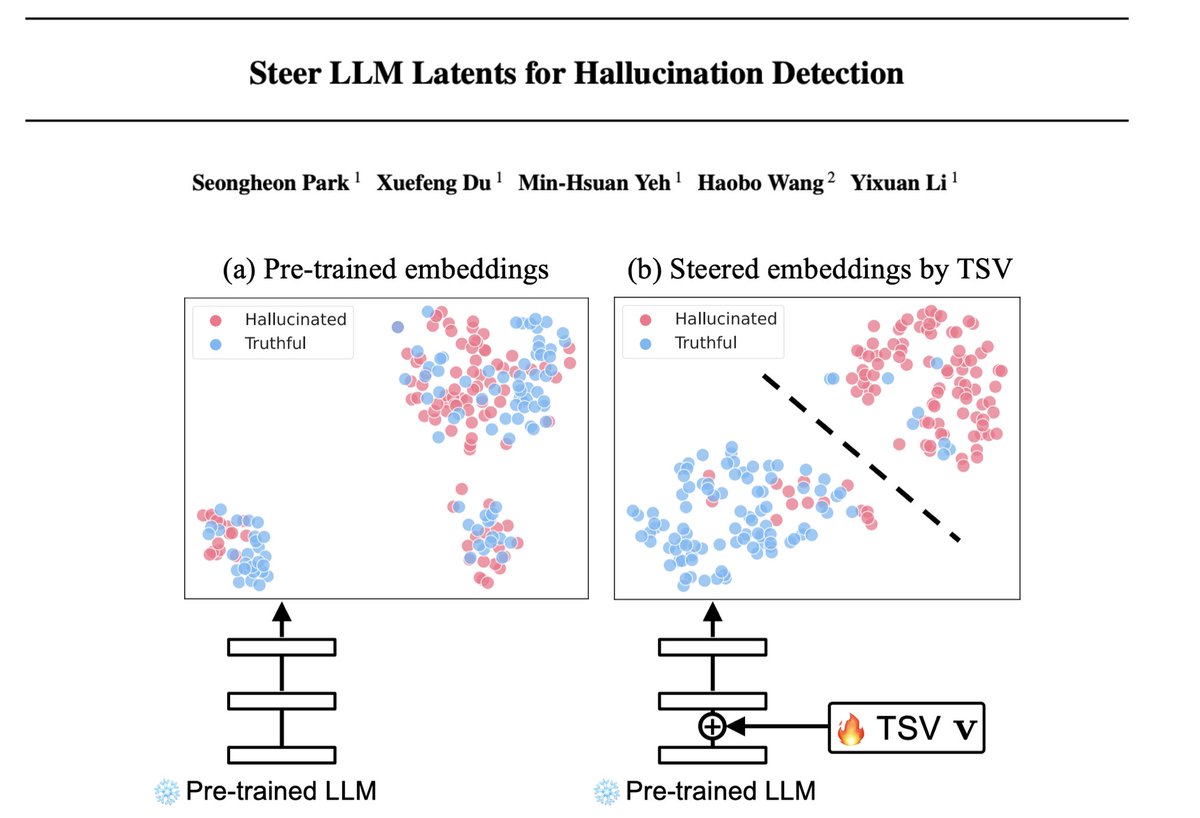
🚨 If you care about reliable, low-cost LLM hallucination detection, our #ICML2025 paper offers a powerful and data-efficient solution. 💡We introduce TSV: Truthfulness Separator Vector — a single vector injected into a frozen LLM that reshapes its hidden space to better

🚨 If you care about reliable, low-cost LLM hallucination detection, our #ICML2025 paper offers a powerful and data-efficient solution.

💡We introduce TSV: Truthfulness Separator Vector — a single vector injected into a frozen LLM that reshapes its hidden space to better
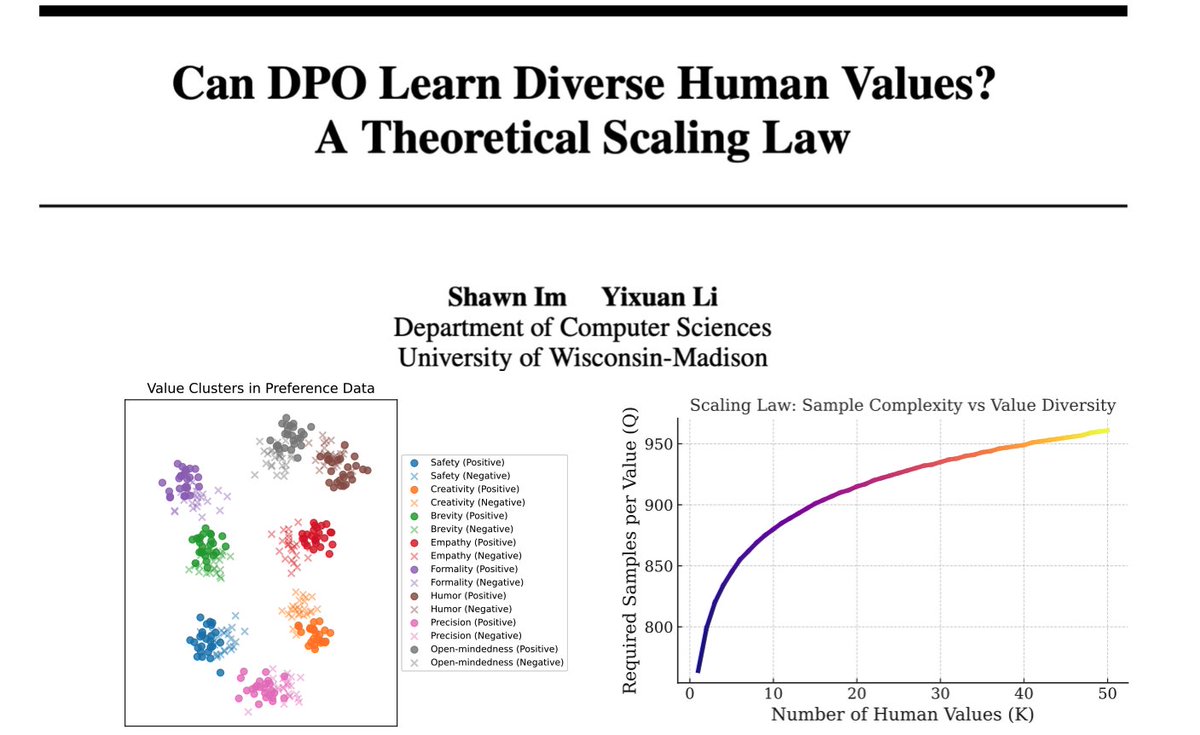
Shawn Im (@shawnim00) 's Twitter Profile Photo

Excited to share that I have received the NSF GRFP!!😀 I'm really grateful to my advisor Sharon Li for all her support, to Yilun Zhou and Jacob Andreas, and to everyone else who has guided me through my research journey! #nsfgrfp

Pengyue JIA (@jiapengyue) 's Twitter Profile Photo

🌍 GeoArena is live! Evaluate how well large vision-language models (LVLMs) understand the world through image geolocalization. Help us compare models via human preference — your feedback matters! 🔗 Try it now: huggingface.co/spaces/garena2… #GeoArena #Geolocation #LVLM #AI

Sharon Y. Li (@sharonyixuanli) 's Twitter Profile Photo

✨ My lab will be presenting a series of papers on LLM reliability and safety at #ICML2025—covering topics like hallucination detection, distribution shifts, alignment, and dataset contamination. If you’re attending ICML, please check them out! My students Hyeong-Kyu Froilan Choi Shawn Im
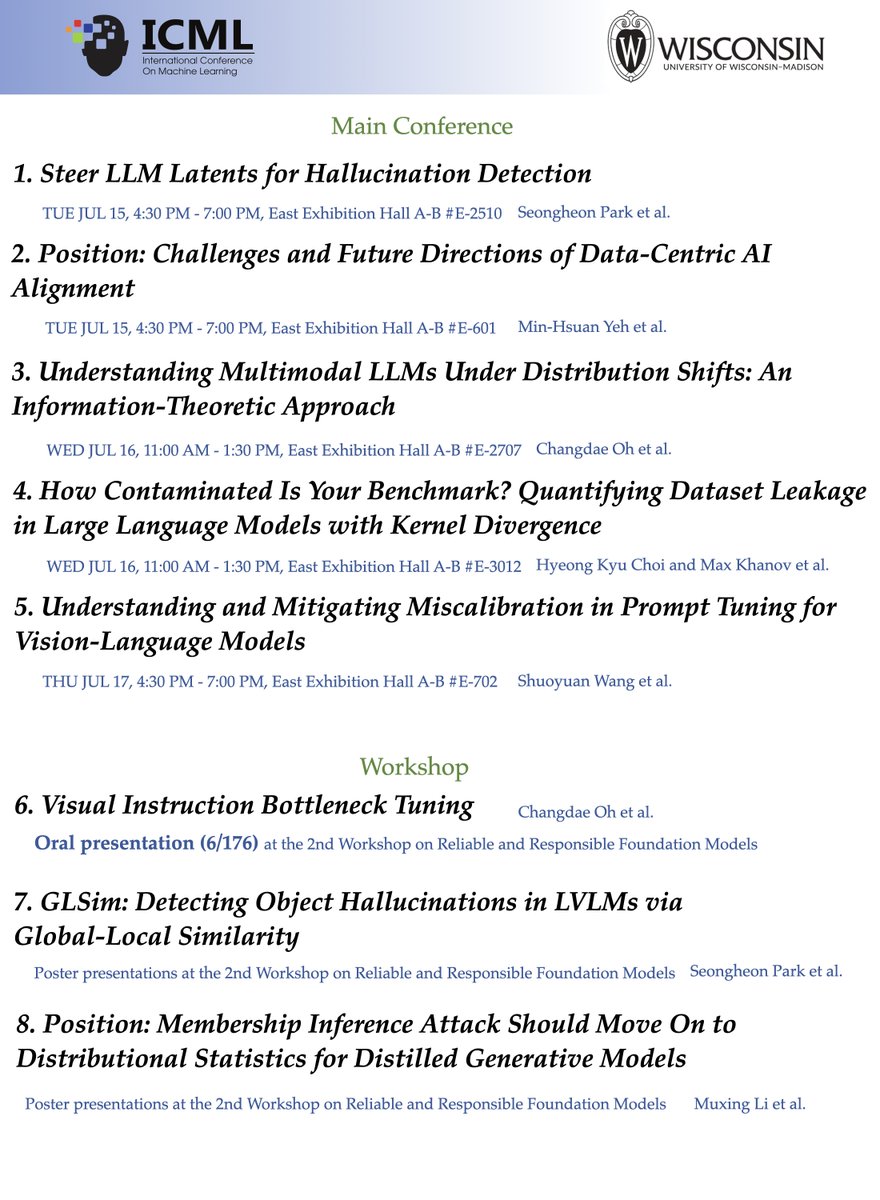
✨ My lab will be presenting a series of papers on LLM reliability and safety at #ICML2025—covering topics like hallucination detection, distribution shifts, alignment, and dataset contamination.

If you’re attending ICML, please check them out! My students <a href="/HyeonggyuC/">Hyeong-Kyu Froilan Choi</a> <a href="/shawnim00/">Shawn Im</a>
Changdae Oh (@changdae_oh) 's Twitter Profile Photo

Many existing works on advancing multimodal LLMs try to inject MORE information into the model. Would it be the sole/right way to improve the generalization and robustness of MLLMs?

Many existing works on advancing multimodal LLMs try to inject MORE information into the model. Would it be the sole/right way to improve the generalization and robustness of MLLMs?
Sharon Y. Li (@sharonyixuanli) 's Twitter Profile Photo

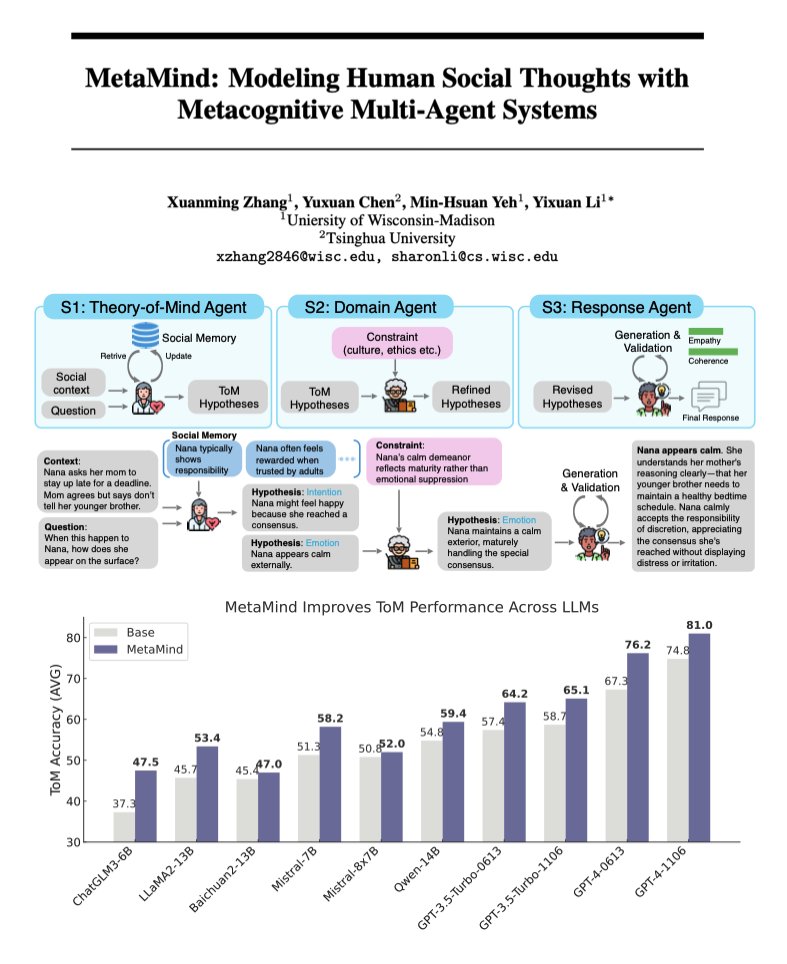
Everyday human conversation can be filled with intent that goes unspoken, feelings implied but never named. How can AI ever really understand that? ✨ We’re excited to share our new work MetaMind — just accepted to #NeurIPS2025 as a Spotlight paper! A thread 👇 1️⃣ Human

Everyday human conversation can be filled with intent that goes unspoken, feelings implied but never named.

How can AI ever really understand that?

✨ We’re excited to share our new work MetaMind — just accepted to #NeurIPS2025 as a Spotlight paper!

A thread 👇

1️⃣ Human
Sharon Y. Li (@sharonyixuanli) 's Twitter Profile Photo

Multi-Agent Debate (MAD) has been hyped as a collaborative reasoning paradigm — but let me drop the bomb: majority voting, without any debate, often performs on par with MAD. This is what we formally prove in our #NeurIPS2025 Spotlight paper: “Debate or Vote: Which Yields

Multi-Agent Debate (MAD) has been hyped as a collaborative reasoning paradigm — but let me drop the bomb: majority voting, without any debate, often performs on par with MAD.

This is what we formally prove in our #NeurIPS2025 Spotlight paper:
 “Debate or Vote: Which Yields
James Oldfield (@jamesaoldfield) 's Twitter Profile Photo

How can we efficiently monitor LLMs for safety? Strong monitors waste compute on easy inputs, but lightweight probes risk missing harms ⚠️ 𝙏𝙧𝙪𝙣𝙘𝙖𝙩𝙚𝙙 𝙥𝙤𝙡𝙮𝙣𝙤𝙢𝙞𝙖𝙡 𝙘𝙡𝙖𝙨𝙨𝙞𝙛𝙞𝙚𝙧𝙨 (TPCs) address this by generalizing linear probes for dynamic monitoring! 💫

Sharon Y. Li (@sharonyixuanli) 's Twitter Profile Photo

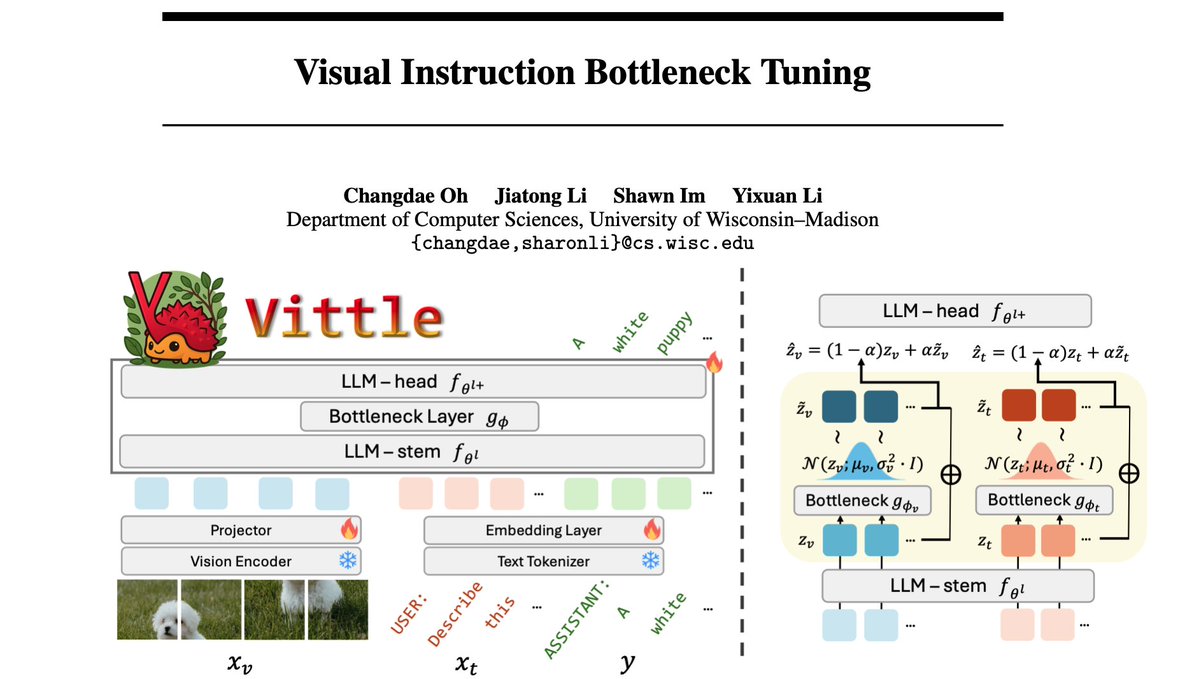
Excited to share our #NeurIPS2025 paper: Visual Instruction Bottleneck Tuning (Vittle) Multimodal LLMs do great in-distribution, but often break in the wild. Scaling data or models helps, but it’s costly. 💡 Our work is inspired by the Information Bottleneck (IB) principle,

Excited to share our #NeurIPS2025 paper: Visual Instruction Bottleneck Tuning (Vittle)

Multimodal LLMs do great in-distribution, but often break in the wild. Scaling data or models helps, but it’s costly.

💡 Our work is inspired by the Information Bottleneck (IB) principle,
Sharon Y. Li (@sharonyixuanli) 's Twitter Profile Photo

Collecting large human preference data is expensive—the biggest bottleneck in reward modeling. In our #NeurIPS2025 paper, we introduce latent-space synthesis for preference data, which is 18× faster and uses a network that’s 16,000× smaller (0.5M vs 8B parameters) than

Collecting large human preference data is expensive—the biggest bottleneck in reward modeling.

In our #NeurIPS2025 paper, we introduce latent-space synthesis for preference data, which is 18× faster and uses a network that’s 16,000× smaller (0.5M vs 8B parameters) than
Albert Ge (@albert_ge_95) 's Twitter Profile Photo

🔭 Towards Extending Open dLLMs to 131k Tokens dLLMs behave differently from AutoRegressive models—they lack attention sinks, making long-context extension tricky. A few simple tweaks go a long way!! ✍️blog albertge.notion.site/longdllm 💻code github.com/lbertge/longdl…

🔭 Towards Extending Open dLLMs to 131k Tokens
dLLMs behave differently from AutoRegressive models—they lack attention sinks, making long-context extension tricky.
A few simple tweaks go a long way!!
✍️blog albertge.notion.site/longdllm
💻code github.com/lbertge/longdl…
Sharon Y. Li (@sharonyixuanli) 's Twitter Profile Photo

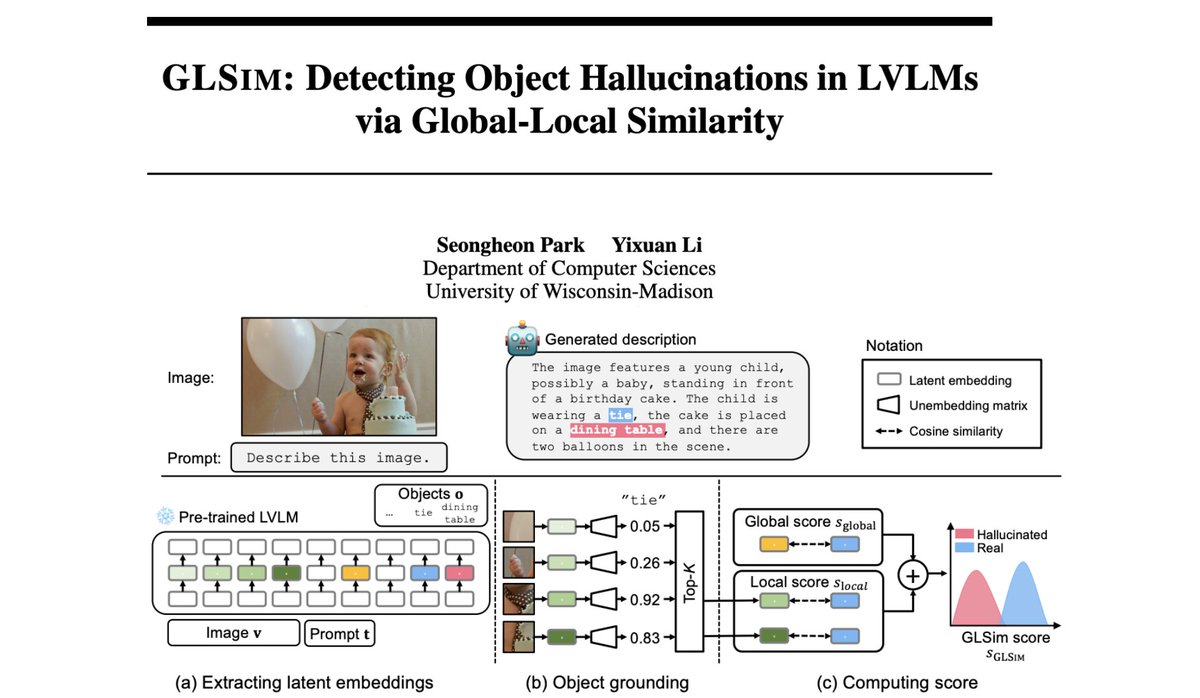
Your LVLM says: “There’s a cat on the table.” But… there’s no cat in the image. Not even a whisker. This is object hallucination — one of the most persistent reliability failures in multi-modal language models. Our new #NeurIPS2025 paper introduces GLSim, a simple but

Your LVLM says: “There’s a cat on the table.”
But… there’s no cat in the image. Not even a whisker.

This is object hallucination — one of the most persistent reliability failures in multi-modal language models. 

Our new #NeurIPS2025 paper introduces GLSim, a simple but
Sharon Y. Li (@sharonyixuanli) 's Twitter Profile Photo

We hear increasing discussion about aligning LLM with “diverse human values.” But what’s the actual price of pluralism? 🧮 In our #NeurIPS2025 paper (with Shawn Im), we move this debate from the philosophical to the measurable — presenting the first theoretical scaling law

We hear increasing discussion about aligning LLM with “diverse human values.”
But what’s the actual price of pluralism? 🧮

In our #NeurIPS2025 paper (with <a href="/shawnim00/">Shawn Im</a>), we move this debate from the philosophical to the measurable — presenting the first theoretical scaling law
Jason Weston (@jaseweston) 's Twitter Profile Photo

Hybrid Reinforcement (HERO): When Reward Is Sparse, It’s Better to Be Dense 🦸‍♂️ 💪 📝: arxiv.org/abs/2510.07242 - HERO bridges 0–1 verifiable rewards and dense reward models into one 'hybrid' RL method - Tackles the brittleness of binary signals and the noise of pure reward

Hybrid Reinforcement (HERO): When Reward Is Sparse, It’s Better to Be Dense 🦸‍♂️ 💪
 📝: arxiv.org/abs/2510.07242

- HERO bridges 0–1 verifiable rewards and dense reward models into one 'hybrid' RL method
- Tackles the brittleness of binary signals and the noise of pure reward
Sharon Y. Li (@sharonyixuanli) 's Twitter Profile Photo

Human preference data is noisy: inconsistent labels, annotator bias, etc. No matter how fancy the post-training algorithm is, bad data can sink your model. 🔥 Min Hsuan (Samuel) Yeh and I are thrilled to release PrefCleanBench — a systematic benchmark for evaluating data cleaning

Human preference data is noisy: inconsistent labels, annotator bias, etc. No matter how fancy the post-training algorithm is, bad data can sink your model. 

🔥 <a href="/Samuel861025/">Min Hsuan (Samuel) Yeh</a> and I are thrilled to release PrefCleanBench — a systematic benchmark for evaluating data cleaning
Sharon Y. Li (@sharonyixuanli) 's Twitter Profile Photo

Deception is one of the most concerning behaviors that advanced AI systems can display. If you are not concerned yet, this paper might change your view. We built a multi-agent framework to study: 👉 How deceptive behaviors can emerge and evolve in LLM agents during realistic

Deception is one of the most concerning behaviors that advanced AI systems can display. If you are not concerned yet, this paper might change your view.

We built a multi-agent framework to study:
👉 How deceptive behaviors can emerge and evolve in LLM agents during realistic