Katuwestākos Göranssen (@seadogdriftwood) 's Twitter Profile
Katuwestākos Göranssen

@seadogdriftwood

Music teacher, historical linguist, writer, translator, decidedly UNorthodox Jew. He/him cishet.
The ermine mocks racists with its ever-black tail-tip

ID: 30165386

calendar_today10-04-2009 04:58:04

208,208K Tweet

764 Followers

454 Following

Arun Schaechter Viswanath (@a_a_viswanath) 's Twitter Profile Photo

How did I never put it together?! Contemporary #Haymish #Yiddish (CHY) seems to feature a perfectly symmetrical paradigm of plural pronouns (generalized from the oblique) and present plural verb inflections (generalized from first and third persons). What do I mean? 🧵 1/12

Arun Schaechter Viswanath (@a_a_viswanath) 's Twitter Profile Photo

Here's the current plural present paradigm for 'to go' in CHY: indz gayen אונדז גײען enk gayen ענק גײען zay gayen זײ גײען Seems neat enough. I'd argue: too neat. Suspiciously neat 🤔. And on top of that, it differs substantially from the older paradigm. 2/12

Arun Schaechter Viswanath (@a_a_viswanath) 's Twitter Profile Photo

The older Southern-Central paradigm is: 1pl: indz gayen mir אונדז גײען מיר 2pl: ets gayt(s) עץ גײט(ס) 3pl: zay gayen זײ גײען The 1pl is odd and its origin is unclear to me — perhaps the ethical dative got generalized to the whole paradigm? 3/12 x.com/a_a_viswanath/…

Arun Schaechter Viswanath (@a_a_viswanath) 's Twitter Profile Photo

Either way, many varieties of CHY seem to have settled on "indz gayen", cutting off the "mir" from the end. I have previously hypothesized that it was a hybrid of the old Southern form with the standard/older/Northern "mir geyen", but I'm not sure. 4/12 x.com/a_a_viswanath/…

Arun Schaechter Viswanath (@a_a_viswanath) 's Twitter Profile Photo

Now 2pl. "ets gayt(s)". The pronoun and inflection derive from the old Germanic dual. The final "-s" does not appear in the present in all varieties, but the imperative always has it — often even in dialects that don't even have "ets" but only "ir"! 5/12 en.wiktionary.org/wiki/Reconstru…

Arun Schaechter Viswanath (@a_a_viswanath) 's Twitter Profile Photo

This form has undergone two changes in CHY, sometimes bemoaned as a mistake in online Haymish forums: the pronoun used is now "enk" (the oblique form of "ets"), and the verbal ending is now "-en". ets gayt(s) -> enk gayen 6/12 ivelt.com/forum/viewtopi…

Arun Schaechter Viswanath (@a_a_viswanath) 's Twitter Profile Photo

But why the (spontaneous?) change in pronoun? And why the switch from "-t" to "-en"? Let's take a step back and see what such a change would achieve. The resulting paradigm features two advantages which might shed light on the (presumably subsconscious) motivation: 7/12

Arun Schaechter Viswanath (@a_a_viswanath) 's Twitter Profile Photo

1) The plural pronouns end up with single form in both nominative and oblique, e.g. • enk hern indz 'yall hear us' • indz hern enk 'we hear yall' And zay 'they' already only had one form. 2) There's now only one plural present ending for verb: -en. 8/12

Occupy Democrats (@occupydemocrats) 's Twitter Profile Photo

BREAKING: Federal judge slams the door on Trump’s voter suppression scheme: “The president gets no say.” Another day, another Trump power grab smacked down by the Constitution. In a blistering rebuke, a federal judge permanently blocked key parts of Donald Trump’s sweeping

BREAKING: Federal judge slams the door on Trump’s voter suppression scheme: “The president gets no say.”

Another day, another Trump power grab smacked down by the Constitution.

In a blistering rebuke, a federal judge permanently blocked key parts of Donald Trump’s sweeping
Kevin Fei Sun 孙愷文 (@kebuhcah) 's Twitter Profile Photo

I used to think Old English was weird for using the same ending, -að, for all present plural verb forms, but apparently Zürich German does a similar thing with the ending -ed 👀

I used to think Old English was weird for using the same ending, -að, for all present plural verb forms, but apparently Zürich German does a similar thing with the ending -ed 👀
Tony Annett (@tonyannett) 's Twitter Profile Photo

Martin Wolf, the chief economics correspondent for the Financial Times, refers to the tech oligarchs who control AI as psychopaths. I repeat: the Financial Times. Not some lefty outfit.

Wu Tang is for the Children (@wutangkids) 's Twitter Profile Photo

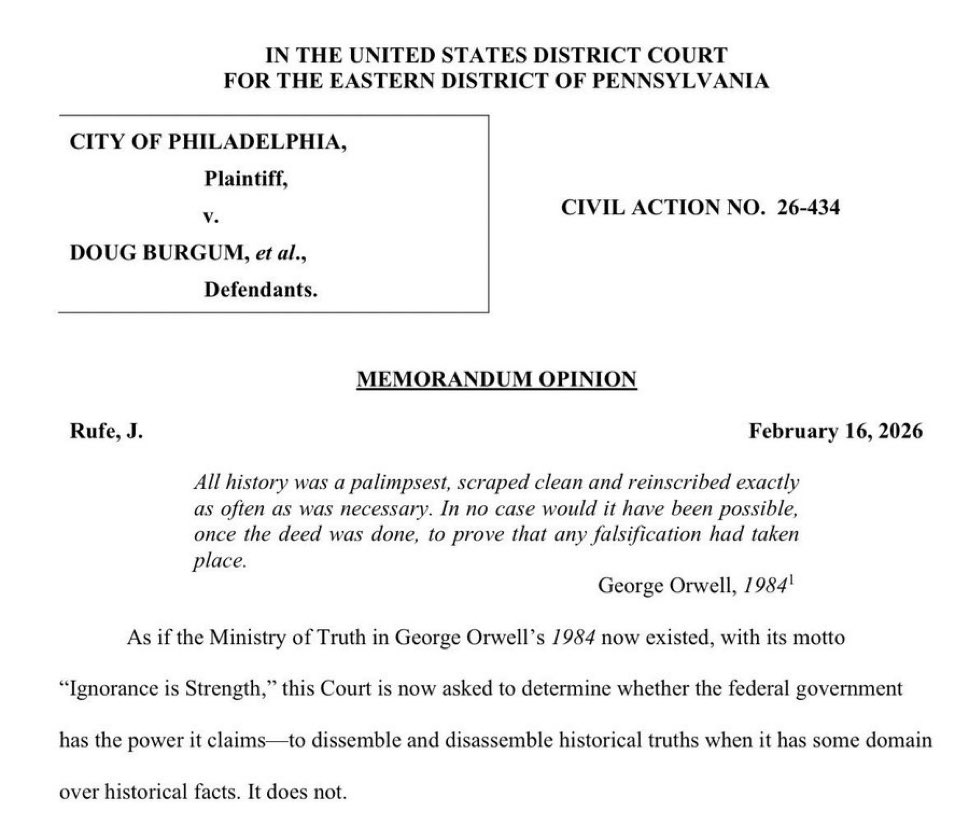
Wow a federal judge invoked George Orwell’s 1984 when ordering Trump to restore the slavery exhibit in Philly: "As if the Ministry of Truth in George Orwell’s 1984 now existed, with its motto “Ignorance is Strength," this Court is now asked to determine whether the federal

Wow a federal judge invoked George Orwell’s 1984 when ordering Trump to restore the slavery exhibit in Philly:

"As if the Ministry of Truth in George Orwell’s 1984 now existed, with its motto “Ignorance is Strength," this Court is now asked to determine whether the federal