Rayan Chikhi (@rayanchikhi) 's Twitter Profile
Rayan Chikhi

@rayanchikhi

Researcher in bioinformatics @institutpasteur and @CNRS. Tweets about methods for DNA sequencing data analysis, and genome assembly.

ID: 376221957

linkhttp://rayan.chikhi.name calendar_today19-09-2011 14:30:03

2,2K Tweet

2,2K Followers

481 Following

Krithik Ramesh (@krithiktweets) 's Twitter Profile Photo

🧬 Meet Lyra, a new paradigm for accessible, powerful modeling of biological sequences. Lyra is a lightweight SSM achieving SOTA performance across DNA, RNA, and protein tasks—yet up to 120,000x smaller than foundation models (ESM, Evo). Bonus: you can train it on your Mac. read

🧬 Meet Lyra, a new paradigm for accessible, powerful modeling of biological sequences. Lyra is a lightweight SSM achieving SOTA performance across DNA, RNA, and protein tasks—yet up to 120,000x smaller than foundation models (ESM, Evo). Bonus: you can train it on your Mac.

read
Heng Li (@lh3lh3) 's Twitter Profile Photo

longcallD is a new variant caller for genomic long reads. It jointly calls phased small and structural variants. Single binary, one command line for the whole process. Comparable accuracy to mainstream callers. Great work by Yan Gao. github.com/yangao07/longc…

Karel Břinda (@karelbrinda) 's Twitter Profile Photo

A decade ago, we had thousands of bacterial genomes. Now, we have millions. How to scale computational methods? Our paper in Nature Methods answers this: use evolutionary history to guide compression and search. …From terabytes to tens of GBs… w/@Baym Zamin Iqbal et al. 🧵1/


A decade ago, we had thousands of bacterial genomes. Now, we have millions. How to scale computational methods?

Our paper in <a href="/naturemethods/">Nature Methods</a> answers this: use evolutionary history to guide compression and search.

…From terabytes to tens of GBs…

w/@Baym <a href="/ZaminIqbal/">Zamin Iqbal</a> et al. 🧵1/
Haoyu Cheng (@chengchhy) 's Twitter Profile Photo

New preprint on hifiasm (ONT)! We can now achieve near T2T human genome assembly using only ONT Simplex reads—in just half a day, with or without ultra-long sequencing. biorxiv.org/content/10.110…

Noam Teyssier (@noamteyssier) 's Twitter Profile Photo

Extracting NCBI SRA files with fasterq-dump can require 17x the size of the accession while decompressing. Our new tool xsra extracts sequences at 5x throughput with significantly less disk usage, built-in compression, and optional BINSEQ outputs github.com/arcInstitute/x…

Lovro Vrček (@lovrovrcek) 's Twitter Profile Photo

GNNome was published in Genome Research! This is a novel paradigm for de novo genome assembly based on GNNs. Without explicitly implementing any simplification strategies, it can achieve results comparable or higher than other SOTA tools. Paper, code, and overview are 👇 [1/8]

GNNome was published in <a href="/genomeresearch/">Genome Research</a>! This is a novel paradigm for de novo genome assembly based on GNNs. Without explicitly implementing any simplification strategies, it can achieve results comparable or higher than other SOTA tools. Paper, code, and overview are 👇 [1/8]
Human Pangenome Reference Consortium (@humanpangenome) 's Twitter Profile Photo

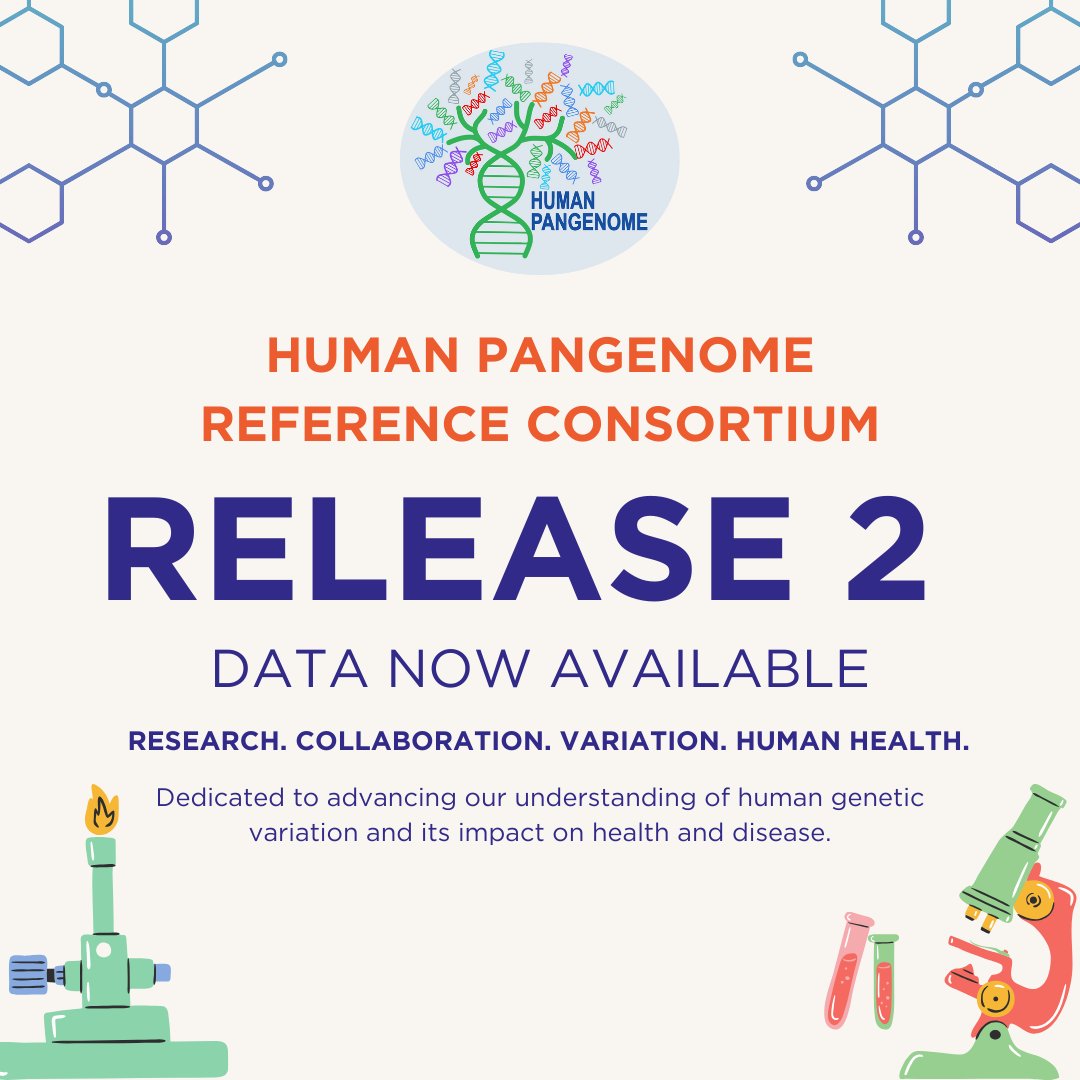
📢 HPRC Release 2 is here! Now with phased genomes from 200+ individuals, a 5x increase from Release 1. Explore sequencing data, assemblies, annotations & alignments in our interactive data explorer ⬇️: humanpangenome.org/hprc-data-rele…

📢 HPRC Release 2 is here! 

Now with phased genomes from 200+ individuals, a 5x increase from Release 1. 

Explore sequencing data, assemblies, annotations &amp; alignments in our interactive data explorer ⬇️:

humanpangenome.org/hprc-data-rele…
Sebastian Deorowicz (@sdeorowicz) 's Twitter Profile Photo

Vclust (the ultra-fast, high-accuracy tool for viral genome comparison & clustering) is now published: nature.com/articles/s4159… Great collaboration with Andrzej Zielezinski, Adam Gudyś, UAM guys, and Bas E.Dutilh

Josipa Lipovac (@josipalipovac) 's Twitter Profile Photo

I am happy to share our new preprint introducing MADRe - a pipeline for Metagenomic Assembly-Driven Database Reduction, enabling accurate and computationally efficient strain-level metagenomic classification. Mile Sikic, Riccardo Vicedomini, Krešimir Križanović 🔗biorxiv.org/content/10.110… 1/9

PM @pashadag@genomic.social @pashadag.bsky.social (@pashadag) 's Twitter Profile Photo

1/4 Hash functions in genomic sequence analysis (tinyurl.com/4kk9ccmt) : a new survey written together with Mingfu Shao, Ke Chen, Xiang Li, and Qian Shi. Before submitting it, we are posting it online to get feedback from the community.

Tatta Bio (@tatta_bio) 's Twitter Profile Photo

We are thrilled to announce our new publication in Science Advances: Gaia, an AI-powered protein search platform that brings genomic context into functional annotation. science.org/doi/10.1126/sc… Gaia enables rapid, scalable discovery of remote homologs across 131,000+ genomes —

PM @pashadag@genomic.social @pashadag.bsky.social (@pashadag) 's Twitter Profile Photo

🧵1/n Estimating mutation rates using k-mers is fast—but what happens when repeats dominate the genome? In a new preprint, Haonan Wu, Antonio Blanca, and myself propose a *repeat-aware* estimator that's accurate even in centromeres.

Sebastian Deorowicz (@sdeorowicz) 's Twitter Profile Photo

Interested in a tool that aligns millions of proteins in minutes with quality similar to or better than the state-of-the-art utilities? Please take a look at our FAMSA2 paper: biorxiv.org/content/10.110… and GH repo: github.com/refresh-bio/FA…

Bernardo Rodriguez Martin (@bernirdgz) 's Twitter Profile Photo

*New Open-Access Long Read Resource*. We sequenced 1,019 genomes from the 1000 Genomes Project sample cohort using Oxford Nanopore. Sequencing data is available at bit.ly/4m8dlE2. EMBL Heinrich-Heine-Universität Düsseldorf IMP Centre for Genomic Regulation (CRG) nature.com/articles/s4158… [1/8]

Kevin K. Yang 楊凱筌 (@kevinkaichuang) 's Twitter Profile Photo

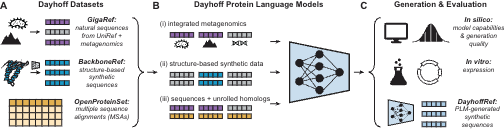
In 1965, Margaret Dayhoff published the Atlas of Protein Sequence and Structure, which collated the 65 proteins whose amino acid sequences were then known. Inspired by that Atlas, today we are releasing the Dayhoff Atlas of protein sequence data and protein language models.

In 1965, Margaret Dayhoff published the Atlas of Protein Sequence and Structure, which collated the 65 proteins whose amino acid sequences were then known. 

Inspired by that Atlas, today we are releasing the Dayhoff Atlas of protein sequence data and protein language models.