Rajat V D (@rajat_vd) 's Twitter Profile
Rajat V D

@rajat_vd

ICME PhD Student at @Stanford. Previously EE undergrad @iitmadras.

Blog: eigentales.com

ID: 1020725315889328128

linkhttps://www.eigentales.com calendar_today21-07-2018 17:40:54

28 Tweet

294 Takipçi

246 Takip Edilen

Rajat V D (@rajat_vd) 's Twitter Profile Photo

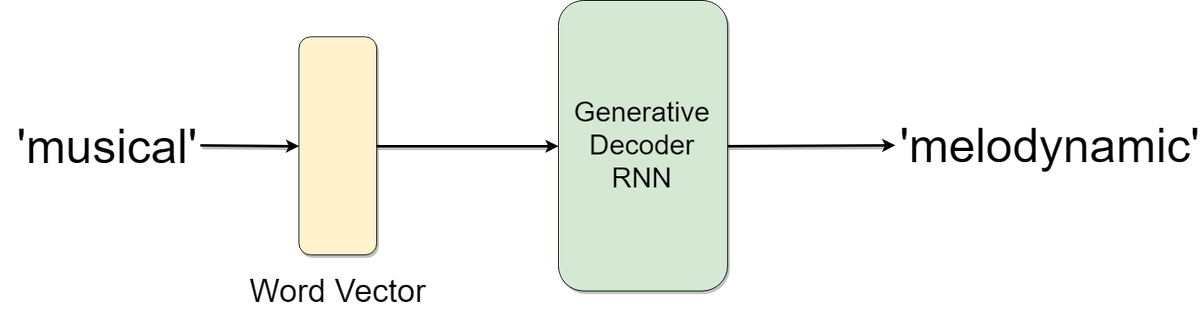
Check out my new post on Generating Words from Embeddings: rajatvd.github.io/Generating-Wor… I've uploaded the code for the project on my github here: github.com/rajatvd/WordGe… Go ahead and sample some words and share any cool looking ones you find!

Check out my new post on Generating Words from Embeddings:
rajatvd.github.io/Generating-Wor…

I've uploaded the code for the project on my github here:
github.com/rajatvd/WordGe…

Go ahead and sample some words and share any cool looking ones you find!
Rajat V D (@rajat_vd) 's Twitter Profile Photo

Check out my new blog post on Neural ODEs and Adversarial Attacks: rajatvd.github.io/Neural-ODE-Adv… … My experiments lead to some interesting parallels between adversarial robustness and equilibria of dynamical systems. Read the post for all the details!

Rajat V D (@rajat_vd) 's Twitter Profile Photo

I finally got around to making a colab notebook for my post on Generating Words from Embeddings. You can get straight into sampling new words from your browser in a matter of minutes! colab.research.google.com/drive/1f_vW0k8… The blog post: rajatvd.github.io/Generating-Wor…

Rajat V D (@rajat_vd) 's Twitter Profile Photo

I gave a talk titled "Generators Explained" PyCon India. You can find the slides here: rajatvd.github.io/PyCon/ I had a really great time meeting new people there, and I particularly enjoyed dabeaz's mind blowing keynote talk on stack machines, python, and WebAssembly!

Rajat V D (@rajat_vd) 's Twitter Profile Photo

New blog post on Visualizing Tensor Operations with Factor Graphs: rajatvd.github.io/Factor-Graphs/ This first post covers basic intuitions and features a neat visual proof! I plan to cover message passing and more in future posts. Animations made using Grant Sanderson's manim.

Rajat V D (@rajat_vd) 's Twitter Profile Photo

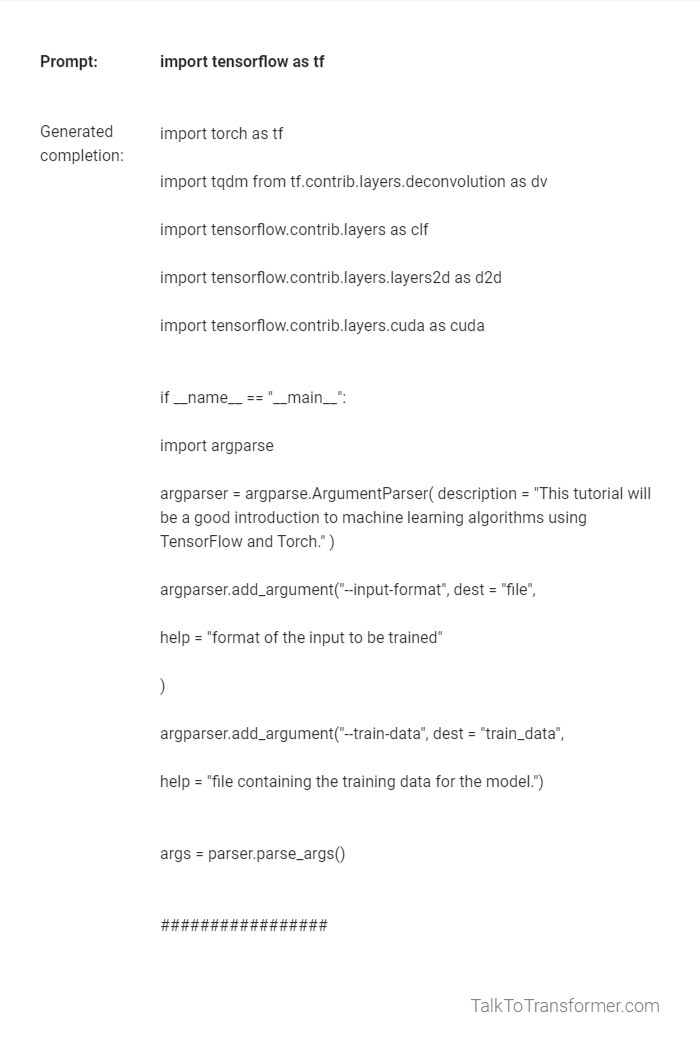
Looks like the new GPT-2 model prefers torch over tensorflow so much that it will overwrite your tf import. I don't think that's a good idea for a tutorial. #talktotransformer

Looks like the new GPT-2 model prefers torch over tensorflow so much that it will overwrite your tf import. I don't think that's a good idea for a tutorial.

#talktotransformer
Andrej Karpathy (@karpathy) 's Twitter Profile Photo

# on technical accessibility One interesting observation I think back to often: - when I first published the micrograd repo, it got some traction on GitHub but then somewhat stagnated and it didn't seem that people cared much. - then I made the video building it from scratch,

Tim Urban (@waitbutwhy) 's Twitter Profile Photo

In 2017, I did something dumb. There was a total solar eclipse passing through the US, but I was in NY, far from the path. Was I really gonna get on a plane to see a cool thing for two minutes? Nah. I had shit to do. The day came. I put my stupid glasses on and saw the sun

In 2017, I did something dumb. There was a total solar eclipse passing through the US, but I was in NY, far from the path. Was I really gonna get on a plane to see a cool thing for two minutes? Nah. I had shit to do.

The day came. I put my stupid glasses on and saw the sun
Rajat V D (@rajat_vd) 's Twitter Profile Photo

New blog post on Floating Point numbers: eigentales.com/Floating-Point/ I highlight a perspective and intuition about floating point that I haven't seen emphasized before. TL;DR: Floating point is fixed point in log space!

jack morris (@jxmnop) 's Twitter Profile Photo

most foundational concept in deep learning that no one understands is probably the Neural Tangent Kernel (NTK) this line of work studies neural networks of *infinite width*, which explain a lot about normal finite-width NNs and there is exactly one Very Good blog post on them:

most foundational concept in deep learning that no one understands is probably the Neural Tangent Kernel (NTK)

this line of work studies neural networks of *infinite width*, which explain a lot about normal finite-width NNs

and there is exactly one Very Good blog post on them:
Vaishnavh Nagarajan (@_vaishnavh) 's Twitter Profile Photo

five years ago, when I was struggling to get a grasp of NTK, I remember coming across Rajat V D 's blog which is when it all properly clicked in my head.

Jerry Liu (@jerrywliu) 's Twitter Profile Photo

1/10 ML can solve PDEs – but precision🔬is still a challenge. Towards high-precision methods for scientific problems, we introduce BWLer 🎳, a new architecture for physics-informed learning achieving (near-)machine-precision (up to 10⁻¹² RMSE) on benchmark PDEs. 🧵How it works: