Payoj Prabhu Bangāḍikumēr🇮🇳 (@pfkodial) 's Twitter Profile
Payoj Prabhu Bangāḍikumēr🇮🇳

@pfkodial

24|Linguistics|History|Epigraphy. Love learning endangered scripts ꙮ. भारतीय • 𐨧𐨌𐨪𐨟𐨁𐨌𐨩 • 𑀪𑀸𑀭𑀢𑀻𑀬 •🇮🇳 koṅkaṇa bhāsī Tauḷava vāsī.🏝𑁍

ID: 949332195746856960

linkhttps://instagram.com/pfkodial?igshid=16ijl1ytfow57 calendar_today05-01-2018 17:30:08

2,2K Tweet

538 Takipçi

229 Takip Edilen

Payoj Prabhu Bangāḍikumēr🇮🇳 (@pfkodial) 's Twitter Profile Photo

I noticed a mistake in #KantaraChapter1. Kanakavati uses a mix of Pallava & Vatteluttu scripts in the permission letter, which fits with the time period & region (4th cent. CE). But when she teaches Berme to write his name, she uses 14-15th century Tulu script, which doesn't fit.

Payoj Prabhu Bangāḍikumēr🇮🇳 (@pfkodial) 's Twitter Profile Photo

People in comments are saying it's Kadamba script, but look at it, it's clearly a mixture of different scripts, mainly Vatteluttu & W. Grantha characters. It's not a real script, looks like they created this just to make it look like a precursor of West Coastal writing systems.

People in comments are saying it's Kadamba script, but look at it, it's clearly a mixture of different scripts, mainly Vatteluttu & W. Grantha characters. It's not a real script, looks like they created this just to make it look like a precursor of West Coastal writing systems.
Payoj Prabhu Bangāḍikumēr🇮🇳 (@pfkodial) 's Twitter Profile Photo

They are not random characters, I wrote it following yajnadevam's decipher of Indus characters. It reads R→L -1- r ā ja r ṣ i -2-m o ṣa s ya dh u ra (#sanskrit)→ moha cho duro(#Vrācaḍa)→ Mohem jo daro(#Sindhi) -3- Sa p ta S i n dh u #IndusScript #IndusValleyCivilization

They are not random characters, I wrote it following <a href="/yajnadevam/">yajnadevam</a>'s decipher of Indus characters.
It reads
R→L
-1- r ā ja r ṣ i
-2-m o ṣa s ya dh u ra (#sanskrit)→ moha cho duro(#Vrācaḍa)→ Mohem jo daro(#Sindhi)
-3- Sa p ta S i n dh u
#IndusScript #IndusValleyCivilization
Payoj Prabhu Bangāḍikumēr🇮🇳 (@pfkodial) 's Twitter Profile Photo

"ॐ-Om" symbol actually originates from the Central-Eastern variant of the #Guptā script (Early Nāgarī), not from Tuḷu or Kannaḍa scripts.

"ॐ-Om" symbol actually originates from the Central-Eastern variant of the #Guptā script (Early Nāgarī), not from Tuḷu or Kannaḍa scripts.
Payoj Prabhu Bangāḍikumēr🇮🇳 (@pfkodial) 's Twitter Profile Photo

The Lord of the Deccan -Dakṣiṇāpatheśvara Pulakeshin II (EREYA) Most famous and powerful ruler of the Badami #Chalukya dynasty, overlord of Mahārāṣṭra trayāṇa (Three great nations- #Konkan, #Rashtrika, and #Karnata). #pfkodial

The Lord of the Deccan -Dakṣiṇāpatheśvara
Pulakeshin II (EREYA)
Most famous and powerful ruler of the Badami #Chalukya dynasty, overlord of Mahārāṣṭra trayāṇa (Three great nations- #Konkan, #Rashtrika, and #Karnata).
#pfkodial
Payoj Prabhu Bangāḍikumēr🇮🇳 (@pfkodial) 's Twitter Profile Photo

Ullāḷdi Abbakka Chowṭa was the courageous 16th-century Queen of Ullāḷa, a kingdom in Tuḷuva country on India's west coast. Known as "The Fearless Queen" (Abhaya Rāṇī), she fiercely resisted the Portuguese for decades. #Abbakka #Ullal #Mangalore #pfkodial

Ullāḷdi Abbakka Chowṭa was the courageous 16th-century Queen of Ullāḷa, a kingdom in Tuḷuva country on India's west coast. Known as "The Fearless Queen" (Abhaya Rāṇī), she fiercely resisted the Portuguese for decades.
#Abbakka #Ullal #Mangalore #pfkodial
Payoj Prabhu Bangāḍikumēr🇮🇳 (@pfkodial) 's Twitter Profile Photo

This has been a symbol of #Tauḷava Country at least since 1000 BCE. This flag is highly honored in all cultural & religious activities of the Tauḷava kṣetra. There is no evidence of any other kingdom or country using these symbols in their emblems or seals prior to 300 CE.

This has been a symbol of #Tauḷava Country at least since 1000 BCE. This flag is highly honored in all cultural &amp; religious activities of the Tauḷava kṣetra. There is no evidence of any other kingdom or country using these symbols in their emblems or seals prior to 300 CE.
Payoj Prabhu Bangāḍikumēr🇮🇳 (@pfkodial) 's Twitter Profile Photo

That’s an edited version taught in schools. The original poem doesn’t name any specific country, but describes a land with 56 countries (merevadaivattārudēśadi), likely referring to Bhārata ( Indian subcontinent).

That’s an edited version taught in schools. The original poem doesn’t name any specific country, but describes a land with 56 countries (merevadaivattārudēśadi), likely referring to Bhārata ( Indian subcontinent).
Payoj Prabhu Bangāḍikumēr🇮🇳 (@pfkodial) 's Twitter Profile Photo

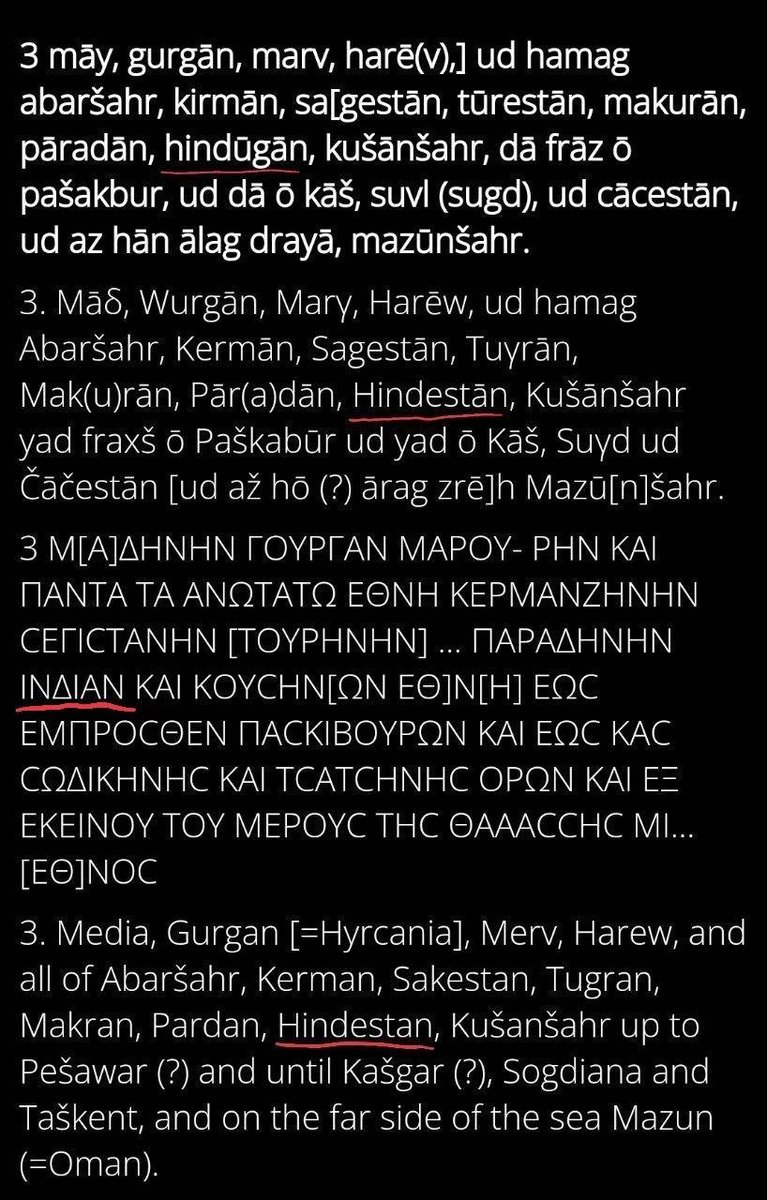
The earliest mention of the term "Hindustān" is from the 3rd-century CE Kaba-e-Zartosht inscription of Shapur I (Fars Province, Iran). This is a trilingual inscription, mentioning India as "Hindūgān" in Partian, "Hindestān" in Persian, and "Indian" in Greek.

The earliest mention of the term "Hindustān" is from the 3rd-century CE Kaba-e-Zartosht inscription of Shapur I (Fars Province, Iran). This is a trilingual inscription, mentioning India as "Hindūgān" in Partian, "Hindestān" in Persian, and "Indian" in Greek.
Payoj Prabhu Bangāḍikumēr🇮🇳 (@pfkodial) 's Twitter Profile Photo

The Skanda Purāṇa describes that when Sage Paraśurāma saw the Tauḷava country from the Sahyādri mountains, he was impressed by its beauty, praised it, and called it the best of all countries (तौळवं देशमुत्तमं।-Tauḷavaṃ dēśamuttamaṃ).

The Skanda Purāṇa describes that when Sage Paraśurāma saw the Tauḷava country from the Sahyādri mountains, he was impressed by its beauty, praised it, and called it the best of all countries (तौळवं देशमुत्तमं।-Tauḷavaṃ dēśamuttamaṃ).
Payoj Prabhu Bangāḍikumēr🇮🇳 (@pfkodial) 's Twitter Profile Photo

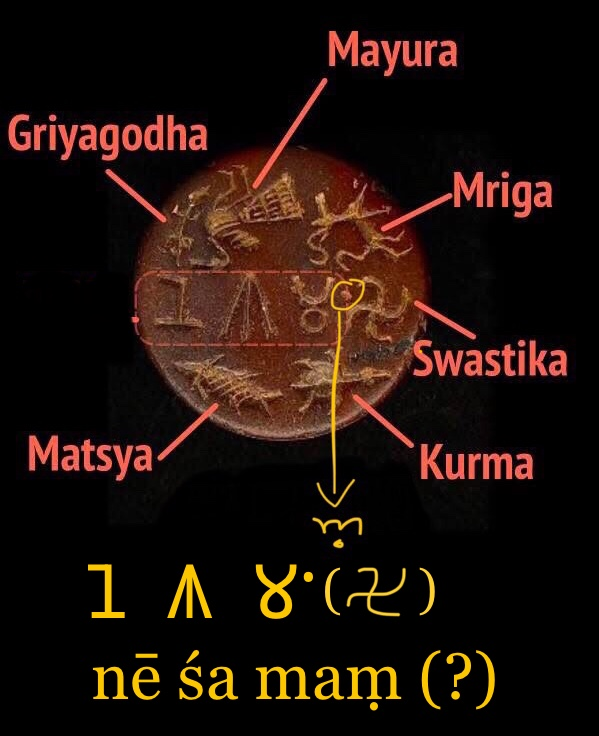
It looks like 𑀦𑁂𑀰𑀫˙-nē śa ma(ṃ)[L-R]. The dot after the 3rd letter 𑀫-ma looks like anuswara sign ं, suggesting the character could be read as 𑀫˙-maṃ. Swastika‑like character is probably a forgotten proto-Brāhmī character, not a symbol.

It looks like 𑀦𑁂𑀰𑀫˙-nē śa ma(ṃ)[L-R]. The dot after the 3rd letter 𑀫-ma looks like anuswara sign ं, suggesting the character could be read as 𑀫˙-maṃ. Swastika‑like character is probably a forgotten proto-Brāhmī character, not a symbol.
Payoj Prabhu Bangāḍikumēr🇮🇳 (@pfkodial) 's Twitter Profile Photo

If it’s mirrored(L←R), the swastika-like character is definitely a forgotten Brāhmī letter, it’s same size and in line with other letters, and the anuswara(ं) sign in front it( 卐˙ ) confirms it’s a letter, not a symbol. 卐˙𑀫𑀰𑀦𑀸 (?)ंमशना (?)ṃmaśanā.

If it’s mirrored(L←R), the swastika-like character is definitely a forgotten Brāhmī letter, it’s same size and in line with other letters, and the anuswara(ं) sign in front it( 卐˙ ) confirms it’s a letter, not a symbol.
卐˙𑀫𑀰𑀦𑀸
(?)ंमशना
(?)ṃmaśanā.
Payoj Prabhu Bangāḍikumēr🇮🇳 (@pfkodial) 's Twitter Profile Photo

Āḷvas (Aḷupa Dynasty) also had a Naval Force, a 11th century inscription of Hoysaḷas mentions Aḷupa Navy as "Tuḷuva Baḷa Jaladhi". #NavyDay2025 #Alupa #Mangalore

Āḷvas (Aḷupa Dynasty) also had a Naval Force, a 11th century inscription of Hoysaḷas mentions Aḷupa Navy as "Tuḷuva Baḷa Jaladhi".
#NavyDay2025 #Alupa #Mangalore