
olivier cotto (@oliviercotto) 's Twitter Profile
olivier cotto

@oliviercotto

ID: 132950730

calendar_today14-04-2010 16:18:49

32 Tweet

34 Followers

66 Following

olivier cotto (@oliviercotto) 's Twitter Profile Photo

Maladaptive Shifts in Life History in a Changing Environment | The American Naturalist: Ahead of Print journals.uchicago.edu/doi/full/10.10…

olivier cotto (@oliviercotto) 's Twitter Profile Photo

New article in press! Fluctuations in lifetime selection in an autocorrelated environment Together with @Lmchev sciencedirect.com/science/articl…

Delphine Destoumieux-Garzón (@ddestoum) 's Twitter Profile Photo

/// A lire dans The Conversation /// #antibioresistance #pesticides #aquaculture : Quelles menaces pour la santé animale et humaine en milieu marin côtier ? Une question au cœur de nos projets de recherche actuels. theconversation.com/eaux-littorale… IHPE_Lab #SPARE-SEA

CNRS 🌍 (@cnrs) 's Twitter Profile Photo

#CNRSleJournal 📰 En adaptant à la France la méthode utilisée par le Giec pour estimer le réchauffement planétaire, des scientifiques viennent de revoir à la hausse les températures qui attendent l'Hexagone. D'ici 2100, cette augmentation serait de ... bit.ly/3S1sIPb

Labos 1point5 (@labos1point5) 's Twitter Profile Photo

Scientists who fly the most have the highest H-index.✈️ This is what is shown in a new study, as part of the Labos 1point5 initiative and published today in Environmental Research Letters. Thread🧵 1/ iopscience.iop.org/article/10.108…


Scientists who fly the most have the highest H-index.✈️ This is what is shown in a new study, as part of the <a href="/labos1point5/">Labos 1point5</a> initiative and published today in Environmental Research Letters. 
Thread🧵
1/
iopscience.iop.org/article/10.108…
olivier cotto (@oliviercotto) 's Twitter Profile Photo

About long-term storage temperature of biological samples and energy saving. Why a norm at -80°C? Any study on increasing temperature from -80 °C to -70 °C? Ideas?

François Blanquart (@francoisjb) 's Twitter Profile Photo

Together with Joshua Weitz, we are organising a course on "Quantitative viral dynamics" at PSL/ENS, 12-16 Dec. There are a few spots left for external Master/PhD students. For more info & how to register, enseignement.biologie.ens.fr/spip.php?artic… Biologie ENS PSL-Qlife


Mastodon (@Mastodon@mastodon.social) (@joinmastodon) 's Twitter Profile Photo

Over 1 million people have joined Mastodon since October 27. Between that and those who returned to their old accounts, the number of active users has risen to over 1.6 million today, which, for context, is over 3 times what it was just about two weeks ago!

Labos 1point5 (@labos1point5) 's Twitter Profile Photo

Le financement par les industries du gaz naturel affecte-t-il le positionnement des rapports produits dans les centres de recherche en énergie, basés dans les universités américaines (MIT, Columbia…) ? nature.com/articles/s4155…

Pichlmair Lab (@pichlmairl) 's Twitter Profile Photo

We are hiring❗️Currently, we're offering an open position in biostatistics/bioinformatics with a focus on multi-omics data analysis. 🧑‍💻 Apply until 31 August! job description 👉innatelab.virologie.med.tum.de/jobs #jobsearch #bioinformatics #biostatistics #systemsvirology #omics #virology

François Blanquart (@francoisjb) 's Twitter Profile Photo

Very glad to share our letter in CID on within-host dynamics of antibiotic resistance in untreated individuals w olivier cotto @EtienneRuppe Laurence Armand-Lefevre and others IAME Research Center academic.oup.com/cid/advance-ar…

François Blanquart (@francoisjb) 's Twitter Profile Photo

Within-host dynamics of drug resistant strains after treatment are important to determine how long a colonised host sheds the R strain. Theory by Nick Davies and others has actually shown this is a key determinant of between-host epidemiological dynamics nature.com/articles/s4155…
François Blanquart (@francoisjb) 's Twitter Profile Photo

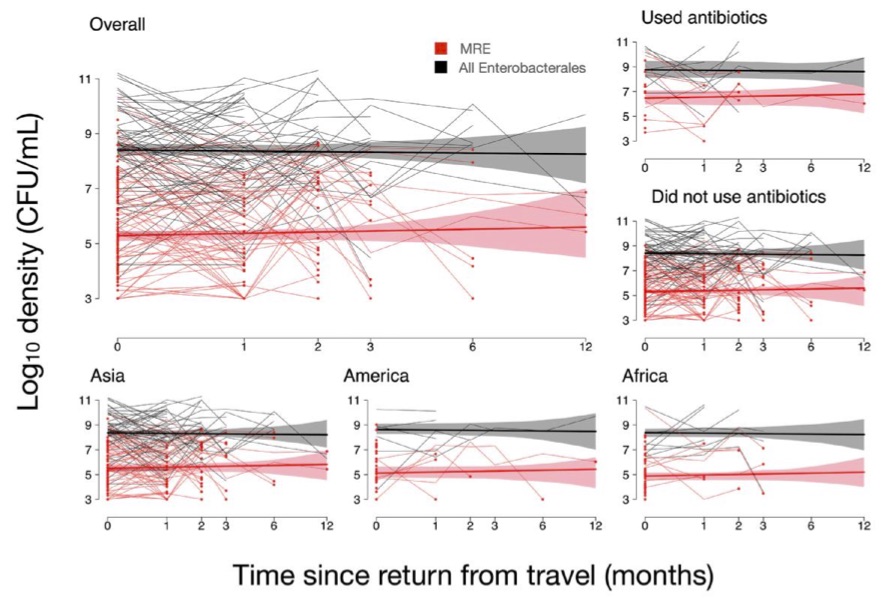
Using longitudinal data on travellers returning with multidrug resistant Enterobacterales, we quantified these dynamics. To our surprise, the resistant strains are actually persisting at stable frequency with sensitive strains for months, although at much lower density (0.1%)

Using longitudinal data on travellers returning with multidrug resistant Enterobacterales, we quantified these dynamics. To our surprise, the resistant strains are actually persisting at stable frequency with sensitive strains for months, although at much lower density (0.1%)
François Blanquart (@francoisjb) 's Twitter Profile Photo

They are then abruptly cleared after one to three months, perhaps as a result of a new colonisation by another sensitive strain. Coexistence over several months of sensitive and a sizable resistant subpopulation is intriguing--it would be important to clarify the mechanism.

Nature Outlook (@natureoutlook) 's Twitter Profile Photo

Human breast milk contains sugar molecules that aren’t for the nutrition of babies – they’re to feed microbes in the baby's gut. go.nature.com/2t0ByXa

Calla Raymond (@callarayy) 's Twitter Profile Photo

Very excited to share my first article, although I wish it delivered better news. Canadian species at risk are not being provided the resources they need to recover, and neither are globally at risk species. These species need to be made a priority. sciencedirect.com/science/articl…