
Matthijs Pals (@matthijs_pals) 's Twitter Profile
Matthijs Pals

@matthijs_pals

Using deep learning to elucidate neural representations and dynamics @MackeLab

ID: 1460663812303032336

calendar_today16-11-2021 17:39:45

108 Tweet

322 Followers

521 Following

Richard Gao (@_rdgao) 's Twitter Profile Photo

My #AI4Neuro magnum opus: Discovery of spiking network model parameters constrained by neural recordings, using simulation-based inference & generative “AI”. (aka the answer to “how the f did you end up in Tübingen?”) Here's what we have in store: biorxiv.org/content/10.110…

Janne Lappalainen (@lappalainenjk) 's Twitter Profile Photo

Biggest joy and honour leading this project at the intersection of visual neuroscience and ML to a successful finish! Paper: nature.com/articles/s4158…

Matthijs Pals (@matthijs_pals) 's Twitter Profile Photo

Want to train neuroscience models consisting of single cells, recurrent neural networks (RNNs), or huge feedforward networks - all with detailed biophysics? Michael Deistler's Jaxley has your back! 👇

Tom Donoghue (@tomdonoghue) 's Twitter Profile Photo

📜🎉 We have a new preprint: an overview & comparison of measures of 'aperiodic' neural activity! This project explores different ideas & many methods used to study non-oscillatory features of intra- & extra-cranial electrophysiological recordings! biorxiv.org/content/10.110…

Richard Gao (@_rdgao) 's Twitter Profile Photo

Back in 2022, Roxana Zeraati & I organized a Cosyne workshop on neural timescales, and after working on it for the last 2 years together, it's now a review paper! arxiv.org/abs/2409.02684 w/ Anna Levina & Jakob Macke (2nd blogpost to turn into a real review paper this year lol)

Back in 2022, <a href="/roxana_zeraati/">Roxana Zeraati</a> &amp; I organized a Cosyne workshop on neural timescales, and after working on it for the last 2 years together, it's now a review paper!

arxiv.org/abs/2409.02684
w/ <a href="/SelfOrgAnna/">Anna Levina</a> &amp; <a href="/jakhmack/">Jakob Macke</a> 

(2nd blogpost to turn into a real review paper this year lol)
Machine Learning in Science (@mackelab) 's Twitter Profile Photo

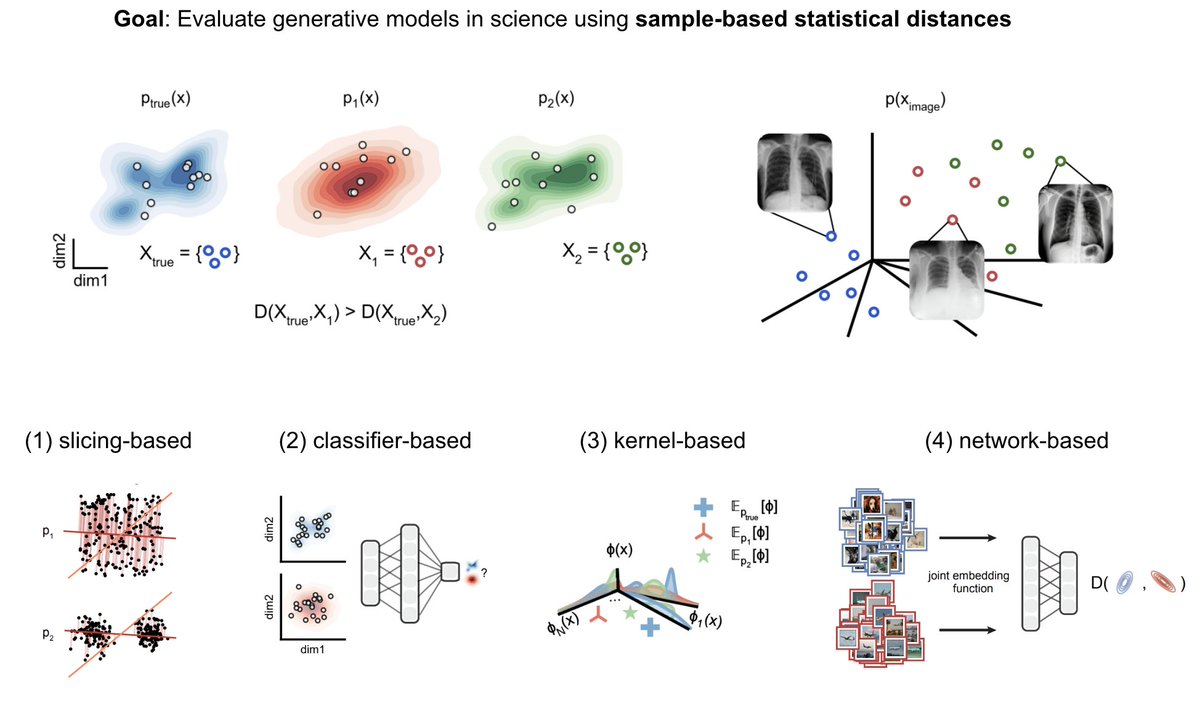
We’re stoked to share: “A Practical Guide to Sample-based Statistical Distances for Evaluating Generative Models in Science”. Now out in TMLR: openreview.net/forum?id=isEFz… This was an incredibly special project for us, as it involved the **entire** lab getting together!

We’re stoked to share: “A Practical Guide to Sample-based Statistical Distances for Evaluating Generative Models in Science”.

Now out in TMLR: openreview.net/forum?id=isEFz…

This was an incredibly special project for us, as it involved the **entire** lab getting together!
Machine Learning in Science (@mackelab) 's Twitter Profile Photo

We’re at Bernstein Conference next week with lots of new work to share: 10 posters, 1 workshop talk, and don’t miss Jakob Macke’s invited talk on Wednesday! If you’re excited about machine learning for (neuro)science, come chat with us—we’re hiring PhD students & postdocs!

We’re at Bernstein Conference next week with lots of new work to share: 10 posters, 1 workshop talk, and don’t miss <a href="/jakhmack/">Jakob Macke</a>’s invited talk on Wednesday!

If you’re excited about machine learning for (neuro)science, come chat with us—we’re hiring PhD students &amp; postdocs!
Machine Learning in Science (@mackelab) 's Twitter Profile Photo

At Poster III-69 Matthijs Pals will explain how to fit RNNs to neural data - and use them as generative models. Want to understand the fit models? We show how to obtain all fixed points in low-rank piecewise-linear RNNs.

At Poster III-69 <a href="/matthijs_pals/">Matthijs Pals</a> will explain how to fit RNNs to neural data - and use them as generative models. 

Want to understand the fit models? We show how to obtain all fixed points in low-rank piecewise-linear RNNs.
Machine Learning in Science (@mackelab) 's Twitter Profile Photo

A propos: Inspired to do a PhD or Postdoc in #ML4Science/#AI4Science? We have multiple openings to work ML and AI tools for scientific discovery, in neuroscience and beyond! Full details: mackelab.org/media/Ad_Macke… Students: Apply by Nov 15, directly to IMPRS-IS or ELLIS

Richard Gao (@_rdgao) 's Twitter Profile Photo

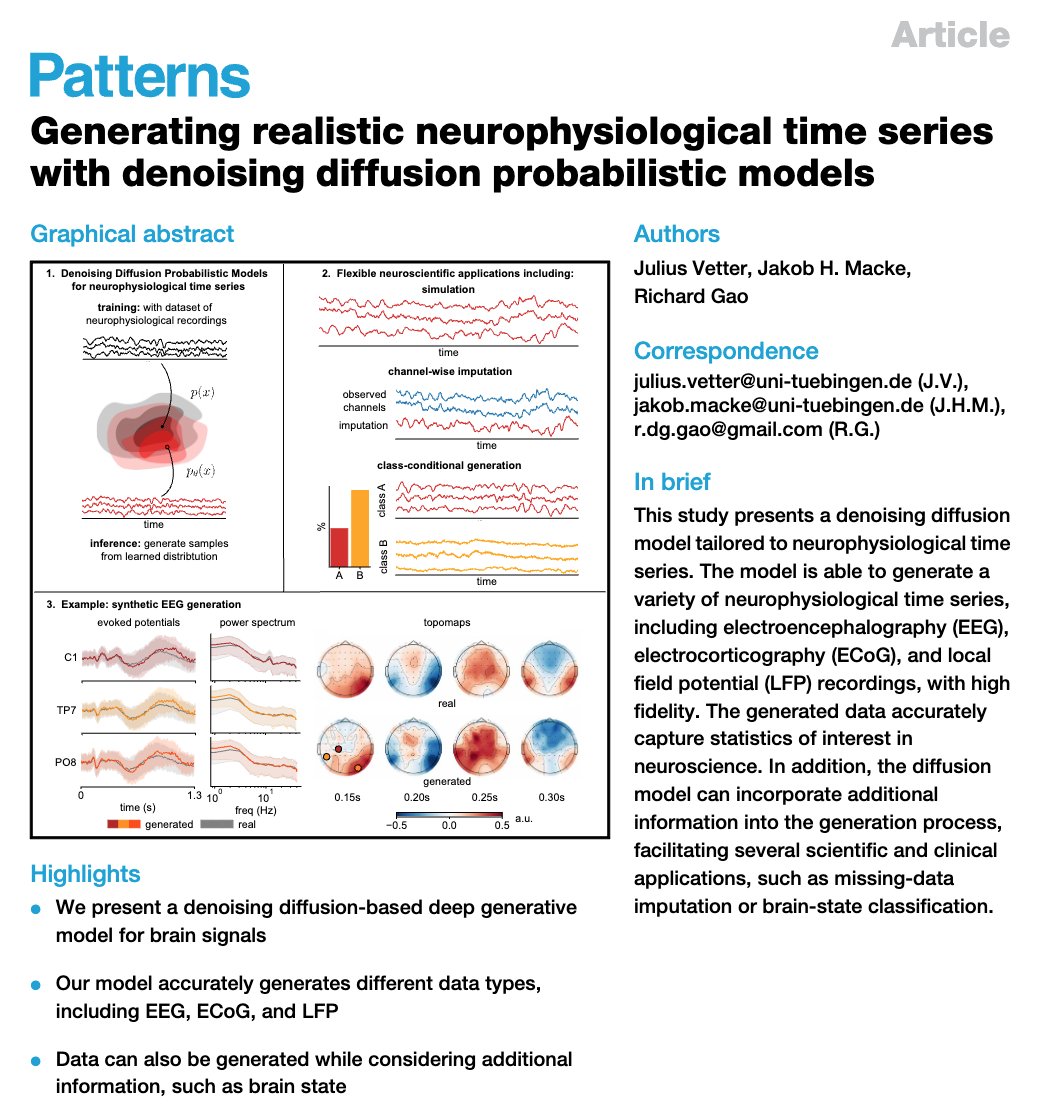
Want a tool that uses ML to generate REALLY good fake brain recordings? You're getting one. Julius' paper on diffusion models for brain data is published! Works with all kinds of densely sampled, multichannel continuous signals (LFP, EEG, etc.) cell.com/patterns/fullt…

Want a tool that uses ML to generate REALLY good fake brain recordings?

You're getting one. Julius' paper on diffusion models for brain data is published! 

Works with all kinds of densely sampled, multichannel continuous signals (LFP, EEG, etc.)

cell.com/patterns/fullt…
sbi developers (@sbi_devs) 's Twitter Profile Photo

The sbi package is growing into a community project 🌎 To reflect this and the algorithms, neural nets, and diagnostics that have been added since its initial release, we have written a new software paper. Reach out if you want to get involved: arxiv.org/abs/2411.17337

Adrián F. Amil (@adriamilcar) 's Twitter Profile Photo

🎉Finally published PLOS Comp Biol ! Why do neurons use low-frequency oscillations for encoding? Why not use higher frequencies for better sampling resolution? We identify a speed-precision trade-off driven by noise, showing that theta (3–8 Hz) maximizes bits/s! Check it out 👇

🎉Finally published <a href="/PLOSCompBiol/">PLOS Comp Biol</a> !

Why do neurons use low-frequency oscillations for encoding? Why not use higher frequencies for better sampling resolution?

We identify a speed-precision trade-off driven by noise, showing that theta (3–8 Hz) maximizes bits/s!

Check it out 👇