
Marcos Sorá (@marc_sora) 's Twitter Profile
Marcos Sorá

@marc_sora

Macroeconomist working in international, financial and labor economics. Postdoc at Católica Lisbon (2024-25) || AP at UIUC (2025-).

ID: 926363408

linkhttp://www.marcossora.com calendar_today04-11-2012 22:59:16

2,2K Tweet

958 Followers

1,1K Following

Esteban Rossi-Hansberg (@hansbergrossi) 's Twitter Profile Photo

Kevin Murphy, Rob Shimer, and I discuss Bob’s great contributions to economics. Remembering Robert E. Lucas, Jr.: A Conversation Among Colleagues youtube.com/playlist?list=… via YouTube

Trade Diversion (Jonathan Dingel) (@tradediversion) 's Twitter Profile Photo

🚨🚚🇮🇳 New! "Internal Trade Barriers in India" with Prabhat Barnwal, Daniil Iurchenko, Pravin Krishna, Eva Van Leemput I will present it this week at CESifo Workshop on Big Data in Urban and Regional Economics and the #UEA2024 meeting at Georgetown. jdingel.com/research/Barnw…
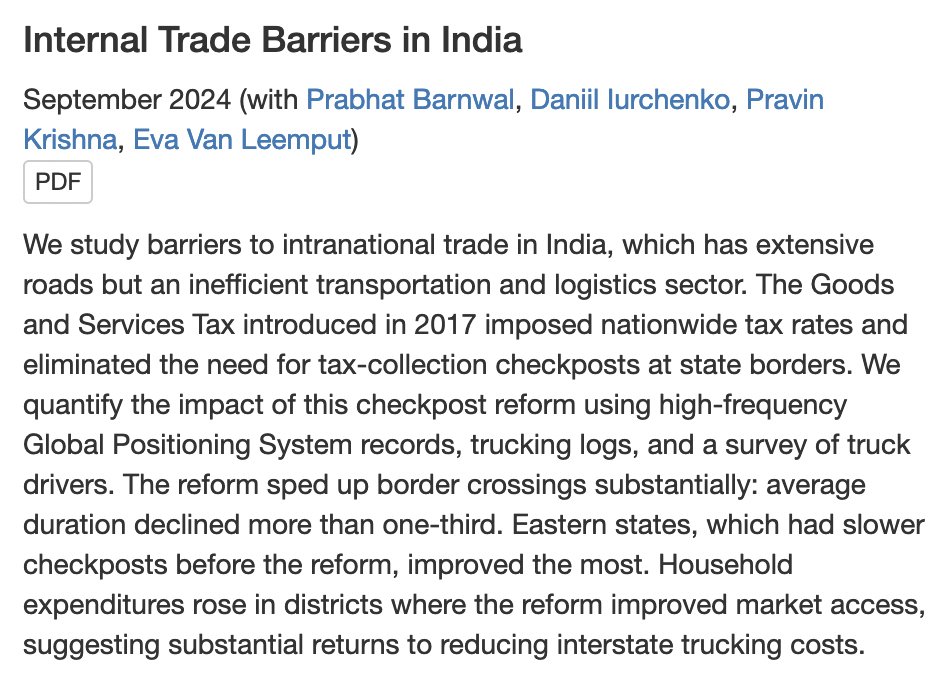
🚨🚚🇮🇳 New! 
"Internal Trade Barriers in India"
with <a href="/PrabhatBarnwal/">Prabhat Barnwal</a>, <a href="/Daniil_Iur/">Daniil Iurchenko</a>, <a href="/krishna_pravin/">Pravin Krishna</a>, Eva Van Leemput

I will present it this week at <a href="/CESifoNetwork/">CESifo</a> Workshop on Big Data in Urban and Regional Economics and the #UEA2024 meeting at Georgetown.

jdingel.com/research/Barnw…
Marcos Sorá (@marc_sora) 's Twitter Profile Photo

It was a lot of fun thinking of an answer to this question. We still have much to learn about the economics of sectoral booms, which are pervasive!

Jason Furman (@jasonfurman) 's Twitter Profile Photo

Between 1970 and 1988 Chile undertook a dramatic tariff reduction while Brazil did not. The result: an increase in the volume of trade in Chile but not Brazil. But no effect on trade deficits in either country. Credit: I believe I originally got this example from Douglas Irwin.
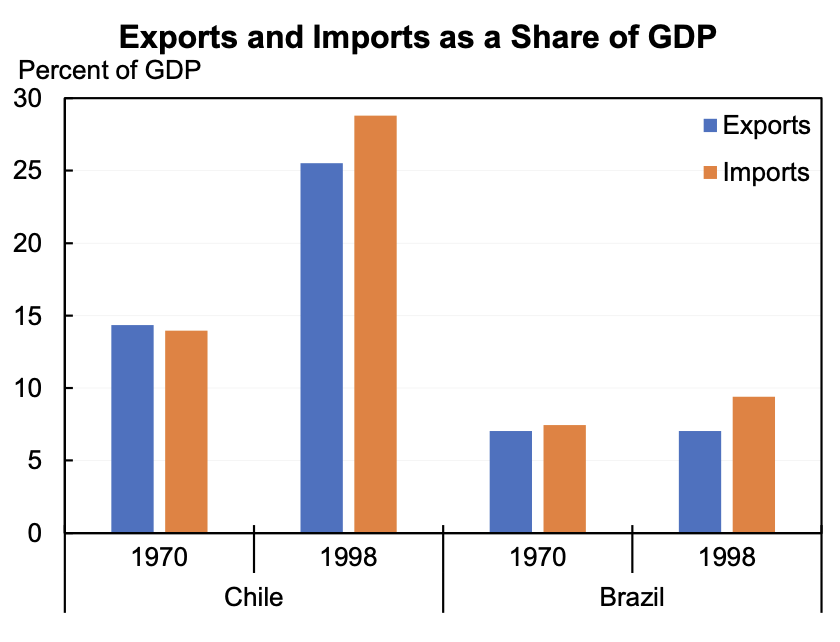
Between 1970 and 1988 Chile undertook a dramatic tariff reduction while Brazil did not.

The result: an increase in the volume of trade in Chile but not Brazil. But no effect on trade deficits in either country.

Credit: I believe I originally got this example from <a href="/D_A_Irwin/">Douglas Irwin</a>.
The University of Chicago (@uchicago) 's Twitter Profile Photo

Prof. James A. Robinson shares the 2024 Sveriges Riksbank Prize in Economic Sciences in Memory of Alfred Nobel for his groundbreaking research on the root causes of global inequality, including what affects’ countries economic prosperity. Learn more: ms.spr.ly/6019m4GwW

JPE (@jpolecon) 's Twitter Profile Photo

Two articles originally published in the JPE were cited in the recent Nobel prize decision. In honor of the achievement of Acemoglu, Johnson, and Robinson, we have made these articles temporarily free to read at journals.uchicago.edu/journals/jpe/p…. #EconTwitter Chicago Journals

Olivia Bordeu (@oliviabordeu) 's Twitter Profile Photo

Come work with us at Haas School of Business! Laura Weiwu, Antoine Levy 🇺🇦 and I are hiring full-time RAs to start in July 2025. Topics at the intersection of urban economics, spatial economics, and political economy. More info here: docs.google.com/document/d/1ng… Econ RA Listings

Esteban Rossi-Hansberg (@hansbergrossi) 's Twitter Profile Photo

Thomas’ paper tells us how to design the best climate club. One of the best papers on climate change I have scene recently. Anyone interested to hire in macro/environmental should look at his impressive portfolio.

Hanno Lustig (@hannolustig) 's Twitter Profile Photo

2024 may also be remembered as the year U.S. fiscal exuberance died. post-mortem 🧵 on how we got here. Right now, with the 10 year US Treasury yield trading well above 4.5% and the federal government spending roughly the equivalent of the defense budget just on interest

2024 may also be remembered as the year U.S. fiscal exuberance died.

post-mortem 🧵 on how we got here. 

Right now, with the 10 year US Treasury yield trading well above 4.5% and the federal government spending roughly the equivalent of the defense budget just on interest
Esteban Rossi-Hansberg (@hansbergrossi) 's Twitter Profile Photo

We have released new yearly measures of local GDP at the 1, 0.5, and 0.25 degree level. They are calculated using remote sensing data and a random forest model. All the data, documentation, and tests can be mapped and downloaded here: bfidatastudio.org/project/local-…

Andrew Greenland (@andrewg_phd) 's Twitter Profile Photo

Let's put a 25% tariff into context. Here's a (brief) US tariff history back to 1900. In 1972 the US average tariff rate was ~6%. We cut tariffs to facilitate development (GSP), control drug production (ATPA), and facilitate integration (GATT/WTO). Then in 1985...

Let's put a 25% tariff into context. Here's a (brief) US tariff history back to 1900.  

In 1972 the US average tariff rate was ~6%.   We cut tariffs to facilitate development (GSP), control drug production (ATPA), and facilitate integration (GATT/WTO). Then in 1985...
Xavier Jaravel (@xjaravel) 's Twitter Profile Photo

Great to see our practical guide to shift-share instruments wiht Kirill Borusyak and Peter Hull out in the Journal of Economic Perspectives today 👇👇👇 pubs.aeaweb.org/doi/pdfplus/10…

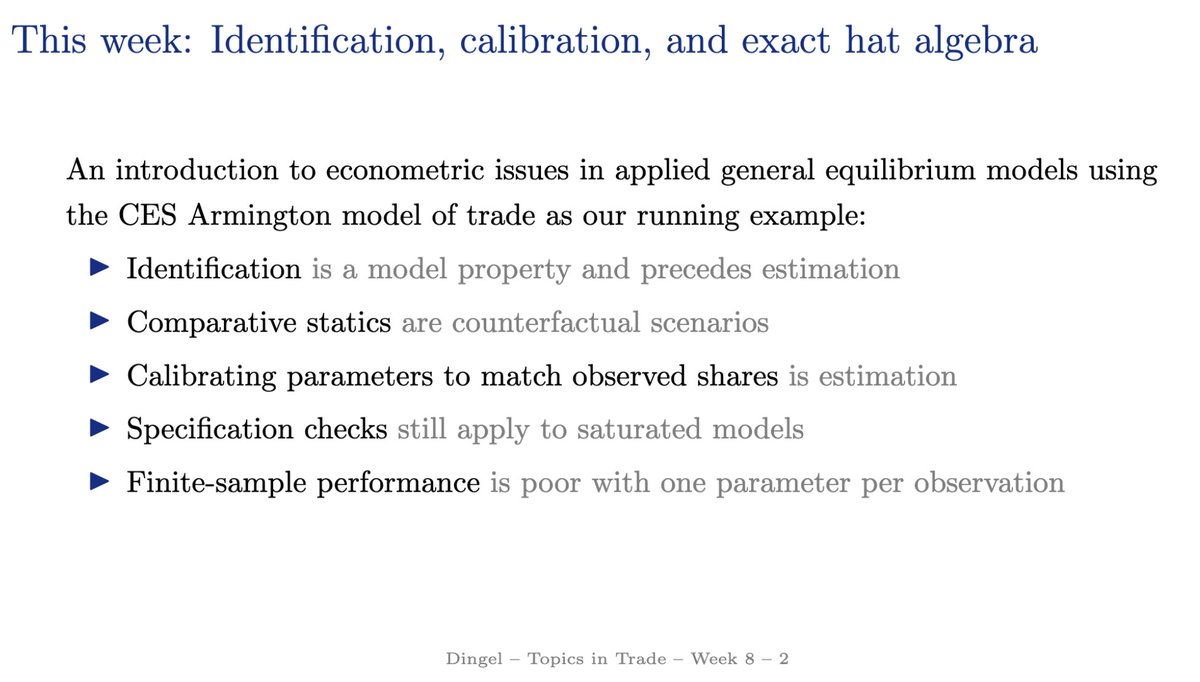
Great to see our practical guide to shift-share instruments wiht <a href="/borusyak/">Kirill Borusyak</a> and <a href="/instrumenthull/">Peter Hull</a> out in the Journal of Economic Perspectives today 👇👇👇
pubs.aeaweb.org/doi/pdfplus/10…

Jeremy Pearce (@jeremygpearce) 's Twitter Profile Photo

Who are the entrepreneurs that drive economic progress, and what does this mean for research and policy? w/ @UfukAkcigit Harun Alp Marta Prato and I use microdata to uncover the critical symbiosis between entrepreneurs and inventors that power innovation and growth 🧵

David Baqaee (@dbaqaee) 's Twitter Profile Photo

What is the value of new and improved goods? The question is central for our theories of trade and economic growth, in which the value of new and better goods provides the motive for trade, and is the source of long-run growth. 1/6