Lotus Protocol (@lotusfi_) 's Twitter Profile
Lotus Protocol

@lotusfi_

Tranched DeFi credit markets powering better vaults 𑁍

1 → 2 → ∞

ID: 1954821395558367233

linkhttp://lotuslabs.net calendar_today11-08-2025 08:25:49

97 Tweet

350 Followers

21 Following

Anthony Bowman (@anthonybowman43) 's Twitter Profile Photo

Why can’t you earn high yields lending against BTC and ETH? It's because the current lending market designs don't allow for it.

David Reising (@davidareising) 's Twitter Profile Photo

Transparent, priced risk improves undewritability for lenders and last mile yield distributors where customer trust is so critical. It also creates a spectrum of new opportunities for borrowers and traders that we’re very excited about Lotus Protocol 🔜

Nomatic (@nomaticcap) 's Twitter Profile Photo

"I would have paid a higher rate for a higher LLTV. That trade was available nowhere." Guess what? I want this to exist to and would pay a bit more for it.

Lotus Protocol (@lotusfi_) 's Twitter Profile Photo

“Bad debt isn’t eliminated. It’s expected, bounded, and compensated.” That's Lotus Protocol: a tranched credit market where risk is priced explicitly along a curve, so your rate reflects your risk tier. What’s in your vault?

Credora Network (@credoranetwork) 's Twitter Profile Photo

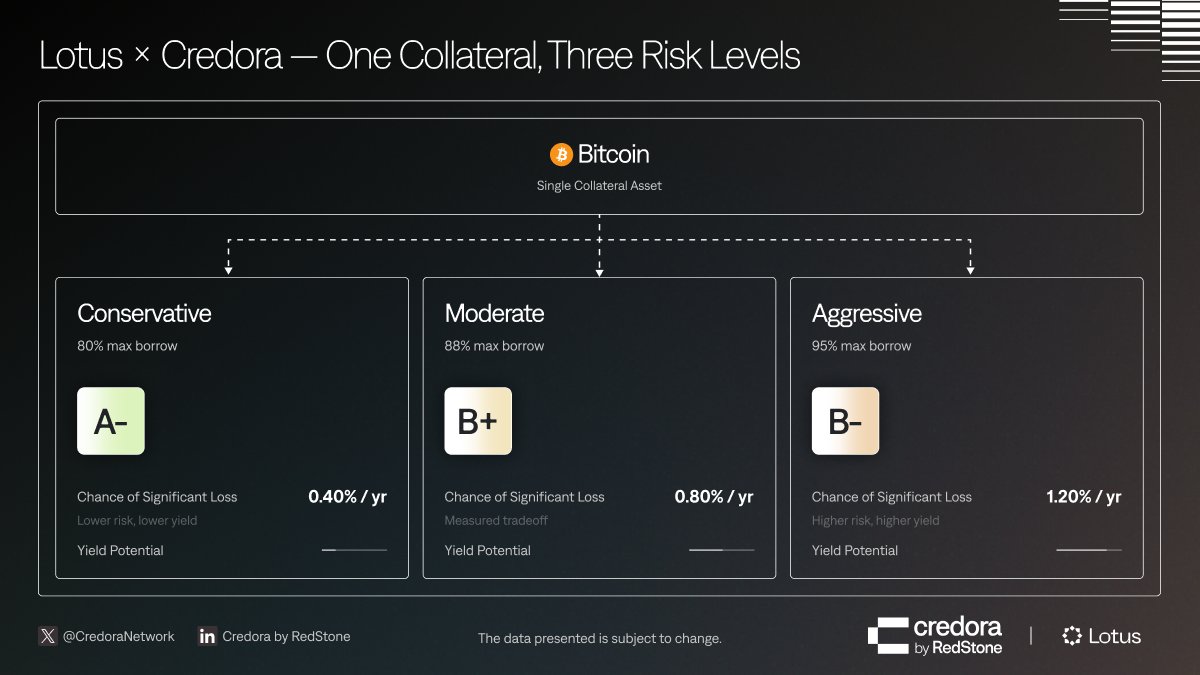
You can display a risk score, or you can build a protocol around it. Credora provides tranche-level ratings that feed directly into Lotus Protocol's credit markets. Each rating determines borrowing capacity. First integration where ratings shape market structure.

You can display a risk score, or you can build a protocol around it.

Credora provides tranche-level ratings that feed directly into <a href="/LotusFi_/">Lotus Protocol</a>'s credit markets. Each rating determines borrowing capacity.

First integration where ratings shape market structure.
jawor | real-time oracle arc ⚡️ (@0xjvrsky) 's Twitter Profile Photo

Risk in DeFi has always been something you consult before entering a position. A dashboard. An audit. A governance parameter set weeks ago. You look it up, you form a view, you deposit. After that, the rating stops being relevant to how the market actually operates. That is the

Risk in DeFi has always been something you consult before entering a position.

A dashboard. An audit. A governance parameter set weeks ago. You look it up, you form a view, you deposit. After that, the rating stops being relevant to how the market actually operates.

That is the
Lotus Protocol (@lotusfi_) 's Twitter Profile Photo

Credora’s tranche-level ratings make risk explicit in Lotus. Lotus connects liquidity across tranches into a single credit market, enabling risk to be priced along a curve. The result is transparent risk you can verify.

definikola (@definikola) 's Twitter Profile Photo

Having a mechanism to charge riskier borrowers more than conservative ones baked into the lending protocol is preferable. It makes sense from a risk perspective as those borrowers naturally bring more risk to the protocol itself. This is not something we've seen (at scale) in

Lotus Protocol (@lotusfi_) 's Twitter Profile Photo

What's Lotus Protocol cooking? Tranched credit markets powering better vaults. Choose your LLTV and get an interest rate that prices your risk on a curve

Marcin | real-time oracle arc ⚡️ (@marcinredstone) 's Twitter Profile Photo

DeFi lending is a $60B+ market. Its infrastructure is still fragmented - separate oracles, separate risk models, separate liquidation intelligence. Gaps between those silos cost protocols millions. RedStone Stack closes them. One unified layer: deterministic price feeds →