Kostas Migkas (@kmigkas) 's Twitter Profile
Kostas Migkas

@kmigkas

Oort fellow at Leiden Observatory. Working on X-ray galaxy clusters and observational cosmology. Dad and husband.

ID: 1248533170774999040

calendar_today10-04-2020 08:48:06

189 Tweet

201 Takipçi

239 Takip Edilen

Andrea Botteon (@and_botteon) 's Twitter Profile Photo

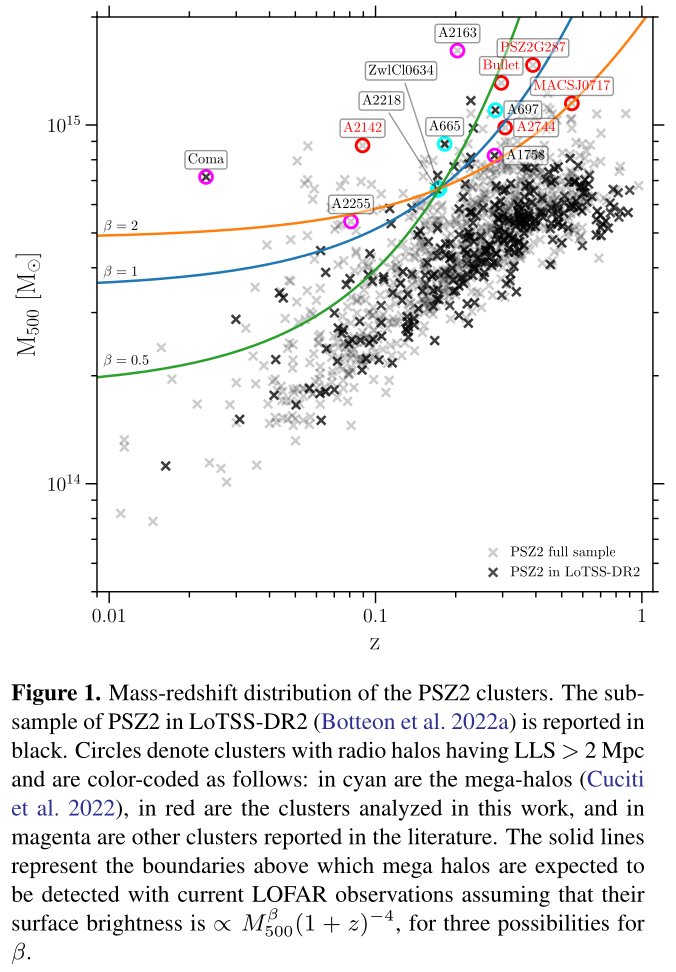
Radial properties of radio halos, by Rajpurohit+ (w/ myself+) New radio halos with LLS>2 Mpc are reported, even at high-frequency. We measured the surface brightness and spectral properties of the emission, obtaining important results (more below) arxiv.org/abs/2505.05415 1/4

Radial properties of radio halos, by Rajpurohit+ (w/ myself+)
New radio halos with LLS>2 Mpc are reported, even at high-frequency. We measured the surface brightness and spectral properties of the emission, obtaining important results (more below) 
arxiv.org/abs/2505.05415
1/4
Kostas Migkas (@kmigkas) 's Twitter Profile Photo

I'm very happy to receive an NWO Open Competition grant to test the uniformity of cosmic expansion at local and distant cosmic scales, using eROSITA and ESA XMM-Newton data of X-ray galaxy clusters! This means I get to stay longer at Leiden Observatory 🥳 tinyurl.com/Leidengrant

South Pole Telescope (@sptelescope) 's Twitter Profile Photo

The proposed FY26 budget will be devastating for NASA science with a nearly 50% cut: 11 NASA astrophysics missions face risk of cancellation bigthink.com/starts-with-a-…

Kostas Migkas (@kmigkas) 's Twitter Profile Photo

🚀 Exciting news! Our proposal for the Lorentz Workshop, focusing on Cosmology with Galaxy Clusters is approved for 8–12 Dec 2025 🎉 Lorentz Center Leiden University We'll bring together cluster enthusiasts and dive into the latest in cluster cosmology! tinyurl.com/lorentzclusters

Kostas Migkas (@kmigkas) 's Twitter Profile Photo

Delighted to share that I got yet another research grant from Leiden University and the Fonds Rijke-Hamaker fund! 🥳 This grant will support the analysis of new X-ray galaxy cluster data obtained by ESA XMM-Newton for further refining our understanding of cosmic expansion uniformity!

ESA Science (@esascience) 's Twitter Profile Photo

For decades, astronomers have been searching for the missing 30–40% of 'normal' visible matter that models tell us should exist in the Universe. But it's not in stars, galaxies, planets or pet cats. Finally, they've found it 👉 esa.int/Science_Explor…

For decades, astronomers have been searching for the missing 30–40% of 'normal' visible matter that models tell us should exist in the Universe.

But it's not in stars, galaxies, planets or pet cats.

Finally, they've found it 👉 esa.int/Science_Explor…
Dr Maggie Lieu (@space_mog) 's Twitter Profile Photo

Huge congrats to my collaborators Kostas Migkas & Florian Pacaud on their groundbreaking work on the universe's missing matter, a significant step in understanding the cosmos. So proud to work alongside such brilliant minds! 🚀 dailymail.co.uk/sciencetech/ar…

ESA XMM-Newton (@esa_xmm) 's Twitter Profile Photo

“The models were right”: astronomers find ‘missing’ matter. Astronomers have discovered a huge filament of hot gas bridging four galaxy clusters. The thread could contain some of the Universe’s ‘missing’ matter, addressing a decades-long mystery. esa.int/Science_Explor…

Nereide (@nereide) 's Twitter Profile Photo

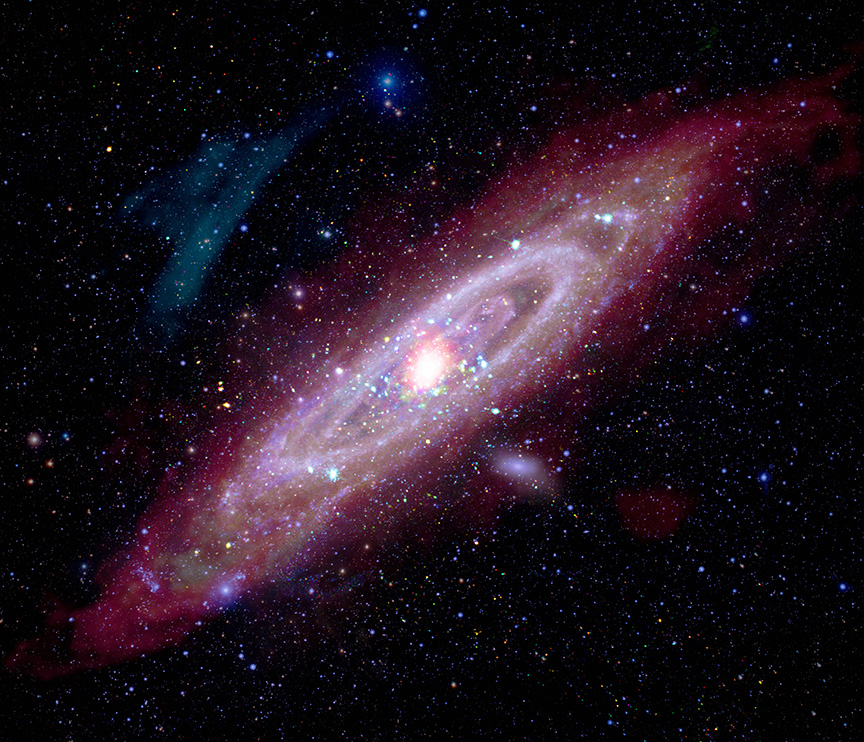
At a distance of about 2.5 Mly, the Andromeda galaxy (M31) is our closest cosmic neighbor, a perfect laboratory for exploring the Universe. This spectacular new image, created by combining data from telescopes Chandra, XMM-Newton, GALEX, Spitzer, and others, gives us an

At a distance of about 2.5 Mly, the Andromeda galaxy (M31) is our closest cosmic neighbor, a perfect laboratory for exploring the Universe.

This spectacular new image, created by combining data from telescopes Chandra, XMM-Newton, GALEX, Spitzer, and others, gives us an
Chandra Observatory (@chandraxray) 's Twitter Profile Photo

The Bullet Cluster is iconic, having provided the first direct proof of dark matter with NASA's Chandra, Hubble, and ground-based telescopes back in 2006. This spectacular new image combines Chandra & Webb Telescope data — helping us learn more about dark matter than ever before.