Dr Daniel Warren (@froggerwarren) 's Twitter Profile
Dr Daniel Warren

@froggerwarren

Senior quantitative ecologist working within the Wildlife Department of the Animal and Plant Health Agency (APHA). My views are my own

ID: 840177962641182721

calendar_today10-03-2017 12:30:10

1,1K Tweet

401 Takipçi

583 Takip Edilen

Frank Harrell (@f2harrell) 's Twitter Profile Photo

New chapter in Regression Modeling Strategies #rms: ordinal regression generalizes Wilcoxon, log-rank, Kaplan-Meier, Cox PH model, and all common survival time analyses. Semiparametric regression is a unifying concept. hbiostat.org/rmsc/ordsurv #rstats #Statistics

Cefas (@cefasgovuk) 's Twitter Profile Photo

Exciting opportunity! Apply now for a jointly-funded lecturer position in Marine Science at Cefas and UEA A great opportunity to work at the intersection of marine science and policy. vacancies.uea.ac.uk/vacancies/1122… #MarineScience #CefasCareers #MarineScienceJobs

Chris Sutherland (@chrissuthy) 's Twitter Profile Photo

Looking for your first quantitative ecology post-doc? Then get in touch. I will be co-supervising a post-doc with Lourens Swanepoel (based in SA: University of Venda). You will have access to many awesome data sets and the focus will be on applying hierarchical models.

Joachim Schork (@joachimschork) 's Twitter Profile Photo

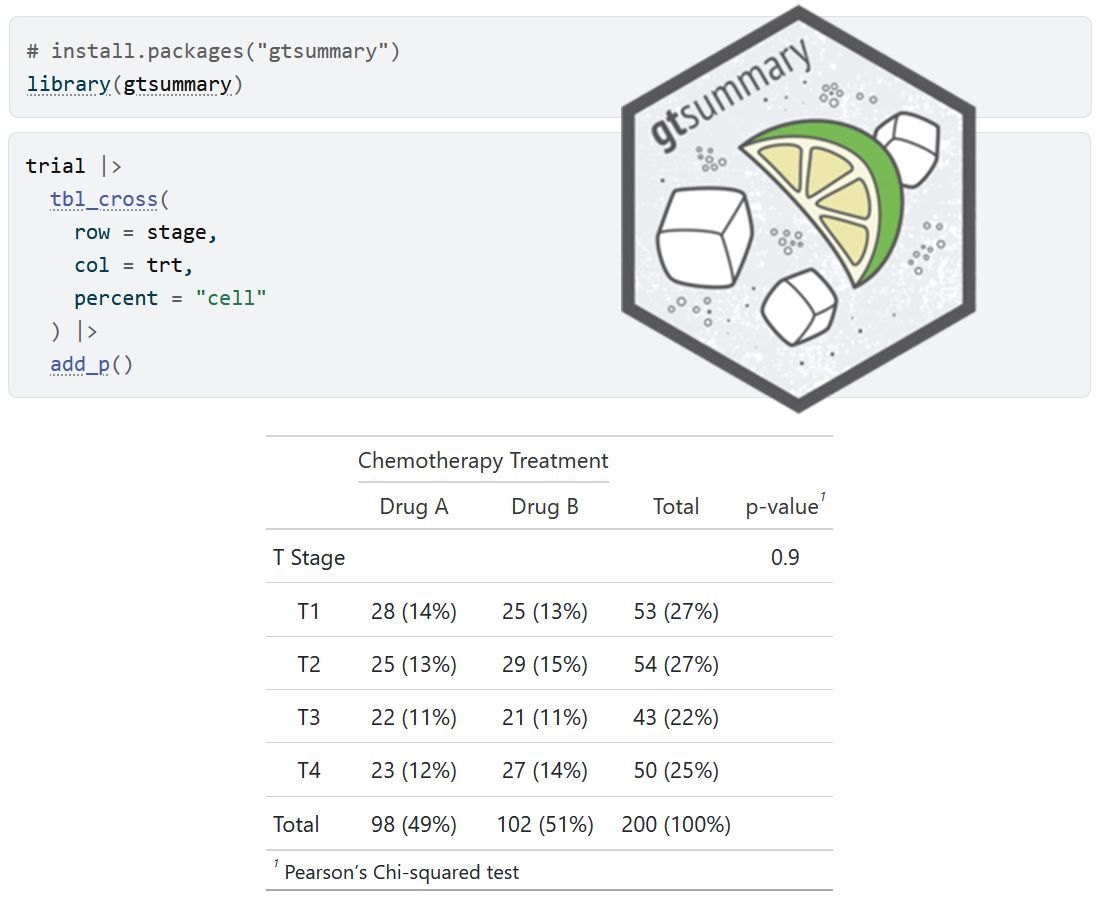
The gtsummary package in R makes it easy to create clean, publication-ready summary tables for your data. The tbl_summary() function takes a data set and generates well-organized tables that display key statistics like counts, percentages, means, and medians, which is perfect for

The gtsummary package in R makes it easy to create clean, publication-ready summary tables for your data. The tbl_summary() function takes a data set and generates well-organized tables that display key statistics like counts, percentages, means, and medians, which is perfect for
Nicholas Wu (@nicholaswunz) 's Twitter Profile Photo

A wide range of conservation actions is shown to reduce a species' extinction risk. But bias towards high-risk species means only a few species show signs of full recovery. 6 times more species have deteriorated than improved in #IUCN status | doi.org/10.1371/journa…

A wide range of conservation actions is shown to reduce a species' extinction risk. But bias towards high-risk species means only a few species show signs of full recovery. 6 times more species have deteriorated than improved in #IUCN status | doi.org/10.1371/journa…
Andrej Spiridonov (@andrejspiridon4) 's Twitter Profile Photo

"regional species pool bridges spatial and temporal scales from ecological dynamics in landscapes to the long- term processes shaping the biotas of entire biogeographic provinces." onlinelibrary.wiley.com/doi/pdf/10.111…

"regional species pool bridges spatial and temporal scales from ecological dynamics in landscapes  to the long- term processes shaping the biotas of entire biogeographic provinces."
onlinelibrary.wiley.com/doi/pdf/10.111…
Methods in Ecology and Evolution (@methodsecolevol) 's Twitter Profile Photo

📖Published📖 PhyBaSE: A Bayesian structural equation model approach to causal inference in phylogenetic comparative analyses. Read the full article here 👇 buff.ly/anb668e

Dr Sam Ross (@samrpjross) 's Twitter Profile Photo

onlinelibrary.wiley.com/doi/10.1111/ge… Huge new GEB Journal paper looking at acoustic monitoring efforts around the world. The who, what, where, when, and how of passive acoustic monitoring. With >100 authors! "Worldwide soundscapes: a synthesis of passive acoustic monitoring across realms"


Methods in Ecology and Evolution (@methodsecolevol) 's Twitter Profile Photo

📖Published📖 Check out our new Research Article 👉 Agent-based versus correlative models of species distributions: Evaluation of predictive performance with real and simulated data buff.ly/6SPv11I

Methods in Ecology and Evolution (@methodsecolevol) 's Twitter Profile Photo

📖Published📖 Schickele et al. introduce CEPHALOPOD, a standardized, highly automated and flexible framework designed to integrate and analyse heterogeneous marine data for multi-species habitat modelling following best practices in the field 🌊 buff.ly/WrYAuO0

📖Published📖 

Schickele et al. introduce CEPHALOPOD, a standardized, highly automated and flexible framework designed to integrate and analyse heterogeneous marine data for multi-species habitat modelling following best practices in the field 🌊 

buff.ly/WrYAuO0
Hanno Seebens (@hannoseebens) 's Twitter Profile Photo

What an honour! 😊 🤩 I realised that the famous data platform "Our World in Data" has now our data set of first records of alien species on their platform. I use this platform quite a lot and I am happy and proud to find our data set there 🤩 ourworldindata.org/grapher/global…

NeoBiota (@neobiotajournal) 's Twitter Profile Photo

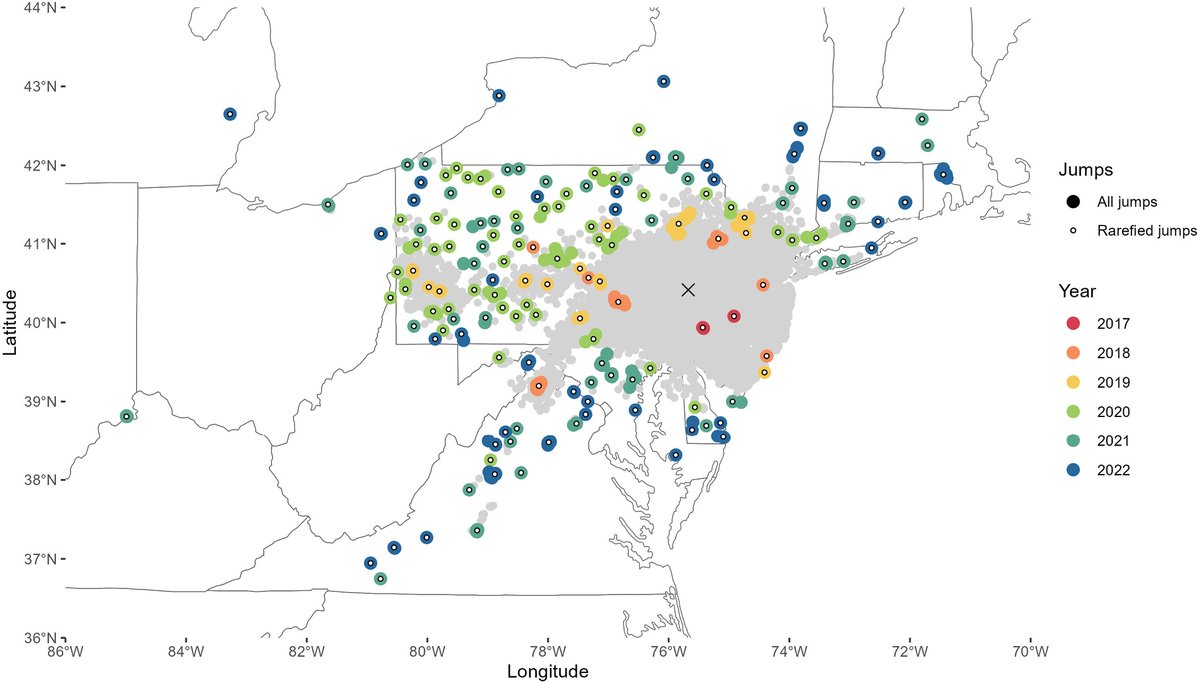
A new R package, jumpID, distinguishes long-distance jump dispersal from diffusive spread in #invasivespecies using occurrence data. Its application to the spotted lanternfly in the U.S. identified 152 such jumps from 2014–2022. 🔗 doi.org/10.3897/neobio…

A new R package, jumpID, distinguishes long-distance jump dispersal from diffusive spread in #invasivespecies using occurrence data. Its application to the spotted lanternfly in the U.S. identified 152 such jumps from 2014–2022.

🔗 doi.org/10.3897/neobio…
Martin A. Nuñez (@martin_a_nunez) 's Twitter Profile Photo

Pro tip for writers: Don’t rush the submission step I know you’re exhausted & just want to hit “submit,” but those annoying little details- suggesting reviewers, suggesting editors, explaining your paper in exactly 97 words- can make a real difference Take the time It’s worth it

Pro tip for writers:
Don’t rush the submission step
I know you’re exhausted & just want to hit “submit,” but those annoying little details- suggesting reviewers, suggesting editors, explaining your paper in exactly 97 words- can make a real difference

Take the time
It’s worth it
Frank Harrell (@f2harrell) 's Twitter Profile Photo

It’s interesting that abandoning p-values and false discovery rates for 2nd generation p-values results in major reductions in decision errors: journals.plos.org/plosone/articl…