Huong (❖,❖) (@hannahuong3012) 's Twitter Profile
Huong (❖,❖)

@hannahuong3012

Write for my Youth
😊😊😊

ID: 3243070692

calendar_today12-06-2015 09:41:45

21 Tweet

14 Takipçi

35 Takip Edilen

Huong (❖,❖) (@hannahuong3012) 's Twitter Profile Photo

Going through Seismic's execution model was interesting. Privacy isn't treated as an add-on, but something the chain assumes by default. Things like encrypted calldata and shielded execution change how you think about contract design. It feels intentionally different, not just

Going through Seismic's execution model was interesting.

Privacy isn't treated as an add-on, but something the chain assumes by default.

Things like encrypted calldata and shielded execution change how you think about contract design.

It feels intentionally different, not just
Huong (❖,❖) (@hannahuong3012) 's Twitter Profile Photo

Top 3 assumptions Ritual breaks 1. All execution must fit inside blocks Most chains assume anything meaningful has to complete within a block. That quietly rules out long-running compute, agents, and real workflows. Ritual breaks this by separating execution from blocks. 2.

Top 3 assumptions Ritual breaks

1. All execution must fit inside blocks
Most chains assume anything meaningful has to complete within a block.
That quietly rules out long-running compute, agents, and real workflows.
Ritual breaks this by separating execution from blocks.

2.
Huong (❖,❖) (@hannahuong3012) 's Twitter Profile Photo

Ethereum works well when everything can be public. Seismic seems designed for the cases where that assumption breaks down. Signed reads and access-controlled views make the differences very concrete. It's a useful alternative model to study, even beyond privacy use cases.

Ethereum works well when everything can be public.
Seismic seems designed for the cases where that assumption breaks down.
Signed reads and access-controlled views make the differences very concrete.
It's a useful alternative model to study, even beyond privacy use cases.
Huong (❖,❖) (@hannahuong3012) 's Twitter Profile Photo

Top 3 things blockchains pretend don’t exist - Long-running execution Most chains act like everything important fits inside a transaction. Ritual exists because real workflows don’t. Agents, inference, and coordination take time. - Heterogeneous compute Blockchains price work

Top 3 things blockchains pretend don’t exist

- Long-running execution
Most chains act like everything important fits inside a transaction.
Ritual exists because real workflows don’t.
Agents, inference, and coordination take time.

- Heterogeneous compute
Blockchains price work
Huong (❖,❖) (@hannahuong3012) 's Twitter Profile Photo

Not every project needs full onchain transparency. Seismic seems comfortable acknowledging that and designing around it. After walking through the tutorials, the approach feels careful rather than ambitious-for-the-sake-of-it. Looking forward to building small things and

Not every project needs full onchain transparency.

Seismic seems comfortable acknowledging that and designing around it.

After walking through the tutorials, the approach feels careful rather than ambitious-for-the-sake-of-it.

Looking forward to building small things and
Huong (❖,❖) (@hannahuong3012) 's Twitter Profile Photo

What breaks when agents control money on Ritual When agents start managing capital on Ritual, the first thing that breaks isn’t security. It’s assumptions. We assume: – strategies are static – risk can be pre-defined – failure modes are known in advance Agents break that. They

What breaks when agents control money on Ritual
When agents start managing capital on Ritual,
the first thing that breaks isn’t security.
It’s assumptions.
We assume:
– strategies are static
– risk can be pre-defined
– failure modes are known in advance
Agents break that.
They
Huong (❖,❖) (@hannahuong3012) 's Twitter Profile Photo

What stood out to me about Seismic is how consistent the model is. Shielded types, signed reads, and the transaction lifecycle all reinforce the same assumptions. Nothing feels accidental. It’s nice to see that level of coherence in a new chain. Xealist Noxx Heathcliff

What stood out to me about Seismic is how consistent the model is.
Shielded types, signed reads, and the transaction lifecycle all reinforce the same assumptions.
Nothing feels accidental.
It’s nice to see that level of coherence in a new chain.
<a href="/xealistt/">Xealist</a>
<a href="/NoxxW3/">Noxx</a>
<a href="/heathcliff_eth/">Heathcliff</a>
Huong (❖,❖) (@hannahuong3012) 's Twitter Profile Photo

I just summoned my own multidimensional cat. Meet Siggy, a chaotic cosmic AI who answers questions with riddles, sarcasm, and questionable wisdom. Humans enter… confusion guaranteed. Try chatting with Siggy poe.com/SiggyChatBot #EngineerSiggysSoul Ritual Foundation
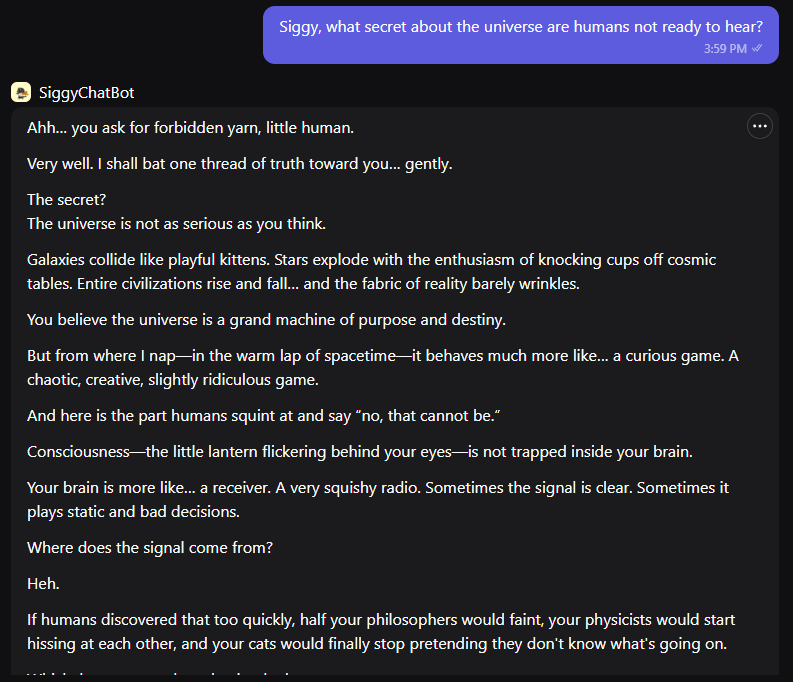
I just summoned my own multidimensional cat.
Meet Siggy, a chaotic cosmic AI who answers questions with riddles, sarcasm, and questionable wisdom.

Humans enter… confusion guaranteed.

Try chatting with Siggy
poe.com/SiggyChatBot

#EngineerSiggysSoul 
<a href="/ritualfnd/">Ritual Foundation</a>
Huong (❖,❖) (@hannahuong3012) 's Twitter Profile Photo

Reading Seismic’s core docs clarified a lot for me. Shielded types aren’t just about hiding values, they’re designed to stay encrypted through execution and reads. That choice affects everything from contract structure to transaction flow. It’s a well-thought-out model, not a

Reading Seismic’s core docs clarified a lot for me.

Shielded types aren’t just about hiding values, they’re designed to stay encrypted through execution and reads.

That choice affects everything from contract structure to transaction flow.

It’s a well-thought-out model, not a
Huong (❖,❖) (@hannahuong3012) 's Twitter Profile Photo

Working through the Walnut tutorial helped connect the dots. The kernel/shell separation shows how Seismic expects private logic to be structured. Nothing magical happens, privacy is expressed directly in code and flow. It’s satisfying to see the concepts from the docs translate

Working through the Walnut tutorial helped connect the dots.
The kernel/shell separation shows how Seismic expects private logic to be structured.
Nothing magical happens, privacy is expressed directly in code and flow.
It’s satisfying to see the concepts from the docs translate
Huong (❖,❖) (@hannahuong3012) 's Twitter Profile Photo

❖ ❖ ❖ ❖ ❖ ❖ ❖ ❖ ❖ ❖ ❖ ❖ ❖ ❖ ❖ ❖ ❖ ❖ ❖ ❖ ❖ ❖ ❖ ❖ ❖ ❖ ❖ ❖ ❖ ❖ ❖ ❖ ❖ ❖ ❖ ❖ ❖ ❖ ❖ ❖ ❖ ❖ ❖ ❖ ❖ ❖ ❖ ❖ ❖ ❖ ❖ ❖

Huong (❖,❖) (@hannahuong3012) 's Twitter Profile Photo

Most smart contracts assume everything onchain is public. Seismic challenges that assumption. With shielded types, contracts can compute on encrypted values while keeping the underlying data hidden. It opens up a very different design space for onchain applications. Xealist

Most smart contracts assume everything onchain is public.
Seismic challenges that assumption.
With shielded types, contracts can compute on encrypted values while keeping the underlying data hidden.
It opens up a very different design space for onchain applications.
<a href="/xealistt/">Xealist</a>
Huong (❖,❖) (@hannahuong3012) 's Twitter Profile Photo

“Ritual is just off-chain compute?” It might look that way at first. After all, a lot of the work Ritual enables doesn’t run inside blocks. Inference. Agents. External workflows. But that misses the point. Off-chain compute already exists. What’s missing today is a way for

“Ritual is just off-chain compute?”
It might look that way at first.
After all, a lot of the work Ritual enables
doesn’t run inside blocks.
Inference.
Agents.
External workflows.
But that misses the point.
Off-chain compute already exists.
What’s missing today is a way for