Vegard Lysne (@vegardlysne) 's Twitter Profile
Vegard Lysne

@vegardlysne

Clinical dietitian, PhD | @Folkehelseinst | Public health statistics | #rstats | Views mine.

ID: 1123124342

linkhttp://www.vegardlysne.no calendar_today26-01-2013 20:55:49

849 Tweet

354 Followers

270 Following

JasonConnor (@jasonconnorphd) 's Twitter Profile Photo

Christel de Bruijn, PhD @christeldebruijn.bsky.soc statsepi Precisely. It's literally one population at *baseline*. The only difference is the coin flip. Therefore any p<0.05 on baseline characteristics is by definition a Type I error since it's one population.

Maarten van Smeden (@maartenvsmeden) 's Twitter Profile Photo

validated doesn't mean valid validated doesn't mean good validated doesn't mean useful validated doesn't mean approved validated doesn't mean sufficient validated doesn't mean accurate validated doesn't mean best available validated means we did a test

Vegard Lysne (@vegardlysne) 's Twitter Profile Photo

Yes, gut bacteria do produce some vitamins and other essential components, but the amounts are really small. Don't rely on your gut bacteria (only 200g, remember) to supply you with nutrients! Hannelore Daniel

Vegard Lysne (@vegardlysne) 's Twitter Profile Photo

Important take-home messages from Hannelore Daniel. To move microbiome research forward, and avoid unfounded hype, there are many issues that must be considered.
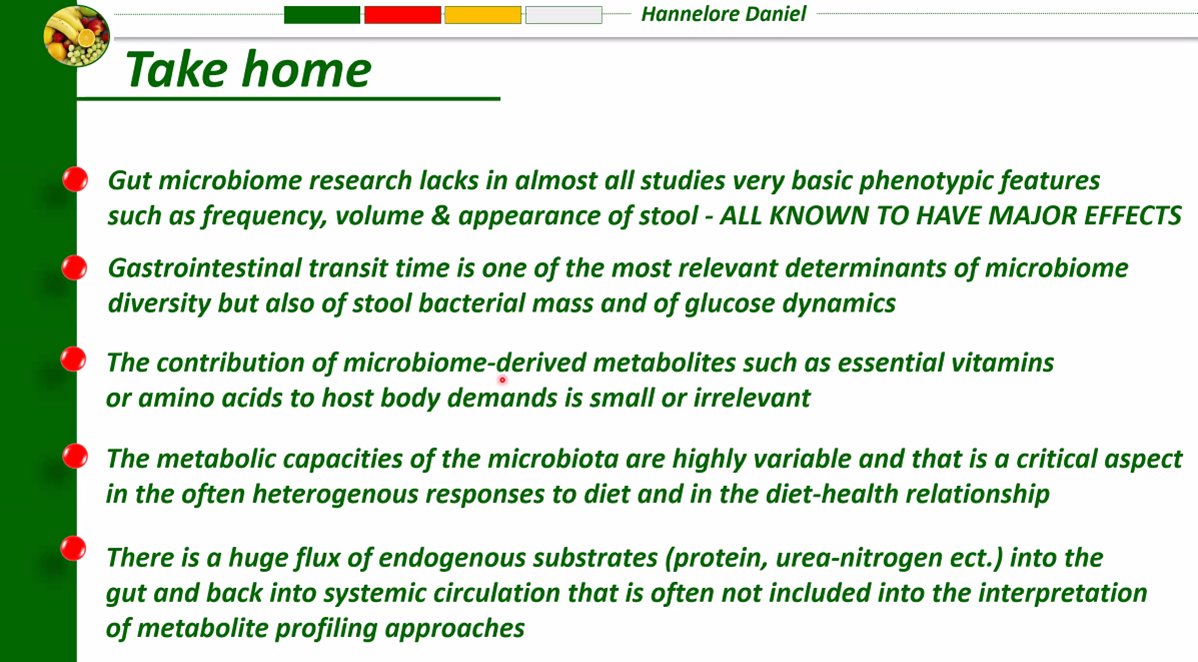
Important take-home messages from 
<a href="/hannidaniel/">Hannelore Daniel</a>. To move microbiome research forward, and avoid unfounded hype, there are many issues that must be considered.
Vegard Lysne (@vegardlysne) 's Twitter Profile Photo

While genomics explain ~3% of the variation in BMI, the metabolomic component explains ~50%! -Jerzy Adamski on the potential of metabolomics i health research.

Vegard Lysne (@vegardlysne) 's Twitter Profile Photo

Should we all adopt the DASH diet? Check out our editorial in #EJPC, commenting on a recent paper by Daniel Ibsen and colleagues. academic.oup.com/eurjpc/advance…

Keren Papier (@kerenpapier) 's Twitter Profile Photo

Twitter friends! Help support our new study. Feeding the future study (FEED) is looking for UK residents to complete a one-off 20 minute online survey about their eating habits, dietary motivations and lifestyle. Please share widely🙏. SHIFT WHO/Europe Oxford Population Health (OxPop) ceu.ox.ac.uk/research/feedi…

Jennifer Yland (@jennifer_yland) 's Twitter Profile Photo

When does non-differential #misclassification *NOT* cause bias towards the null, and why should we avoid over-reliance on #heuristics? This paper was super fun to write up with Matthew Fox @AKWesselink and Tim Lash! Now out in Am J Epidemiology #epitwitter academic.oup.com/aje/advance-ar…
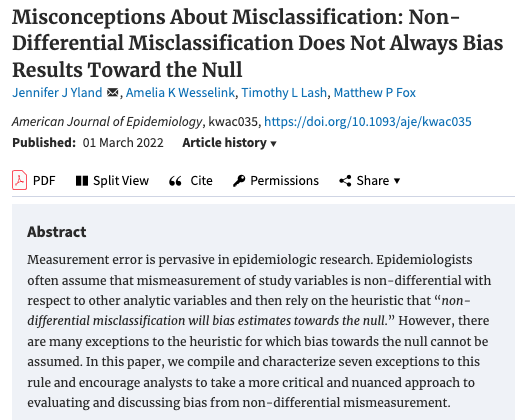

When does non-differential #misclassification *NOT* cause bias towards the null, and why should we avoid over-reliance on #heuristics? This paper was super fun to write up with <a href="/ProfMattFox/">Matthew Fox</a> @AKWesselink and Tim Lash! Now out in <a href="/AmJEpi/">Am J Epidemiology</a> 

#epitwitter

academic.oup.com/aje/advance-ar…
Richard Riley (R²) (@richard_d_riley) 's Twitter Profile Photo

Recent reviewer nonsense: "Add p-values, as this is for a clinical audience" "Non-linearity is confusing; re-do analyses at clinically meaningful cut-points" "Something's wrong if complex stats methods are needed" "Reduce methods section - it's distracting for clinical readers"

Vegard Lysne (@vegardlysne) 's Twitter Profile Photo

Our response to the recent modeling study estimating the effect of sustained dietary changes on life expectancy. @DierkesJutta @tho_ols osf.io/5wdfp/

Kevin C. Klatt, PhD, RD (@kcklatt) 's Twitter Profile Photo

Vitamin D is a case study in the challenges of nutrition assessment & of applying the principles of evidence-based medicine to nutrition, & how little citing a role of a nutrient in the body informs upon how much to ingest. It's definitely a lucrative biohacker brand builder tho.

Richard Riley (R²) (@richard_d_riley) 's Twitter Profile Photo

August reminder for meta-analysis folk: I-squared estimates between-study heterogeneity❌ I-squared is a test for between-study heterogeneity❌ I-squared > 50% means large heterogeneity❌ I-squared measures proportion of total variability due to between-study heterogeneity✅

Vegard Lysne (@vegardlysne) 's Twitter Profile Photo

New paper out on dairy products and cardiovascular disease outcomes, with (among others) @AntheaVanparys @DierkesJutta @tho_ols Kathrine Vinknes Åslaug Matre Anfinsen Kirsten Holven academic.oup.com/eurjpc/advance…


Tessa Davis (@tessardavis) 's Twitter Profile Photo

More than 25 million people use Google Docs. But most of us still don't know its best features. Here are 11 Google Docs tips that'll save you 100s of hours of your life:

Kevin C. Klatt, PhD, RD (@kcklatt) 's Twitter Profile Photo

If you're at the point where you're spreading fear about folks eating fruits in smoothie form, just stop. The hypothetical micro-optimization focus of so much health information focuses on a possibly existing tree while missing the forest.

Stephen John Senn (@stephensenn) 's Twitter Profile Photo

This is the key challenge for personalised medicine wannabes. How do you distinguish between A) This works for X% all the time B) This works for everyone X% of the time C) Some mixture of A & B? (Hint: parallel group trial + responder” analysis doesn’t work.)