Khyati Malhan (@kmalhan07) 's Twitter Profile
Khyati Malhan

@kmalhan07

Astrophysicist | Ex @UCPH_Research @mpi_astro @Stockholm_Uni @ObsStrasbourg @UnivofDelhi |

ID: 3232627976

linkhttps://www.youtube.com/@kmalhan07 calendar_today01-06-2015 13:48:14

778 Tweet

523 Followers

109 Following

Michael Perryman (@mac_perryman) 's Twitter Profile Photo

169. A billion radial velocities: DR3 includes 33 million radial velocities. DR4, in 2025, should have 100 million. A recent study has derived 125 million (of much lower accuracy) from the low-res BP/RP spectra, with perhaps 1–2 billion in the future. wix.to/nWiwd2f

ESO (@eso) 's Twitter Profile Photo

2/ Called BH3, the #BlackHole was discovered by ESA Gaia 🛰️ because it imposes an odd wobbling motion on the star orbiting it ⭐️⚫️ Ground-based telescopes, including ESO’s #VLT 🔭, then found its mass to be 33 times that of the Sun. Artist’s animation of the system 👇

Eduardo Balbinot (@balbinotdd) 's Twitter Profile Photo

Paper day: arxiv.org/abs/2404.11604 We show that Gaia BH3 is part of the ED-2 star cluster. The update astrometry puts GaiaBH3 in excellent agreement with the orbit of ED-2. Using some ESO data we got last period we also show that ED-2 is very likely a disrupted globular cluster

Khyati Malhan (@kmalhan07) 's Twitter Profile Photo

Galactic map of #StellarStreams detected in the ESA Gaia dataset. Each star in the stream represents an actual Gaia source, color-coded by heliocentric distance (as computed by the STREAMFINDER algorithm): blue for nearer (~1 kpc) and red for distant (>~30 kpc).

Galactic map of #StellarStreams detected in the <a href="/ESAGaia/">ESA Gaia</a> dataset. Each star in the stream represents an actual Gaia source, color-coded by heliocentric distance (as computed by the STREAMFINDER algorithm): blue for nearer (~1 kpc) and red for distant (&gt;~30 kpc).
David Martínez Delgado (@astro_delgado) 's Twitter Profile Photo

Our paper on the discovery of five dwarf galaxies around the galaxy NGC 253, found by Giuseppe Donatiello in the DESI Survey deep imaging, is available today in: arxiv.org/pdf/2405.03769. This result gives new insights on the presence of a satellite plane in this Sculptor group spiral.

Our paper on the discovery of five dwarf galaxies around the galaxy NGC 253, found by <a href="/GJDonatiello/">Giuseppe Donatiello</a> in the <a href="/desisurvey/">DESI Survey</a> deep imaging, is available today in: arxiv.org/pdf/2405.03769. This result gives new insights on the presence of a satellite plane in this Sculptor group spiral.
Khyati Malhan (@kmalhan07) 's Twitter Profile Photo

A talk I gave for the "International Astronomical Union (IAU) Commission H1 - The Local Universe" seminar, on the topic "Atlas of Milky Way mergers created using the ESA Gaia dataset". youtu.be/soabSPRFims?t=…

Khyati Malhan (@kmalhan07) 's Twitter Profile Photo

A webinar I gave Swinburne University of Technology, hosted by Prof. Duncan A. Forbes, on "The LMS1 stellar stream: A very metal-poor fossil remnant of our Galaxy's formation". youtube.com/watch?v=6mtrAz…

Paul McMillan (@mcmillan_astro) 's Twitter Profile Photo

Paper day! With Viktor Hrannar Jónsson looking at velocities of stars in the Milky Way's warp. We find that they just don't match the picture of a steadily precessing warp where we see it today. arxiv.org/abs/2405.09624

Paper day! With <a href="/ViktorHJonsson/">Viktor Hrannar Jónsson</a> looking at velocities of stars in the Milky Way's warp. We find that they just don't match the picture of a steadily precessing warp where we see it today. arxiv.org/abs/2405.09624
Karina Voggel ✨🔭🏃🏼‍♀️ (@karinavoggel) 's Twitter Profile Photo

The paper I have been working on for a while is out! In this one I predicted the detectability of Globular Clusters in the full 6-year Euclid survey! And then tested detection models and size measurement using the first ERO data on the Fornax Cluster! arxiv.org/abs/2405.14015

The paper I have been working on for a while is out! In this one I predicted the detectability of Globular Clusters in the full 6-year Euclid survey! And then tested   detection models and size measurement using the first ERO data on the Fornax Cluster! 
arxiv.org/abs/2405.14015
ESA Gaia (@esagaia) 's Twitter Profile Photo

What stellar substructures does Gaia map? This visualisation of the Milky Way by Stefan Payne-Wardenaar / Khyati Malhan highlights globular clusters, dwarf galaxies and stellar streams. Notice also Shakti & Shiva, subjects of a recent story: esa.int/Science_Explor… youtu.be/YQDfdpT6yZ4

Akshara Viswanathan (@astroakshara) 's Twitter Profile Photo

Paper thread!! This was up on arXiv a bit over a week ago: arxiv.org/abs/2405.13124 We show here the dynamical analysis of the first spectroscopic follow-up of extremely metal-poor stars using photometric metallicities based on Gaia XP CaHK magnitudes run on Pristine survey model

Khyati Malhan (@kmalhan07) 's Twitter Profile Photo

The Gaia-Sausage/Enceladus stars, which were previously hypothesized to have originated from an ancient (8-11 Gyrs ago) merger event, likely came from a more recent (< 3 Gyrs ago) event, now dubbed as the Virgo Radial Merger (VRM).

Khyati Malhan (@kmalhan07) 's Twitter Profile Photo

Evolution of merger stars in the (Lz, E) space of a Milky Way analog in the TNG 50 cosmological simulation. youtube.com/watch?v=qGNtSW…

Khyati Malhan (@kmalhan07) 's Twitter Profile Photo

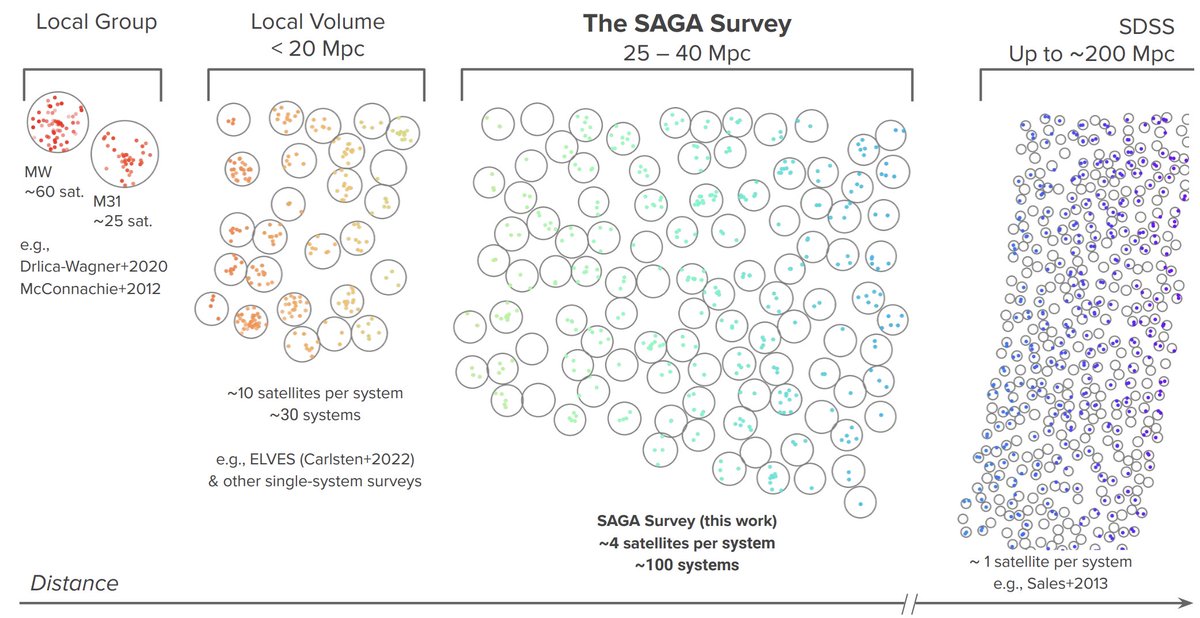
A schematic overview of MW-mass satellite systems in Local group and beyond (taken from arxiv.org/pdf/2404.14498) #dwarfgalaxies2024 conference in #Durham

A schematic overview of MW-mass satellite systems in Local group and beyond (taken from arxiv.org/pdf/2404.14498)
#dwarfgalaxies2024 conference in #Durham
David Martínez Delgado (@astro_delgado) 's Twitter Profile Photo

In our new paper today (arxiv.org/abs/2407.20483), we report the catalog and photometry of the extragalactic tidal streams found in Dark Energy Survey as part of the Stellar Stream Legacy Survey. A comparison of the stream frequency with cosmological models is coming very soon!
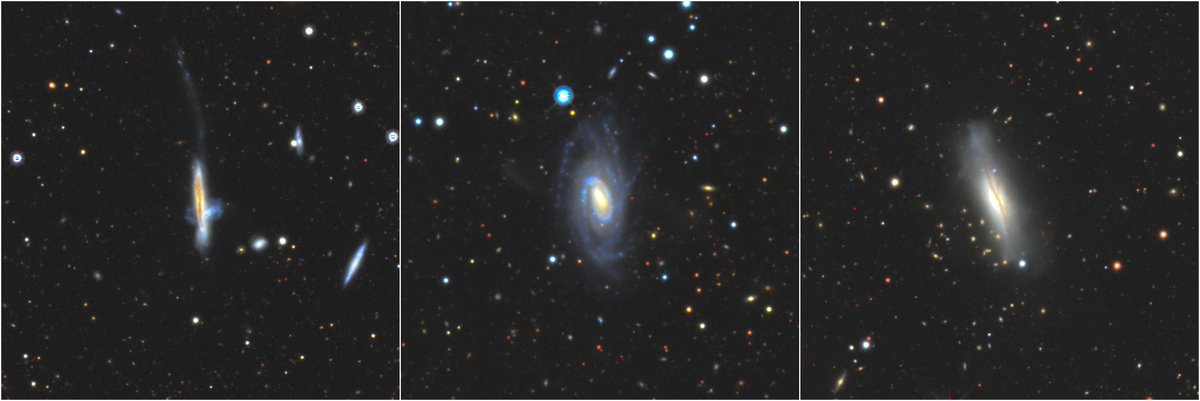
In our new paper today (arxiv.org/abs/2407.20483),  we report the catalog and photometry of the extragalactic tidal streams found in  <a href="/theDESurvey/">Dark Energy Survey</a>  as part of the Stellar Stream Legacy Survey.  A comparison of the stream frequency with cosmological models is coming very soon!
Khyati Malhan (@kmalhan07) 's Twitter Profile Photo

Our paper made it to the “Selections from 2024” series that looks back at some of the most-read AAS journal articles published in 2024!

ESA Gaia (@esagaia) 's Twitter Profile Photo

Today marks Gaia's end of observations: cosmos.esa.int/en/web/gaia/en…. Gaia now performs a set of technology tests to help future missions: cosmos.esa.int/en/web/gaia/te…. The most up to date view of our Milky Way was created thanks to Gaia, with much more to come with #GaiaDR4 + #GaiaDR5.

Today marks Gaia's end of observations: cosmos.esa.int/en/web/gaia/en…. Gaia now performs a set of technology tests to help future missions: cosmos.esa.int/en/web/gaia/te…. The most up to date view of our Milky Way was created thanks to Gaia, with much more to come with #GaiaDR4 + #GaiaDR5.
Khyati Malhan (@kmalhan07) 's Twitter Profile Photo

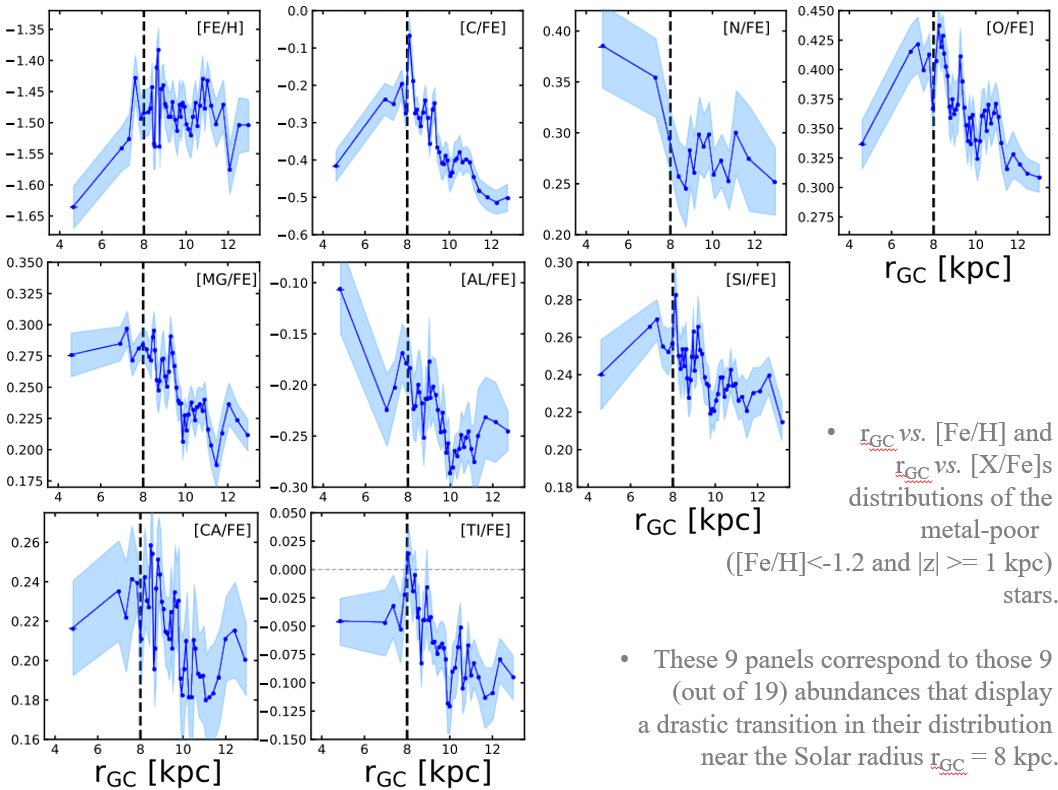
Milky Way’s Metal-Poor Stars display Chemical Transition near the Solar Radius. Accepted in ApJL. arxiv.org/abs/2508.08360 Results obtained using the data from ESA Gaia and APOGEE Survey .

Milky Way’s Metal-Poor Stars display Chemical Transition near the Solar Radius. Accepted in ApJL. arxiv.org/abs/2508.08360
Results obtained using the data from <a href="/ESAGaia/">ESA Gaia</a> and <a href="/APOGEEsurvey/">APOGEE Survey</a> .