Antonio M. Espín (@a_m_espin) 's Twitter Profile
Antonio M. Espín

@a_m_espin

PhD in Economics. Co-founder & Chief Research Officer @kodopeople - Behavioral Assessments for the remote world

ID: 1105614885608669189

linkhttps://sites.google.com/view/antonioespin calendar_today12-03-2019 23:41:44

4,4K Tweet

582 Followers

738 Following

John A. List (@econ_4_everyone) 's Twitter Profile Photo

Our new study just came out in JEEA. We conducted a natural field experiment to measure the value of flexible work schedules. We combine the experiment with panel data on wages and work decisions to estimate a dynamic labor supply model that allows recovery of reservation

Alison Gopnik (@alisongopnik) 's Twitter Profile Photo

A fascinating podcast with Sheina Lew-Levy and Dorsa Amir about childhood across cultures, very insightful ideas about how contemporary Western parents could learn from forager childhoods, especially the importance of peer culture (read the Opies!). podcasts.apple.com/us/podcast/var…

Joaquin Navajas (@joaconavajas) 's Twitter Profile Photo

La Alhambra y la crisis climática. Mi nota para #AlterEco en LA NACION sobre cómo las ciencias del comportamiento pueden y deben ir más allá de generar pequeños cambios individuales. lanacion.com.ar/economia/la-al… Gracias Sebastián Campanario, como siempre, por el espacio

Marta Kowal (@marta7kowal) 's Twitter Profile Photo

Interested in love and mate preferences? Our dataset includes responses from 117,293 participants across 175 countries. You're welcome to use it for your own research! Paper and dataset linked below. @ with amazing collaborators from the large-scale cross-cultural consortium <3

Interested in love and mate preferences? Our dataset includes responses from 117,293 participants across 175 countries. You're welcome to use it for your own research! Paper and dataset linked below. @ with amazing collaborators from the large-scale cross-cultural consortium &lt;3
Edmond (Eddy) Awad (@edmondawad) 's Twitter Profile Photo

🧠 Is your research still relying on Western participants? 15 years after “The WEIRDest People in the World” by Joe Henrich et al., most studies still overuse WEIRD samples. In this paper, published in Behavior Research Methods, I offer digital pathways to move beyond that.
Nature Human Behaviour (@naturehumbehav) 's Twitter Profile Photo

Shen et al. show that pre-existing neural similarity in strangers predicts future friendship and changes in social distance over time in an emerging social network of MBA students. Lisa (Yixuan) Shen, Ryan Hyon, Carolyn Parkinson nature.com/articles/s4156…

Nature Human Behaviour (@naturehumbehav) 's Twitter Profile Photo

A Registered Report of 7,978 people in 20 countries finds that decision-makers willfully ignore inconvenient information. Learning about the negative consequences of their choices increases prosociality, especially among guilt-prone individuals. @JF_Schul nature.com/articles/s4156…

Nature Human Behaviour (@naturehumbehav) 's Twitter Profile Photo

In this new paper, Ghassani Swaryandini et al. present a systematic review and meta-analysis of 53 randomized controlled trials and find that educational interventions can reduce cognitive biases among students. Michael Noetel🔸 UQ News #CognitiveBias #Education nature.com/articles/s4156…

Oliver Scott Curry (@oliver_s_curry) 's Twitter Profile Photo

It was a terrible mistake to frame trolley problems as a choice between utilitarian and deontological options. (Both are incoherent; utilitarian and deontological rationales can be crafted for both options; there are much more interesting things going on.)

Nature Human Behaviour (@naturehumbehav) 's Twitter Profile Photo

Systematic review and meta-analysis of RCTs using social norms messaging for changing health behaviours in developed countries finds an initial small effect. The effect however disappeared when controlling for publication bias. Tris Papakonstantinou nature.com/articles/s4156…

RedNIE (@rednie5) 's Twitter Profile Photo

Nuestros resultados sugieren que cuando los participantes se enfrentan a un problema hipotético de distribuir una pequeña cantidad de dinero, tienden a utilizar una regla de distribución igualitaria. Por Pablo Brañas-Garza, Antonio M. Espín y Diego A. Jorrat ideas.repec.org/p/aoz/wpaper/3…
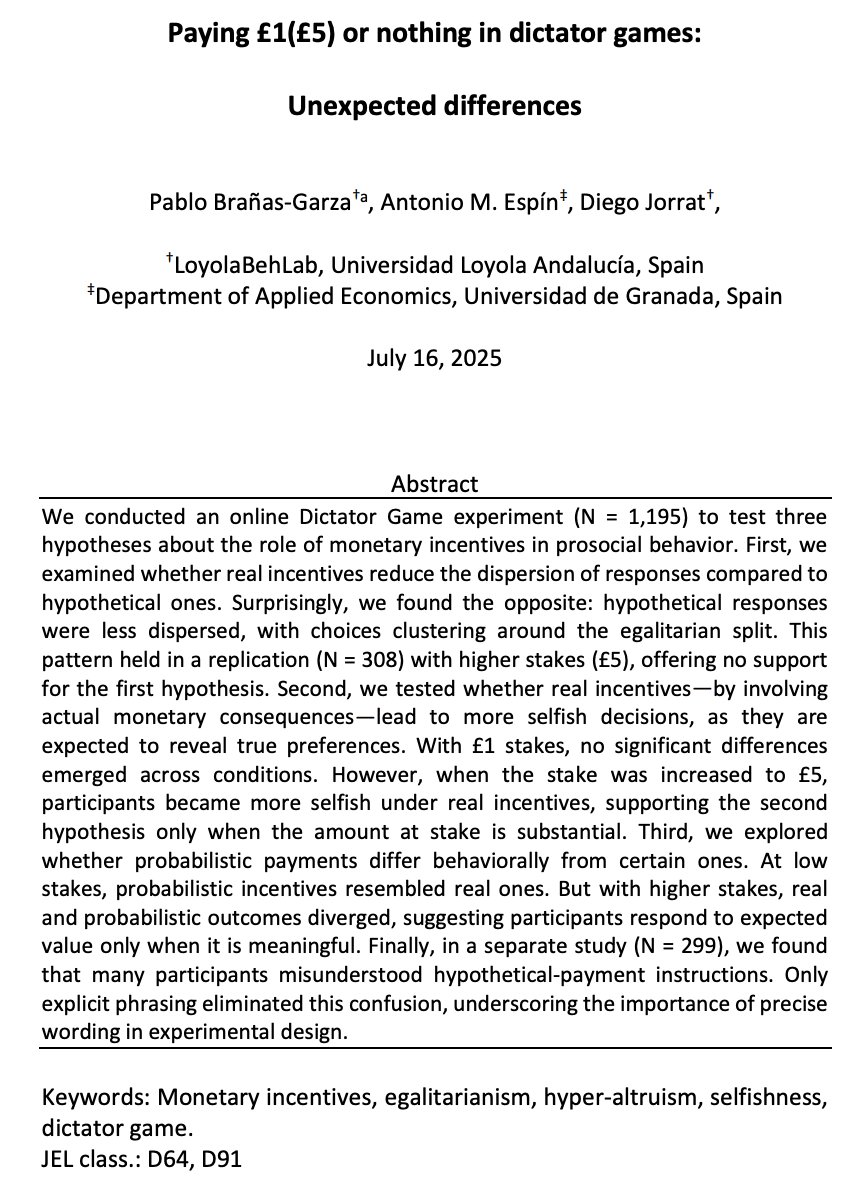
Nuestros resultados sugieren que cuando los participantes se enfrentan a un problema hipotético de distribuir una pequeña cantidad de dinero, tienden a utilizar una regla de distribución igualitaria.

Por Pablo Brañas-Garza, <a href="/A_M_Espin/">Antonio M. Espín</a> y <a href="/dajorrat/">Diego A. Jorrat</a> 

ideas.repec.org/p/aoz/wpaper/3…
Noticias de Economía (@ndp_economia) 's Twitter Profile Photo

Adiós al 'trabajo bien en equipo' en el CV: un certificado de soft skills basado en comportamiento real notasdeprensa.es/1267684/adios-…

Ndp Estilo de vida (@ndp_estilo_vida) 's Twitter Profile Photo

Adiós al 'trabajo bien en equipo' en el CV: un certificado de soft skills basado en comportamiento real notasdeprensa.es/1267684/adios-…

Ciencia y Tecnologia (@ndp_ciencia_tec) 's Twitter Profile Photo

Adiós al 'trabajo bien en equipo' en el CV: un certificado de soft skills basado en comportamiento real notasdeprensa.es/1267684/adios-…

Noticias de Salud (@ndp_salud) 's Twitter Profile Photo

Adiós al 'trabajo bien en equipo' en el CV: un certificado de soft skills basado en comportamiento real notasdeprensa.es/1267684/adios-…

Noticias de Ocio (@ndp_ocio) 's Twitter Profile Photo

Adiós al 'trabajo bien en equipo' en el CV: un certificado de soft skills basado en comportamiento real notasdeprensa.es/1267684/adios-…

Noticias de Internet (@ndp_internet) 's Twitter Profile Photo

Adiós al 'trabajo bien en equipo' en el CV: un certificado de soft skills basado en comportamiento real notasdeprensa.es/1267684/adios-…